Jessica Wachter Notes for Finance 604
Topic 7: Expected Returns and Risk
(a) Return Definitions
Geometric vs. Arithmetic Average
You invest $435 in a mutual fund. In the first year, you earn 8%, and in the second, you
earn 12%. How do you describe your average annual return over the two-year period?
Arithmetic Average Return: One way is to calculate the simple arithmetic average of the
annual returns: 0.08 + 0.12
2= 0.10.
This may not be the return about as an investor. We will apply our previous concept of
holding period return (HPR):
Geometric Average and HPR
Recall: we know how to calculate the average annual return, assuming annual
compounding, of an initial sum V0that grows to Vtover tyears:
HPR = Vt
V01/t
−1.
Given this formula, we use two steps to then find HPR:
1. How much money did you make?
V2= $435(1.08)(1.12) = $526.17.
2. What return do I need to earn each year so that I have $526.17 at the end of 2 years?
HPR = Vt
V0
1
t
−1
=526.17
435
1
2
−1=9.98%
Because we calculated 0.0998 using the proper definitions of annual returns, we know
that it is correct.
In calculating HPR, we have just taken a geometric average. Let’s see why:
1

Jessica Wachter Notes for Finance 604
•We know the following is true:
(V2/V0) = (V2/V1)(V1/V0).
•We also know that by the definition of annual return:
(V1/V0) = 1 + R1.
(V2/V1) = 1 + R2.
•In our example:
1 + HPR = V2
V01/2
=V1
V0
V2
V11/2
= [(1.08)(1.12)]1/2
= [(1 + R1)(1 + R2)]1/2.
⇒The last expression above is called the geometric average of R1and R2. More generally,
if Rtis the return in year t, and assuming the proceeds of year 1 are reinvested in year 2
and so on, we could take the geometric average of returns over tperiods:
HPR = [(1 + R1)(1 + R2)···(1 + Rt)]
1
t−1.
Who cares for such a small difference? In fact, geometrical and arithmetic averages would
be identical if R1=R2. However, when R1and R2differ substantially, then the geometric
and arithmetic averages produce very different answers. Consider an internet stock fund:
•Return in first period: 100%.
•Return in second period -50%.
•Manager of this fund claims:
1.00 + (−0.50)
2=0.50
2= 0.25 = 25% arithmetic return.
25% doesn’t look so bad. However, investors might not agree – return they actually earned:
HPR = [(1 + R1)(1 + R2)]1/2−1
= [(1 + 1.00)(1 −0.50)]1/2−1
= [2(0.5)]1/2−1 = 0 = 0% geometric return.
2

Jessica Wachter Notes for Finance 604
How is it that the arithmetic average is 25% and the geometric is 0%? Although we know
geometric average is the correct HPR measure, it is useful to provide a numerical example
showing why the return over 2 years is 0%. Let’s see what happens to $100 in this fund:
•1st year (you earn 100%): 100 →200.
•2nd year (you lose 50%): 200 →100.
•Thus, you earn a return of zero over the two- year period.
Does it make any difference whether we experienced the 100% first or second? No:
•1st year (you lose 50%): 100 →50.
•2nd year (you earn 100%): 50 →100.
•Again, you earn a return of zero over the two- year period.
In the first period, you halve your wealth, and in the second you double it. You are back
where you started at the end of the second period. Once again, the arithmetic average
gives you 25%, but the geometric average gives you zero.
It can make a big difference whether you look at geometric or arithmetic average. If you
want to know what return investors in the mutual fund actually earned, you should pay
attention to the geometric average.
When might you be interested in arithmetic average?
There are two cases where it is correct to use the arithmetic mean (or average):
1. Simple interest: if you don’t reinvest your earnings in the fund.
•Thus, you start each year with the same amount of money, e.g. $100.
•In the previous example:
interest = 100 1st period + −50 2nd period.
•Over two periods, interest was $50 ⇒equivalent to earning 25% each period.
•Generally, we prefer geometric average because it tells us how an initial sum
grows ’untouched by human hands’. But if you like to add and subtract at the
end of each year to maintain the same dollar investment (you probably won’t
like the adding part), then arithmetic mean tells the truth.
2. As a statistician: if you are calculating the average return on this fund using
historical data, then you would most likely look at monthly returns over five or ten
years. In this case, the arithmetic mean would be your estimate of the average return.
3
Jessica Wachter Notes for Finance 604
Dividend Yield and Capital Gain
If dealing with stock returns, we have to account for both dividend yield and capital gain.
Suppose you buy 1 share now, hold it for 2 years, and reinvest dividends back in the stock:
•P0= $100.
•P1= $106, D1= $2.
•P2= $110, D2= $2.
What is your HPR over the 2 years? Two ways to calculate HPR yield the same answer:
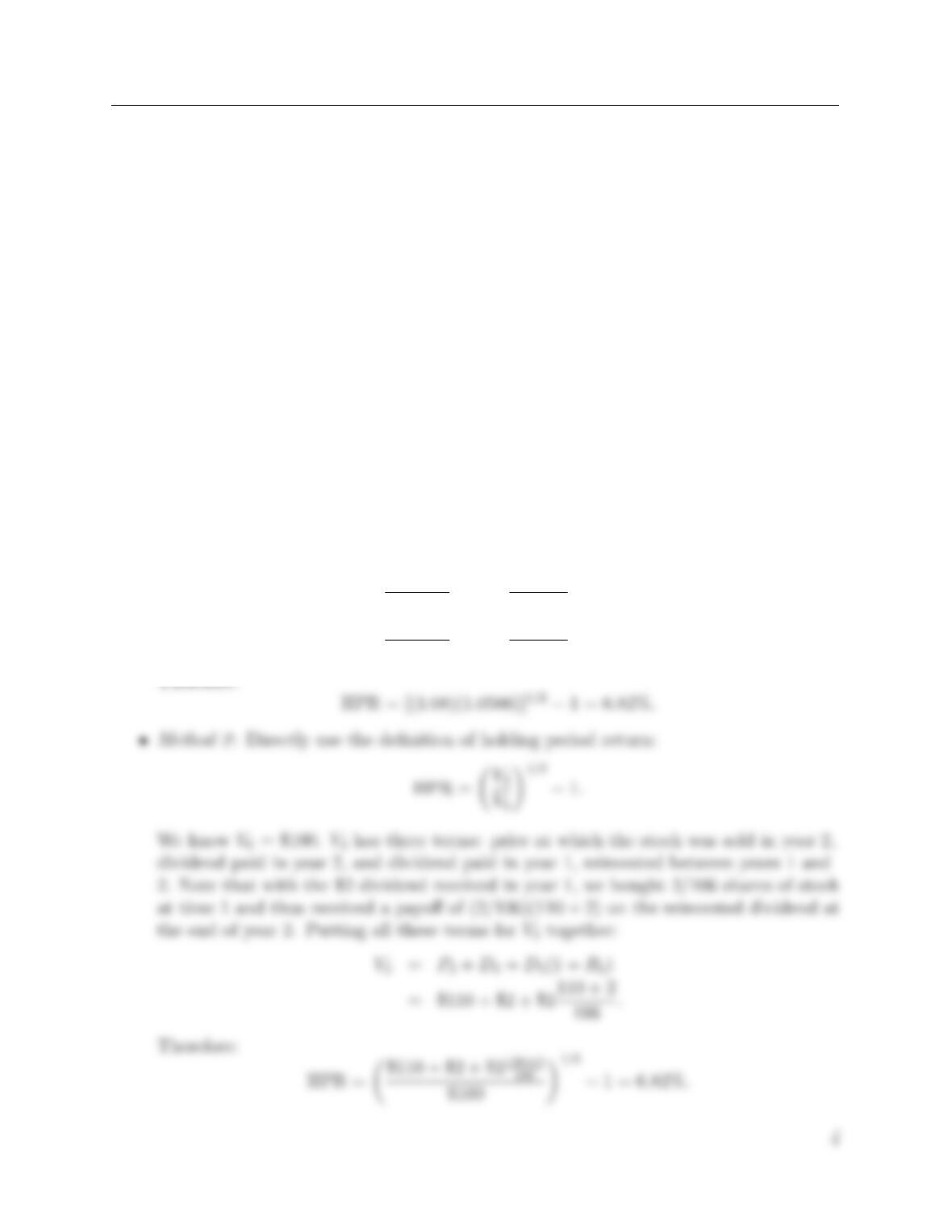
•Method 1 : Recall that the holding period return on an investment is:
HPR = [(1 + R1)(1 + R2)]1/2−1.
Where R1was the return over the first year and R2was the return over the second.
Note that R1and R2could be returns on any investment, not just on holding stock.
For our example:
R1=P1+D1
P0−1 = 106 + 2
100 −1 = 8%.
R2=P2+D2
P1−1 = 110 + 2
106 −1=5.66%.