EXCESSIVE ABSENCE IN COLLEGE CLASSROOMS
TABLE OF CONTENTS
EXECUTIVE SUMMARY………………………………………………………………….. iv
INTRODUCTION…………………………………………………………………………… 1
PROBLEM: ABSENCES AFFECT GPA, GRADUATION, AND EMPLOYMENT …….. 1
DISCUSSION: CIRCUMSTANTIAL EVENTS AND ABIDING CONDITIONS………… 3
CIRCUMSTANTIAL EVENTS …………………………………………… 4
ABIDING CONDITIONS…………………………………………………. 5
CONCLUSION……………………………………………………………………………… 9
REFERNECES………………………………………………………………………………. 11
LIST OF FIGURES
Figur
e
1Number of Certificates and Degrees Awarded per 100 Students Enrolled by
Country…………………………………………………………………………….. 2
2Number of Days of Required School Attendance by Country…………..………… 3
3Two Absence Categories by Frequency of Absence……………………………… 3
4Most Common Circumstantial Excuses and How Frequently They Are
Used……………………………………………..………………….……………… 5
EXECUTIVE SUMMARY
The purpose of this investigative report is to identify and explain the causes of excessive absence
in college classrooms. It is widely theorized that class attendance has a direct impact on a
student’s GPA. The more absences a student has, the lower their GPA may be. A low GPA can
hinder a student from graduating, entering graduate school, or obtaining a good job.
Furthermore, habitual absence is likely to carry over into the workforce and hurt job
performance. Undoubtedly, excessive absence is an important issue, which is why its causes
must be laid out and analyzed.
Circumstantial events. These include sickness, medical emergencies, and personal
obligations.
Abiding conditions. These include three broad categories: school environment, the
student’s conscious decisions, and personal conflicts.
oSchool environment. A student may be absent due to issues with their teacher or
course or because of the class size.
oConscious Decisions. The student may be absent due to external class alternatives
such as studying for another class or because of their irresponsible choices.
oPersonal conflicts. Students are absent because they are unmotivated,
discouraged, and deprived of sleep, among other things.
INTRODUCTION
Excessive student absence is a longstanding, worldwide problem, and has notoriously perplexed
researchers, teachers and school officials in all levels of education for decades. So far, little has
been done to actually solve the issue since the causes behind it are so numerous and often unique
to each individual. That of course does not mean there are no practical solutions; it simply means
that more work must be done to identify and understand the causes of excessive student absence.
Purpose
The purpose of this report is to thoroughly investigate the most common causes of student
absence in college and university classrooms and expand previous and current research to
include even more relevant causes. Ultimately, permanent solutions to this issue must be
developed and careful decisions must be made regarding the undesirable state of classroom
attendance.
Scope
This report will encompass numerous causes of absence among college students. While much of
the information presented may also be relevant to attendance issues in secondary schools, the
focus of this report will be on post-secondary classroom attendance with the goal of improving
attendance policies and practices at , specifically. The research of causes for this report was
derived primarily from student interviews and a survey, along with personal yet objective input
by the report’s author. The majority of the survey questions were duplicated from a survey
conducted by Paul Friedman, Fred Rodriguez, and Joe McComb in their study entitled, “Why
Students Do and Do Not Attend Classes.” In addition, the bulk of informational support for this
research was found on the Internet. Before the causes of excessive absenteeism are fully
discussed, some background must be shed on why attendance is a worthwhile issue and how it
affects the entire university system and even society.
PROBLEM: ABSENCES AFFECT GPA, GRADUATION, AND EMPLOYMENT
The general hypothesis correlating absence with student performance states that regular class
attendance is a critical component of a student’s learning process and absenteeism is thus
detrimental to a student’s education, having the opposite effect of attendance. This hypothesis is
recognized worldwide in every learning institution, meaning that most people believe absence,
especially when in excess, hinders a student’s academic performance. Quite simply, excessive
absence by a student results in a lower GPA than the GPA the student would potentially have
achieved had they not missed class. If a student’s GPA drops below the 1.0 mark, the student
may be suspended from future course registration or may voluntarily drop out. Even if the
student’s GPA does not reach this low point, their excessive absence may cause them to fail some
courses, forcing them to push back their graduation date. Clearly, excessive absence can have
serious ramifications.
But the consequences of excessive absence do not stop with post-secondary education. The effect
of poor class attendance on a student’s GPA can follow the student in their future ventures,
negatively impacting their chances at success. For instance, a low GPA as a result of erratic
attendance may restrict the student from entering graduate school. In today’s competitive job
market, a bachelor’s degree is not worth as much as it was in previous years. With no impressive
GPA and no graduate work to add to a résumé, the student may find it difficult to start a
rewarding career. Furthermore, the student may experience hardships even if they are able to
obtain a good job. This is because habitual class absence is likely to be repeated in the
workforce. Absence in the workforce has the same effect as absence in the classroom: poor
performance. As the worker’s productivity decreases due to absence, they will likely be
reprimanded or terminated. Appropriate action must be taken soon to develop permanent
solutions to growing attendance issues. The state of our national workforce depends on it.
For the majority of the past decade, America has been having difficulty competing with other
industrialized nations as the productivity of our workforce has declined. Perhaps most working
Americans were ill-prepared in high school and college for the challenges of real world
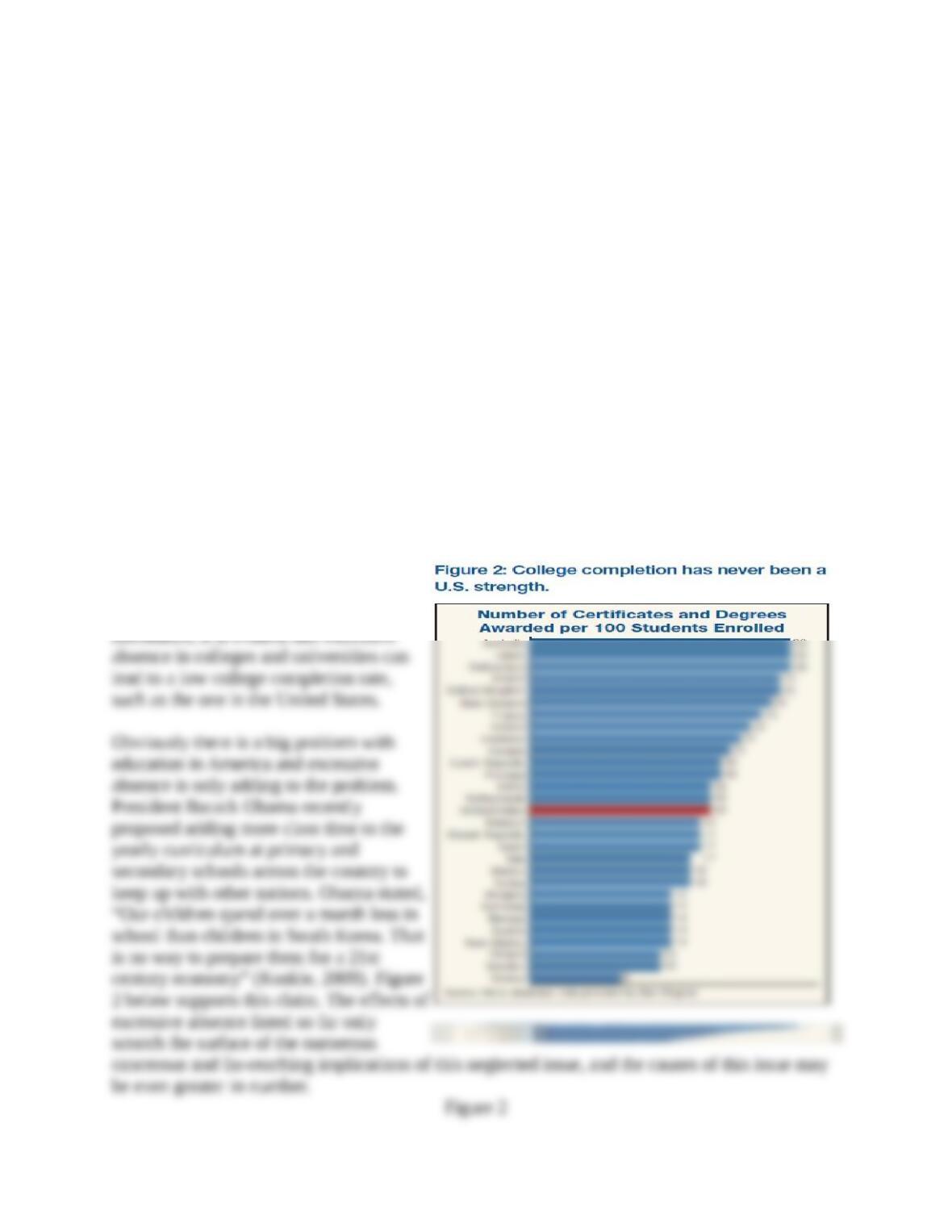
occupations. This statement is supported by the figure below, indicating that America’s has a
very low college completion rate in comparison with other countries.
Figure 1
Since the failure to graduate college can
be partly attributed to a low GPA and
since a low GPA can result from poor