1. Definition of the strategy
• The concept of strategy is rooted in game theory in the
field of economics, where strategy refers to the design of
a series of specific game draws (actions) where each
action is drawn in relation to the potential for own and
foreign game draws.
• Based on this, the concept of strategy was adopted by
business economics and was first applied here at
American universities (first of all, Harvard Business
School) (CHANDLER, 1962, ANSOFF, 1965, ANDREWS,
1971).
• Goal-directed decisions and actions in which
capabilities and resources are matched with the
opportunities and threats in the environment. (It is
very close to SWOT)
Definition of Strategy II.
• “Strategic management is the process by which senior
management determines the long-term direction and
performance of an organization by carefully designing,
implementing, and continuously evaluating strategy.” [Rue
1986, p.5]
• “Strategy is a process to be understood, not a discipline to
teach. The process by which an organization, in often
changing environments, determines its intentions, goals,
and desired level of achievement; decide on actions to
achieve them and their timing, execute actions, evaluate
progress and results. It modifies and changes actions
when and where needed. ”[Thompson 1997, p.6]
2. Why is strategic management important?
• Gives everyone a role
• Makes a difference in performance levels
• Provides systematic approach to uncertainties
• Coordinates and focuses employees
Why Strategy?
• To change, an organization needs
• Burning Platform
• Vision
• Leadership
• Strategic Management
• Political Management
3. Strategy vs. Strategic Management
• Strategy
• A series of goal–directed decisions and actions matching an organization’s skills and
resources with the opportunities and threats in its environment. Strategic
Management • Analyze current Situation • Develop appropriate Strategies • Put
strategies into Action • Evaluate, modify, or change strategy
• Strategy involves
• Organization’s goals
• Goal-oriented action
• Related decisions
and actions
• Internal strengths
• External
opportunities and
threats
• Strategic
management
• Planning
• Organizing
• Implementing
• Controlling
4. Strategic management process – the 3 main part
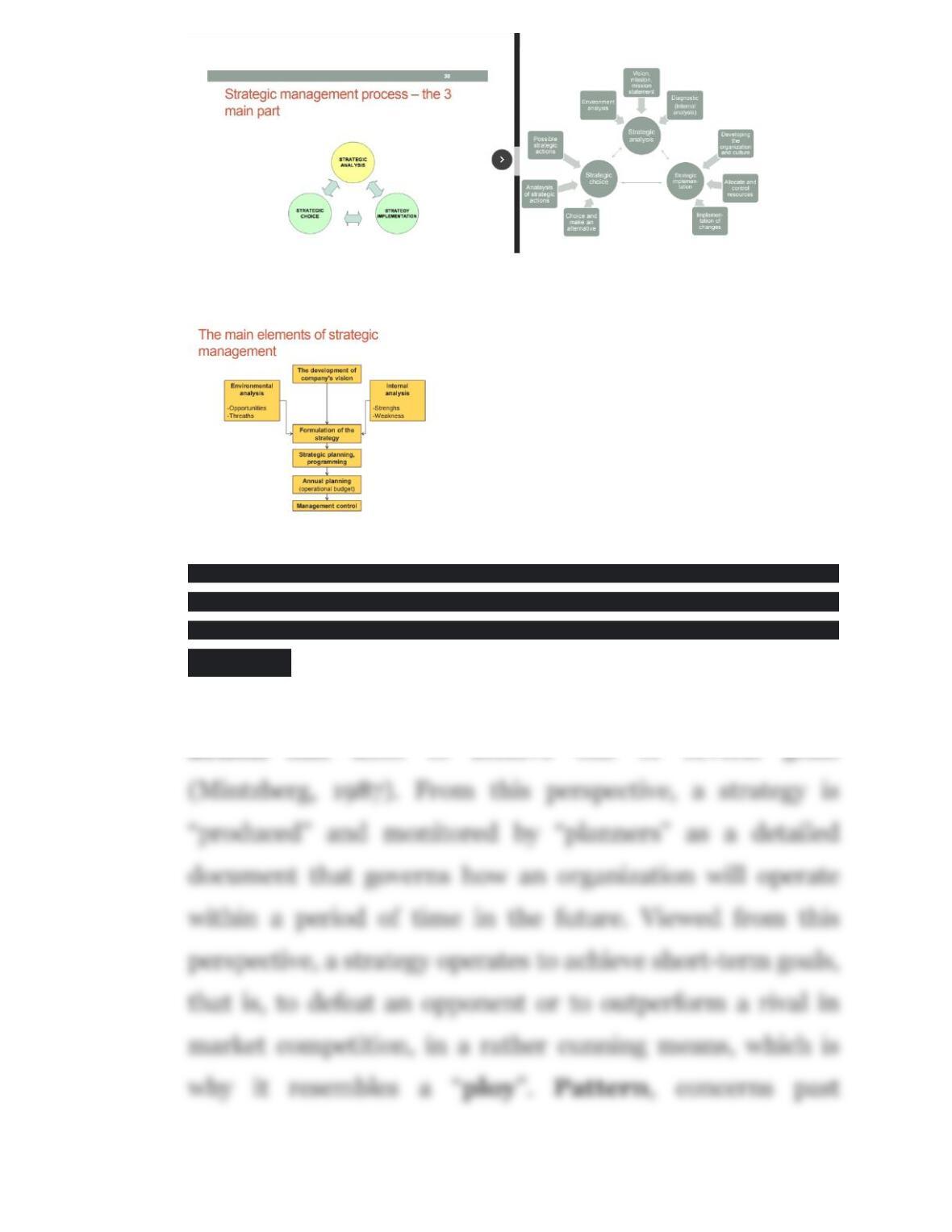
5. Levels of strategy
6. The main elements of strategic management
7. The strategy’s „5P” (Henry Mintzberg)
Henry Mintzberg’s (1987) thoughts on strategy are condensed into what he called the “5
Ps”, which stand for the 5 senses, or ways of understanding, a strategy. To be specific,
through these “Ps”, a strategy can be seen as a Plan, a Ploy, a Pattern, a Position, or a
Perspective. Plan, a strategy is consciously and internally
intended by an organization, often as a “course of