EPILOGUE
Leftovers to Takeaway
One bright April day in 1989, I was invited to have lunch with one of the Haida hereditary
chiefs I had worked with in Old Massett. He wanted to go to the local Chinese-Canadian
restaurant in New Masset; a good place to eat, with lots of food, I was told. I was nearing the
end of my fieldwork and he wanted to talk about what I had learned during my months in
the community, and what impressions would I take away to sustain my memory in Britain.
We laughed, reminisced, and talked about Haida art, community life, kinship, politics, and
the deep emotional connection to the islands of Haida Gwaii. We shared several dishes from
the restaurant’s menu: sweet and sour pork, lemon chicken, stir-fried beef in black bean sauce,
and an ample serving of fried rice. At the conclusion of the meal we sat back, relaxed, contem–
plated the food, and discussed our shared experience. is was not specifically Haida food, but
it was made and eaten locally, and was enjoyed as the background to our conversation about
Haida culture. As time moved forward into the afternoon, the restaurant became quieter, and
it was time to pay the bill and collect our plastic-wrapped leftovers. e chief insisted it was
“his treat” and was adamant I should accept his gift without too much fuss, and I acquiesced
gratefully. He was pleased to take the “doggy bag,” noting they were like kowkleth, the leftovers
used to judge a community feast or potlatch. e more leftovers, the better; they give you
something to eat later and a way to think about the previous meal. e restaurateurs thanked
us for our business and returned to their tasks of wiping the tables and setting the cutlery,
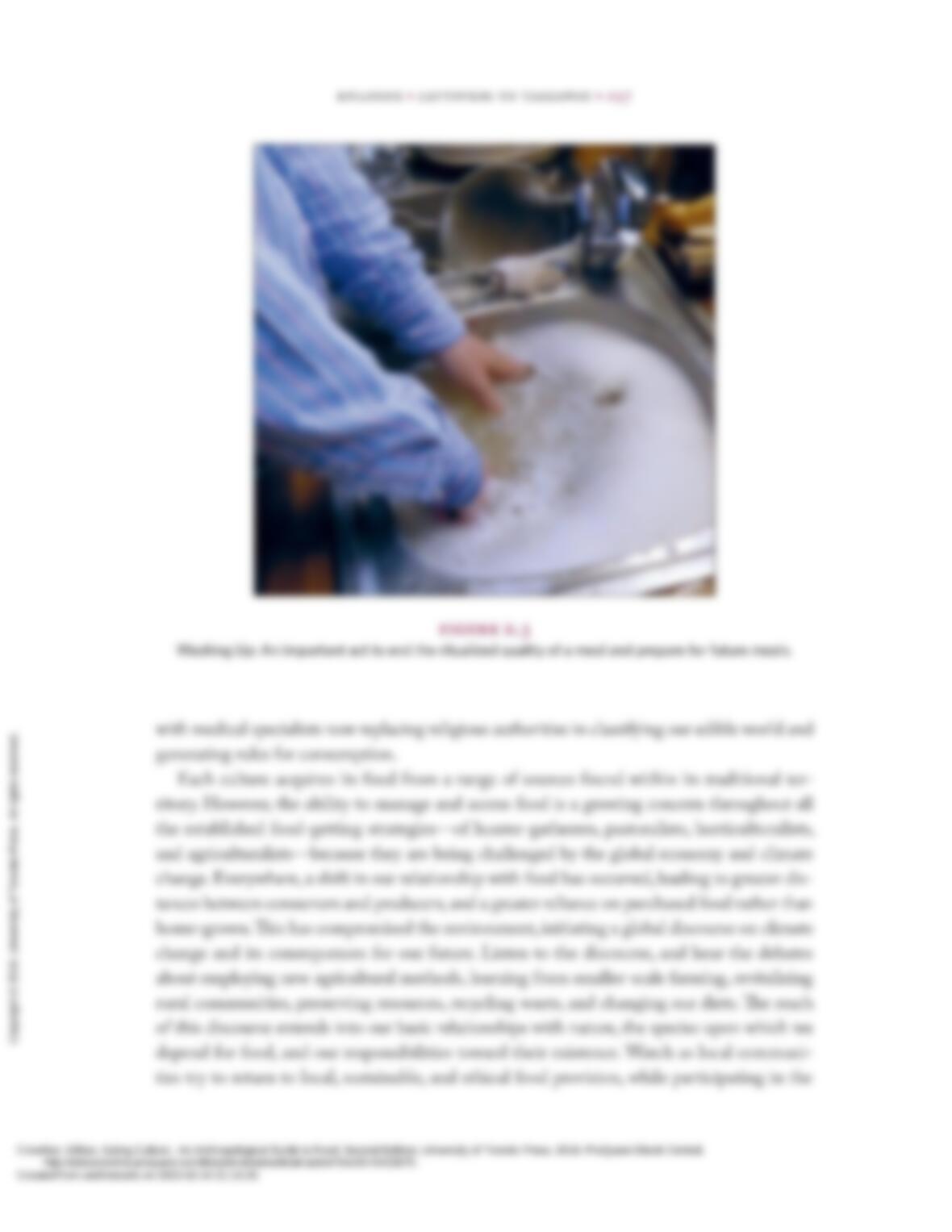
and in the back the distinctive clatter of washing up could be heard. e door chimed shut
behind us, and we walked back to the village along the beach, with the plastic bag of leftovers
catching the ocean breeze.
As I look back on this meal now, I reffect on the leftover memories of what I learned about
Haida culture through food—and while this meal was marked as “Chinese” food, it was part
of the local community’s eating culture, and part of a wider sense of Canadian culture. In this
one foodscape, many culinary practices coexist. e Haida do eat their traditional foods, such
E
P
I
L
O
G
U
E
L
E
F
T
O
V
E
R
S
T
O
T
A
K
E
A
W
A
Y
UTP-EatingCulture-2e-04.indd 291 4/16/18 4:46 PM
0P?4CEECG2CGA0E?,/G/GIEAC=E4C?38?=G2CCG:GC?CQ9G?7?2D0?GE
I,?D=?GEI?=FEC?E ?D?CE=CG.=51-
0??F?E ?DG ,,
0IQCA:GC?CQ9G?/EECA???
as salmon, halibut, razor clams, and seaweed, but they also buy foods and make dishes that are
from other cuisines, and they eat Chinese-Canadian meals; this does not deny the presence
of their cuisine nor their distinct culture. A story I was told in Old Massett concerned the
“pizza test,” which referred to a lawyer for the Crown at a land claims court hearing asking if
First Nations people ate pizza. For the lawyer, First Nations people eating pizza meant that
they had become assimilated, and their distinct Aboriginal rights would be extinguished. But
the eating of new foods does not extinguish culture, and all the inhabitants of Old Massett,
whether Haida or not, will eat their learned home cuisine and sample others that are avail–
able. It is no different in rural or urban communities across Canada, North America, Europe,
or anywhere else. Everywhere that food is acquired by production or purchase, it will be
organized and classified, given values and meanings that reference tradition, nutrition, and
personal preferences. e ingredients and ffavours are simultaneously local and global, but are
made sense of in the place of consumption by members of different ethnic groups, who engage
with one another in the daily tasks of life. Women tend to cook at home, and men willingly
cook in public, and there can be gender crossover in both contexts. Recipes are performed
from memory or from books, and websites are consulted; new dishes are made and old ones
reaffirmed as favourites. Kids watch, and some learn, and others wait for their meals to arrive.
On occasion, people will eat out, hosted by relatives, friends, and the community, and in return
guests will be invited back in reciprocal and redistributive rounds of eating. e food will be
remarked upon, a topic of discussion, a public cuisine, and it will serve as a guide to mark the
social occasion and judge its social and cultural significance. e living cuisine of the Haida
crosses from private to public life, is cultural, and identifies the Haida Nation. Restaurants
may also be frequented, and there will be a choice of differing ethnic cuisines, consumed in the
company of family and friends following the protocols of the usual gastro-politics. e food
will be discussed, assessed, and judged using gastronomic knowledge to mark the occasion,
with possible leftovers prolonging the experience and bringing the food into the familiarity of
domestic life. ese general patterns are reproduced across Canada, mediated by place, income,
ethnicity, and personal likes and dislikes; elsewhere in the world, we can discern patterns that
will be inffuenced by the specific context but will share many commonalities. It is these gen-
eral patterns that have been examined throughout the book, using the concept of cuisine as a
guide to identify the similarities in eating cultures, and to explore the settlement and mobility
of ingredients, ffavours, and dishes, combined with the movement of people carrying culinary
and gastronomic knowledge across the world. Any cuisine must be located in its social, cul–
tural, political, economic, and historical circumstances; it is an amalgamation of what we eat;
how, with whom, and when; and what we think and say about it. Cuisine is much more than
a sum of dishes—it is everything we have, think, and do with food.
• EATING CULTURE
UTP-EatingCulture-2e-04.indd 292 4/16/18 4:46 PM
0P?4CEECG2CGA0E?,/G/GIEAC=E4C?38?=G2CCG:GC?CQ9G?7?2D0?GE
I,?D=?GEI?=FEC?E ?D?CE=CG.=51-
0??F?E ?DG ,,
0IQCA:GC?CQ9G?/EECA???
Takeaway Cuisine
roughout this book, the concept of cuisine has been applied as a means to draw attention
to its presence as a facet of everyone’s culture. It is often easier to identify other people’s tradi-
tions and practices and harder to find our own distinct patterns. For this reason, it is worth
reffecting on some of the qualities of cuisines that make them integral to our cultural identity,
although they are often overlooked. Cuisine is learned, with food tastes and individual prefer–
ences probably being the first site of enculturation and socialization. Infants are fed by their
mothers, and other family members, and grow up experiencing their culinary traditions as
a matter of daily life. is transforms the culture’s complex classification of food, its values
and meanings, into sensations and memories of food, embodying a cuisine within the physi-
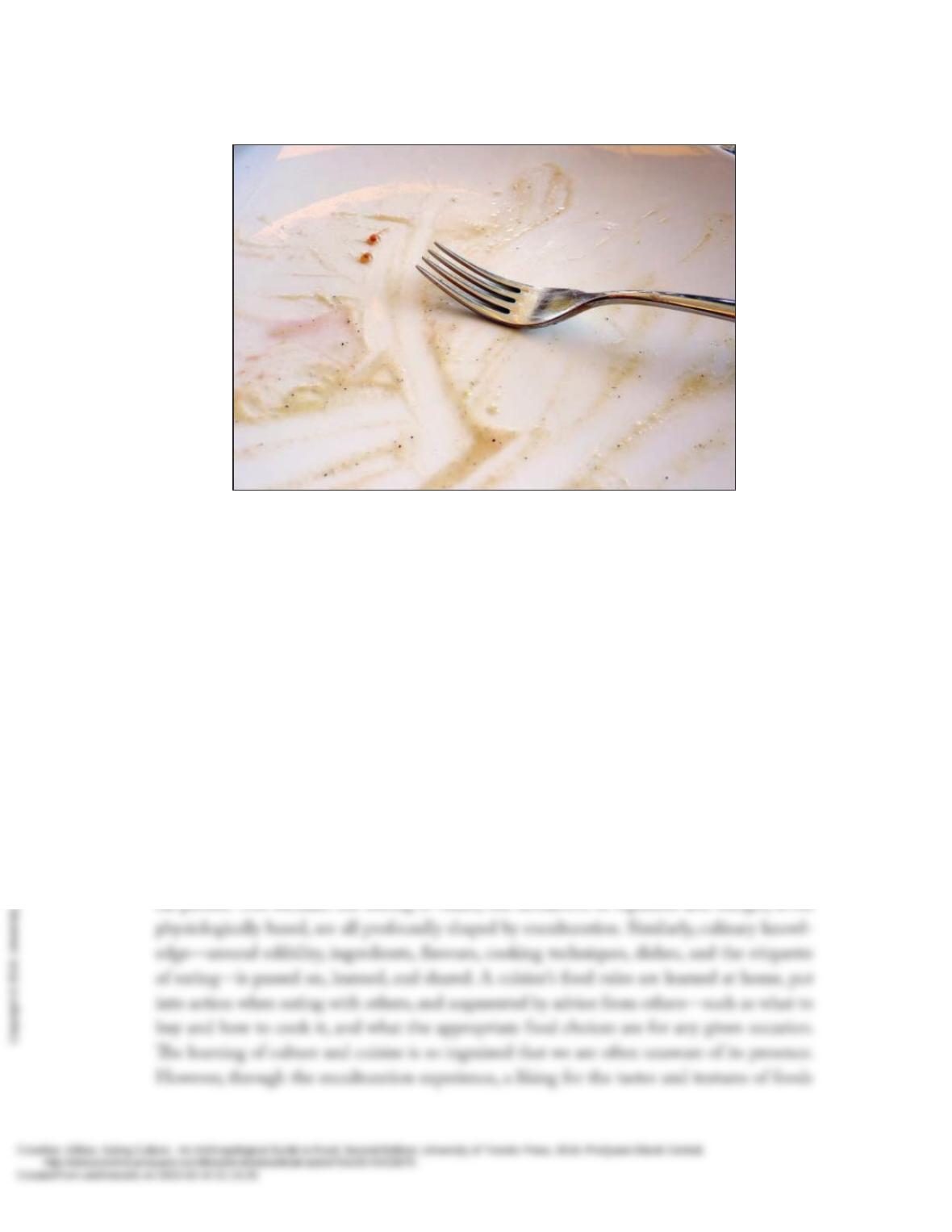
FIGURE E.
Empty Plate: All finished—or perhaps a second helping?
EPILOGUE • LEFTOVERS TO TAKEAWAY •
UTP-EatingCulture-2e-04.indd 293 4/16/18 4:46 PM
UTP-EatingCulture-2e-04.indd 294 4/16/18 4:46 PM
UTP-EatingCulture-2e-04.indd 295 4/16/18 4:46 PM
UTP-EatingCulture-2e-04.indd 296 4/16/18 4:46 PM
UTP-EatingCulture-2e-04.indd 297 4/16/18 4:46 PM
UTP-EatingCulture-2e-04.indd 298 4/16/18 4:46 PM
UTP-EatingCulture-2e-04.indd 299 4/16/18 4:46 PM