Z5059494
1
Everest simulation reflective report
Executive summary
This report is a reflection and overall analysis of the experiences encountered in the Everest
simulations by Lynn’s Legends. The report includes problems we encountered as a team during
the Everest simulations and describes how we overcame them to effectively communicate,
strategize and progress through the simulation. In addition, the report also discusses
personality traits and their impact on leadership as well as leadership styles and the style we
found to be most effective at improving our results from the first climb which was done
virtually in comparison to our second climb which was done in person.
With all other factors aside, we found it immediately much easier to convey our ideas and
communicate in person during the second climb versus online in a chatroom. We successfully
adopted a democratic leadership style and ensured a growth mindset was adopted by all
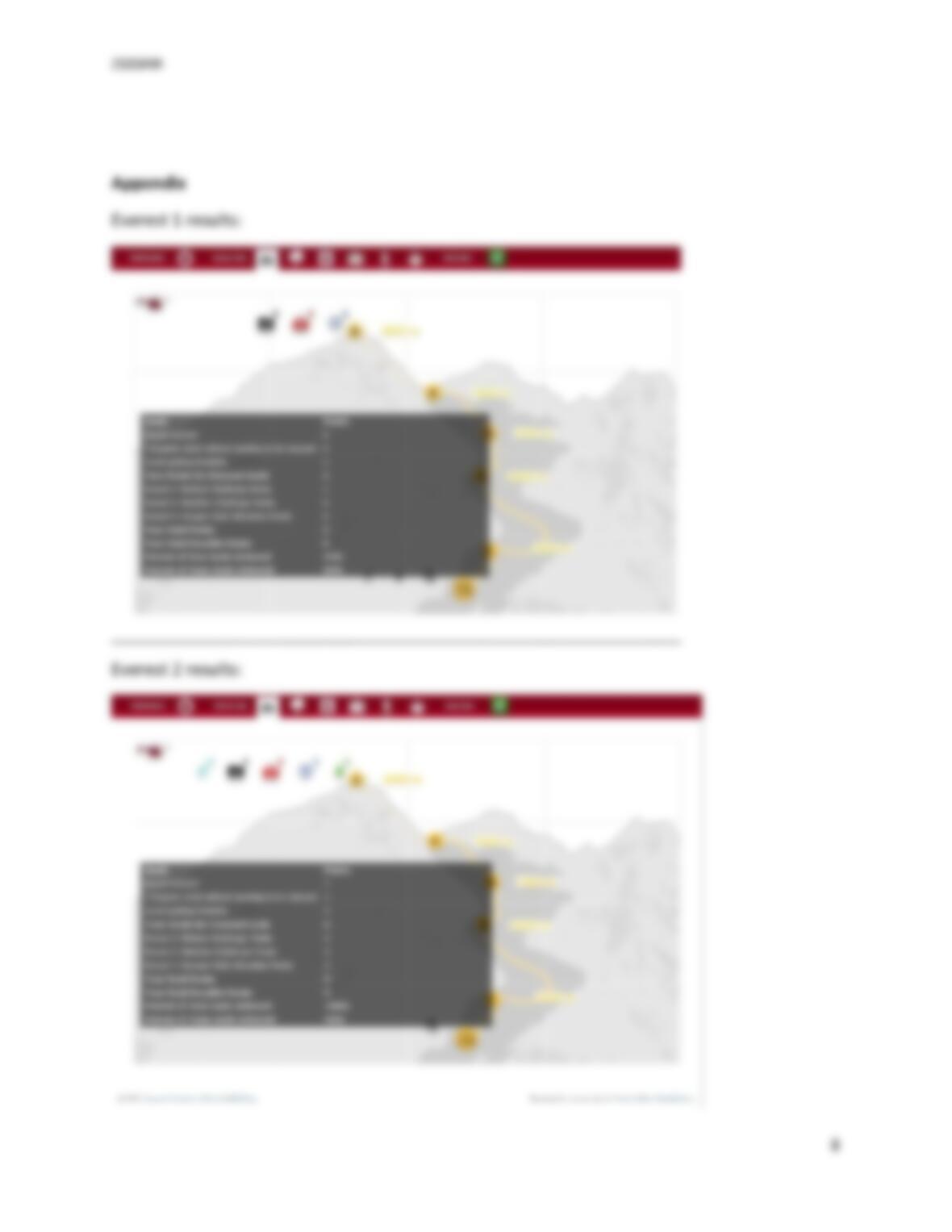
members and worked through our team issues to increase our initial Everest climb result of
56% to 96% for the second climb. Furthermore, we found that the use of simulations as a
learning tool to develop our team and leadership skills proved to be effective.
The report also contains my personal reflection. Through my reflection, I was able to determine
what skills I was required to work on to become a better leader. Naturally having an introverted
personality made me realize the importance of adopting extrovert traits when stepping into a
leadership position as well as higher levels of confidence in my decisions, generating greater
trust amongst the team.
Table of contents:
Executive summary…………………………………1
Introduction…………………………………………….2
Section one……………………………………………..3
Section two……………………………………………..4-5
Section three……………………………………………6
Conclusion……………………………………………….7
References……………………………………………….7
Appendix…………………………………………………8
Team contract………………………………………….9–12
Z5059494
2
Introduction:
Simulations are an effective method of learning and training. I was randomly assigned a team of
which we had to complete two simulations of the Mt Everest climb, one virtually and one in
person. Through these simulated climbs, we developed teamwork and leadership skills to
effectively strategize and communicate to complete the climbs to the best of our ability. This
report reflects on our experiences, limitations of the simulation and effectiveness of our
teamwork skills to improve our results from the first climb to the second. Virtual
communication versus in person was also analyzed as it was a large factor of our success in the
second climb in comparison to the first. Developing the correct leadership style is extremely
important for creating the best possible environment for ideas and strategies to be effectively
communicated across the team to be analyzed, improved and implemented into the simulation
to achieve our Everest goals.

Z5059494
3
Section one: Simulations as a learning tool
Simulations allow the individual to experience and/or practice routines in order to be successful
in scenarios replicated by the simulation. Thus, it is able to implemented as an effective
learning tool, especially for iterative learning as the scenarios are able to be repeated. The
Everest simulation replicated decisions faced when climbing Mt Everest and required us to
work as a team to climb to the summit. Through the simulation, we were able to identify, as a
team, our flaws and weakness’ since these were exposed when trying to make decisions and
overall progress in the game. Different mindsets and approaches to the problems faced during
the simulation were some of the greatest issues we encountered in our experience. The Everest
simulation allowed us to practice working as a team, troubleshoot the issues encountered and
solve problems entailing logic and reasoning as well as developing our leadership skills in the
process. Furthermore, from completing Everest 1 and proceeding discussions, strategizing and
iteration of the second simulation, we were able to significantly improve our results, from 56%
to 96% (Everest 1 to Everest 2). Since the first Everest climb was done virtually and second was
done face to face, which was much easier, we believe this also contributed to a much higher
score. We were capable learning from all of our mistakes from the first climb and re-iterating to
improve our simulation result and thus, indicating simulations have a great value in learning.
Furthermore, simulations have also been proven to be effective at practicing these specific skills
required by the simulation for real world use, predominately in high-risk workplace scenarios
across many fields and are frequently used because of this. (Cartier et al. 2016, pg 568-574)
demonstrates the positive impact of simulations on medical worker’s performance and
compares it to their performances pre-training before the simulations and concluded
knowledge, confidence and competency all increased substantially (up to 80% relative increases
in performance).
Simulations allow the user/s to test different leadership styles across the same scenarios and
compare the results to determine the most effective style that fits the team dynamics and
personalities possessed by the team members. From the simulation, we discovered the
importance of developing the correct leadership approach to cater for our team’s needs and
give us the greatest chance for improvement from Everest 1 to Everest 2 where we successfully
reached our goal. Each member of the team adopted the leader position at least one point
during the simulations and discussions when strategizing by asserting their ideas and
coordinating the team, although this was often not consistent during our Everest participation.
Through trial and error using the simulation, we discovered implementing a democratic
leadership style worked the best and was most effective at accomplishing our given tasks and
was ideal when considering the team dynamics.
Z5059494
Section two: Team development and leadership
Many team troubleshooting situations were encountered at all stages of the Everest
simulations and thus, leading many failures as well as success’. Initially, my team did not know
or understand much about the simulation mechanics, what to do or how to approach the
simulation which further complicated our decision making and ability solve problems effectively
as a team in order to advance through the stages of the simulation. Dweck (2014) asserts the
advantage of having a growth mindset in comparison to a fixed mindset when confronted with
difficult tasks that are unable to be achieved at that point in time as it promotes greater brain
activity and positivity.
Different personalities contribute to an individual’s approaches to problem solving. Naturally,
some individuals of our team were inclined to have a positive approach when faced with
challenges and processed a growth mindset. One of the main issues we encountered in our
group was everyone not initially processing a growth mindset and thus sabotaging our
progression and simulation results (predominately in Everest 1). This problem started prevailing
toward the end of the first Everest climb and continued to get worse after the climb had been
completed where we only scored 56%. Our physician initially had a fixed mindset, a mindset
that runs away from error and difficulty as explained by Dweck (2014), this was shown through