Tuomas Komulainen
Essays on financial crises
in emerging markets
Bank of Finland Studies
E:29 · 2004

Tuomas Komulainen
Essays on fi nancial crises
in emerging markets
Bank of Finland Studies
E:29 · 2004
The views expressed in this study are those of the author and
do not necessarily refl ect the views of the Bank of Finland.
ISBN 952-462-140-1
ISSN 1238-1683
(print)
ISBN 952-462-141-X
ISSN 1456-5943
(online)
Vammalan Kirjapaino Oy
Vammala 2004
3
Abstract
The financial crises in emerging markets in 1997–1999 were preceded
by financial liberalisation, rapid surges in capital inflows, increased
levels of indebtedness, and then sudden capital outflows. The study
contains four essays that extend the different generations of crisis
literature and analyse the role of capital movements and borrowing in
the recent crises.
Essay 1 extends the first generation models of currency crises. It
analyses bond financing of fiscal deficits in domestic and foreign
currency, and compares the timing and magnitude of attack with the
basic case where deficits are monetised. The essay finds that bond
financing may not delay the crisis. But if the country’s indebtedness is
low, the crisis is delayed by bond financing, especially if the
borrowing is carried out with bonds denominated in foreign currency.
Essay 2 extends the second generation model of currency crises by
adding capital flows. If these depend negatively on crisis probability,
there will be multiple equilibria. The range of country fundamentals
for which self-fulfilling crises are possible is wider when capital flows
are included, and thus more countries may end up in crisis. An
application of the model shows that in 1996 in many emerging
economies the fundamentals were inside the range of multiple
equilibria and hence self-fulfilling crises were possible.
Essay 3 studies financial contagion and develops a model of the
international financial system. It uses a basic model of financial
intermediation, but adds several local banks and an international bank.
These banks are able to use outside borrowing, the amount of which is
determined by the value of their collateral. The essay finds that the use
of leverage by local and global banks and the fall in collateral prices
comprise an important channel and reason for contagion.
Essay 4 analyses the causes of financial crises in 31 emerging
market countries in 1980–2001. A probit model is estimated using 23
macroeconomic and financial sector indicators. The essay finds that
traditional variables (eg unemployment and inflation) and several
indicators of indebtedness (eg private sector liabilities and banks’
foreign liabilities) explain currency crises. When the sample was
divided into pre- and post-liberalisation periods, the indicators of
indebtedness became more important in predicting crisis in the post-
liberalisation period.
Key words: currency crises, banking crises, emerging markets,
borrowing, collateral, contagion, liberalisation
4
Tiivistelmä
Vuosien 1997–1999 valuutta- ja pankkikriisejä kehittyvillä markki-
noilla edelsi pääomavirtojen nopea kasvu, velkaantumisen lisääntymi-
nen ja yhtäkkinen pääomapako. Tämä tutkimus koostuu neljästä artik-
kelista, jotka laajentavat nykyistä kirjallisuutta tutkimalla pääomavir-
tojen ja velkaantumisen merkitystä.
Ensimmäisessä artikkelissa laajennetaan ensimmäisen sukupolven
valuuttakriisimalleja tutkimalla koti- ja ulkomaanvaluutan määräistä
velkaantumista ja vertaamalla sitä perustilanteeseen, jossa budjetti-
alijäämät katetaan keskuspankkirahoituksella. Lainaaminen ei välttä-
mättä lykkää kriisiä. Jos maan velkaantuminen on vähäistä, lainaami-
nen kuitenkin lykkää kriisiä, varsinkin jos obligaatiot ovat ulkomaan-
valuutan määräisiä.
Toisessa artikkelissa laajennetaan toisen sukupolven valuuttakriisi-
malleja tutkimalla pääomavirtoja. Jos pääomavirrat ovat riippuvaisia
kriisin syntymisestä, syntyy monen tasapainon tila. Kun pääomavirrat
lisätään malliin, itseään toteuttavat kriisit ovat entistä todennäköisem-
piä. Mallin sovellus osoittaa, että monien kehittyvien maiden funda-
mentit olivat vuonna 1996 alueella, jolla itseään toteuttavat kriisit oli-
vat mahdollisia.
Kolmannessa artikkelissa tutkitaan kriisien leviämistä ja kehitetään
yksinkertainen malli kuvaamaan kansainvälistä rahoitusjärjestelmää.
Tutkimuksessa laajennetaan perusmallia rahoituksen välittymisestä
lisäämällä siihen monta paikallista ja yksi globaali pankki. Pankit
voivat käyttää ulkopuolista rahoitusta, jonka suuruuden määräävät
pankkien vakuusarvot. Artikkelissa osoitetaan, että velkaantuminen ja
vakuusarvojen romahtaminen luovat merkittävän väylän ja syyn
rahoituskriisien leviämiselle.
Neljännessä artikkelissa tutkitaan valuutta- ja pankkikriisien syitä
31 kehittyvässä maassa vuosina 1980–2001. Selittävinä muuttujina on
23 makrotaloutta ja rahoitussektoria kuvaavaa indikaattoria, joiden
vaikutusta kriiseihin tarkastellaan probit-menetelmän avulla. Tulosten
perusteella eräät perinteiset muuttujat, kuten työttömyys ja inflaatio, ja
useat maan velkaantuneisuutta kuvaavat indikaattorit, kuten yksityisen
sektorin velkaantuminen ja pankkien ulkomainen velkaantuminen,
selittävät valuuttakriisejä hyvin. Rahoitusmarkkinoiden vapauttamisen
jälkeen velkaindikaattorien selitysaste kasvoi entisestään.
Asiasanat: valuuttakriisi, kehittyvät maat, liberalisointi, velkaantumi-
nen, probit-menetelmä, kriisien tarttuminen, pääomavirrat
5
Acknowledgements
This thesis was inspired by the financial crises in Asia, Russia and
Latin America in 1997–1999. These crises have been interesting and
fun for economists and have inspired numerous academic studies, but
they surely were not fun for the citizens of these poor countries.
Hopefully, the essays of the thesis and my future work can provide
some practical help for the authorities in these emerging economies.
The thesis will be presented at the Turku School of Economics and
Business Administration and was written mainly at the Bank of
Finland Institute for Economies in Transition (BOFIT). Without
BOFIT’s pleasant environment and resources, this project would have
never been completed. I am greatly indebted to Pekka Sutela, the head
of the Institute, who in the summer of 1998 gave me the opportunity
to pursue these inquires. The project took longer than it should have,
and now Pekka might well regret his recruitment decision.
I have had the privilege of having not just one supervisor but
several talented commentators. I owe my special gratitude to Professor
Pertti Haaparanta and Research Supervisor Jukka Pirttilä, who have
carefully read and commented on the various versions of the essays.
Also many other colleagues have commented on my papers and
encouraged me. For example, Fernando Broner, Abdur Chowdhury,
Douglas Gale, Lauri Kajanoja, Iikka Korhonen, Mika Kuismanen,
Paul Masson, and Pedro Rodriguez have provided valuable comments.
I would also like to thank Johanna Lukkarila, the co-author of the
fourth essay, for fluent and productive cooperation. I am also grateful
to Professor Guillermo Calvo, who gave me the opportunity to spend
the year 2001 at the University of Maryland, where, among other
things, the ideas for the first and third essay were born. In the final
stages, the suggestions by the preliminary examiners, Professors Tapio
Palokangas and Kari Heimonen, clearly improved the thesis. Naturally
all the remaining errors are mine.
I would also like to thank the whole BOFIT staff, the Bank of
Finland’s great library, Glenn Harma who revised the language, and
Päivi Nietosvaara for the make-up work. Finally, I would like to thank
my family and friends. My parents, Maija and Eero, have given
valuable support during the early years of my life, and today Riina and
Camilla are my sources of daily encouragement and support. This
work is dedicated to Riina and our children.
Helsinki, July 2004
Tuomas Komulainen
6
7
Contents
Abstract…………………………………………………………………………………..3
Tiivistelmä……………………………………………………………………………….4
Acknowledgements…………………………………………………………………..5
Introduction
Capital mobility, borrowing, and financial crises……………………….9
Essay 1
Borrowing and balance of payment crises………………………………..33
Essay 2
Sudden stop of capital inflows and currency crises …………………..53
Essay 3
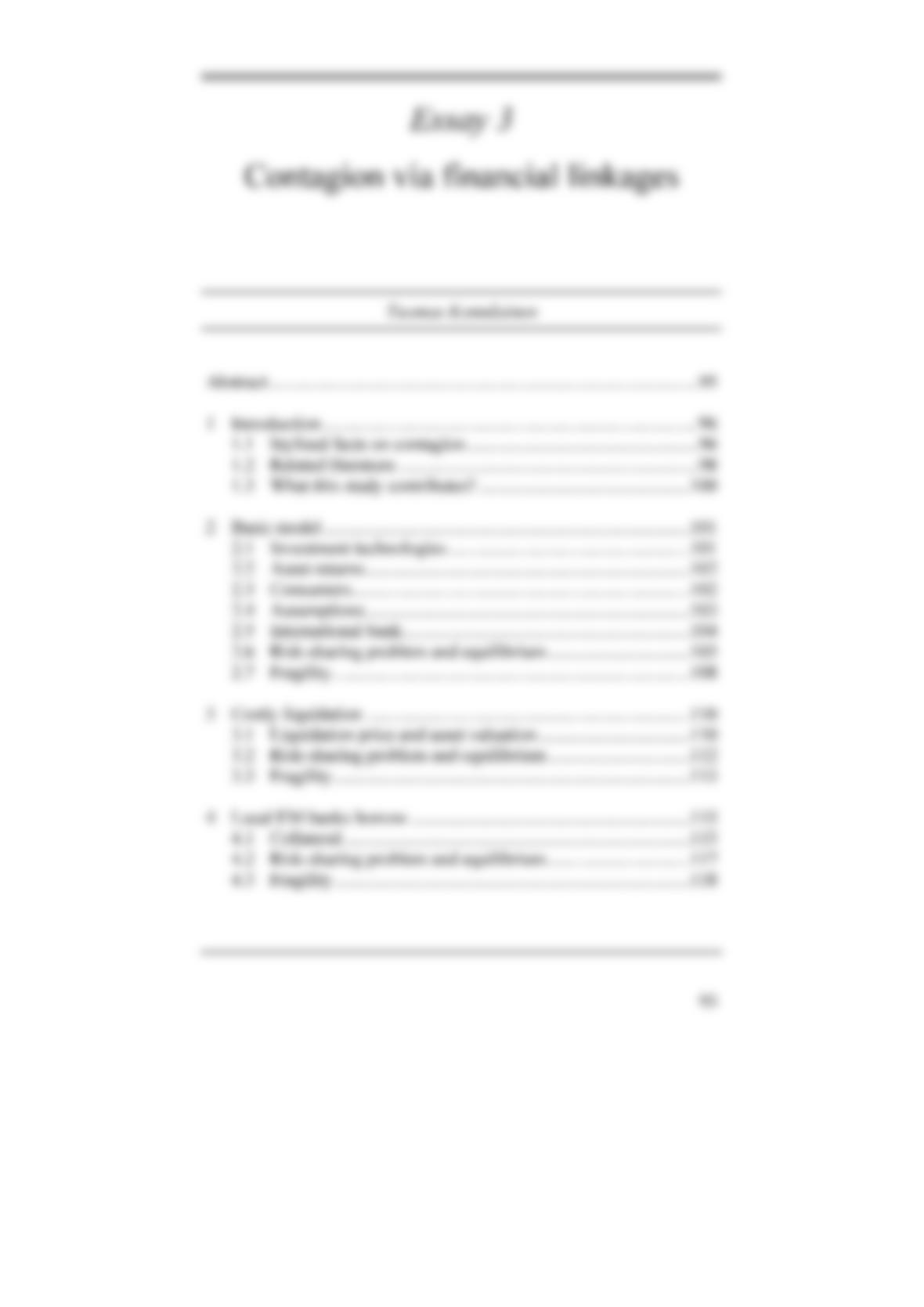
Contagion via financial linkages ……………………………………………..93
Essay 4
What drives financial crises in emerging markets?…………………141
8

9
Introduction
Capital mobility, borrowing,
and financial crises
Tuomas Komulainen
1 Motivation …………………………………………………………………………10
2 Literature overview……………………………………………………………..12
2.1 First generation models ………………………………………………..12
2.2 Second generation models…………………………………………….15
2.3 Banking crises in an open economy ……………………………….18
2.4 Empirical literature………………………………………………………20
3 Summary of the essays and contributions……………………………….22
3.1 Borrowing and balance of payments crises ……………………..22
3.2 Sudden stop of capital inflows and currency crises…………..23
3.3 Contagion via financial linkages ……………………………………24
3.4 What drives financial crises in emerging markets? …………..24
3.5 Main contributions and discussion …………………………………25
References………………………………………………………………………………27

1 Motivation
The literature on financial crises has generally progressed most
rapidly in the wake of actual crises, and the resulting analyses have
changed in line with the economic circumstances and problems of the
period in question.1 The most recent round of crises started in Asia in
July 1997, when the Thai authorities allowed the baht to float and
depreciate. Shortly thereafter, four other Asian countries (Philippines,
Malaysia, Indonesia and Korea) were forced to float their currencies.
During 1997–1999 altogether more than ten emerging market
countries experienced currency crisis, which inspired a new wave of
academic research. The new studies should be closely attuned to the
current economic environment and thus better able to explain the
recent crises in emerging markets.
The answer surely is that capital movements today are the central
issues. Crises are now different in that they involve very large
amounts of very short-term money. That is one aspect. Second, that
the economy is highly leveraged around that money, so that when
something happens, the whole house of cards collapses. And
thirdly, the world economy is deeply global, through the financial
structures and that means that when something happens anywhere,
it happens everywhere. So that of course makes international
financial crises today something really interesting. (R. Dornbusch
1998)
The financial liberalisation, and capital flows that followed, clearly
changed the environment in which emerging market countries