Running head: ENZYME KINETICS LAB 1
Lactose/Lactase & Inhibition
Lab Report
Michael Reyes
Hodges University
BSC 3800
Professor Clifton
December 9, 2014

ENZYME KINETICS LAB 2
Lab Report Part I – Enzyme Kinetics of Lactose/Lactase
Introduction
Lactose is a disaccharide consisting of two compounds glucose and galactose. Lactose,
which is found in milk, requires an enzyme lactase (β-galactosidase); enzyme that catalyzes the
hydrolysis of lactose to galactose and glucose, for proper digestion (Montalto, M., Curigliano,
V., Santoro, L., Vastola, M., Cammarota, G., Manna, R., … & Gasbarrini, G. 2006). People
worldwide tend to consume large quantities of lactose, which leads to a form of intolerance
(lactose intolerance), interrupting proper digestion. This condition is not typically an indicator of
a lack thereof [E] but more so that the concentrations are in smaller amounts.
This oset of [S]-substrate “lactose” to [E]-enzyme “lactase” overwhelms the digestion
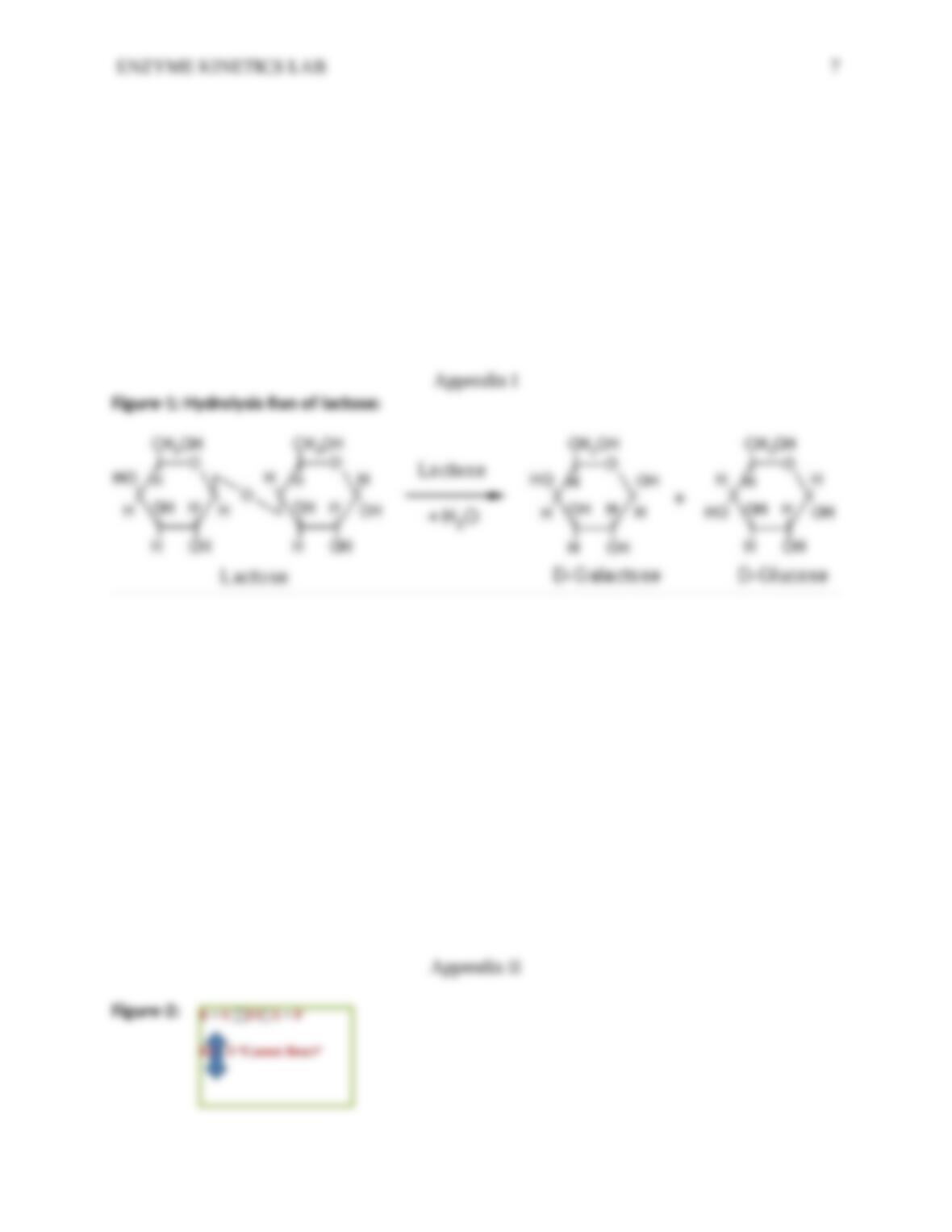
process, more specifically the [E]. Lactose molecules go through a process of hydrolysis (See
Appendix-I); a chemical process in which a certain molecule is split into two parts by the
addition of a molecule of water. One fragment of the parent molecule gains a hydrogen ion (H+)
from the additional water molecule. The other group collects the remaining hydroxyl group
(OH−), which is initiated by the [E]-lactase (Adler-Nissen, J. 1986). The unbalanced [S]: [E]
initiates an improper hyrdrolization of the lactose molecules, delivering them to the large
intestine where they ferment, produce CO₂ gas, induce bloating and diarrhea in the lactose
intolerant individual(s). While dairy products contain key nutrients i.e. (calcium, vitamin D, etc.)
synthetic versions of lactase have been streamlined, for example, Lactaid® or lactase in the form
of a pill to provide the missing concentrations of [E].
Enzymes are biological catalysts that speed up otherwise slow reactions. Lactase [E]
catalyzes the hydrolysis of lactose [S] to glucose and galactose, as seen in (figure-1) note: Two
platforms will be initiated: (A Platform) – The initial lactose concentration, lactase enzyme with
phosphate buffer experiment, followed by determining the enzyme kinetics via “glucometer” and
linear regression model graph and a lineweaver-Burke Plot (B Platform) – An additional lactose
and lactase set up, mirroring platform (A), furthermore, determining the enzyme kinetics with the
addition of an inhibitor. There are three types of enzyme inhibitors (1) competitive; works by
binding to free enzyme or [E], to form EI, or Enzyme Inhibitor Complex and that will block the
enzyme and make it unable to react with the substrate to form product. Note: In this case the
inhibitor competes with the substrate for space on the enzyme. (2) Uncompetitive; works by
binding to the enzyme-substrate complex to form ESI, which prevents the enzyme from turning
substrate into product. (3) Non-Competitive; “Mixed”- can act as both a competitive or
uncompetitive inhibitor, so it can either bond to free enzyme to from EI or it can bind to the ES
complex to form ESI, neither of which can react to form product. (See Appendix-II)

ENZYME KINETICS LAB 3
The purpose of this experiment is to gain a thorough understanding of each tier (1) –
how does the enzyme (lactase) act as catalysts to speed up the reaction rate in lactose?, (2) –
What is the Vmax and the Km from a linear regression model graph a=er demonstrating the
concentration of glucose through the usage of a “glucometer” and selected enzyme (lactase)?,
(3) – What is the rate of rxn of the lactose a=er the inhibitor(s) have been introduced?, and (4)
Identify the which form of inhibition is taking place: competitive, non-competitive, or
uncompetitive? These calculations will be deciphered by the Michaelis-Menten mechanism
denoted in (Appendix-3).
Materials and Methods [Part I: Serial Dilution/Lactose Concentrations: (Pla”orm A) ]
Initial preparation. First, prepare [E] lactase; measured as (225 units/mL) given a pill of
lactase, measuring (9000 units in 40 mL of 50mM) phosphate buer. Secondly, prepare a 1M
Lactose [S] “solution,” in distilled water (note: a 1 molar solution is 1 mole of lactose in 1 liter of
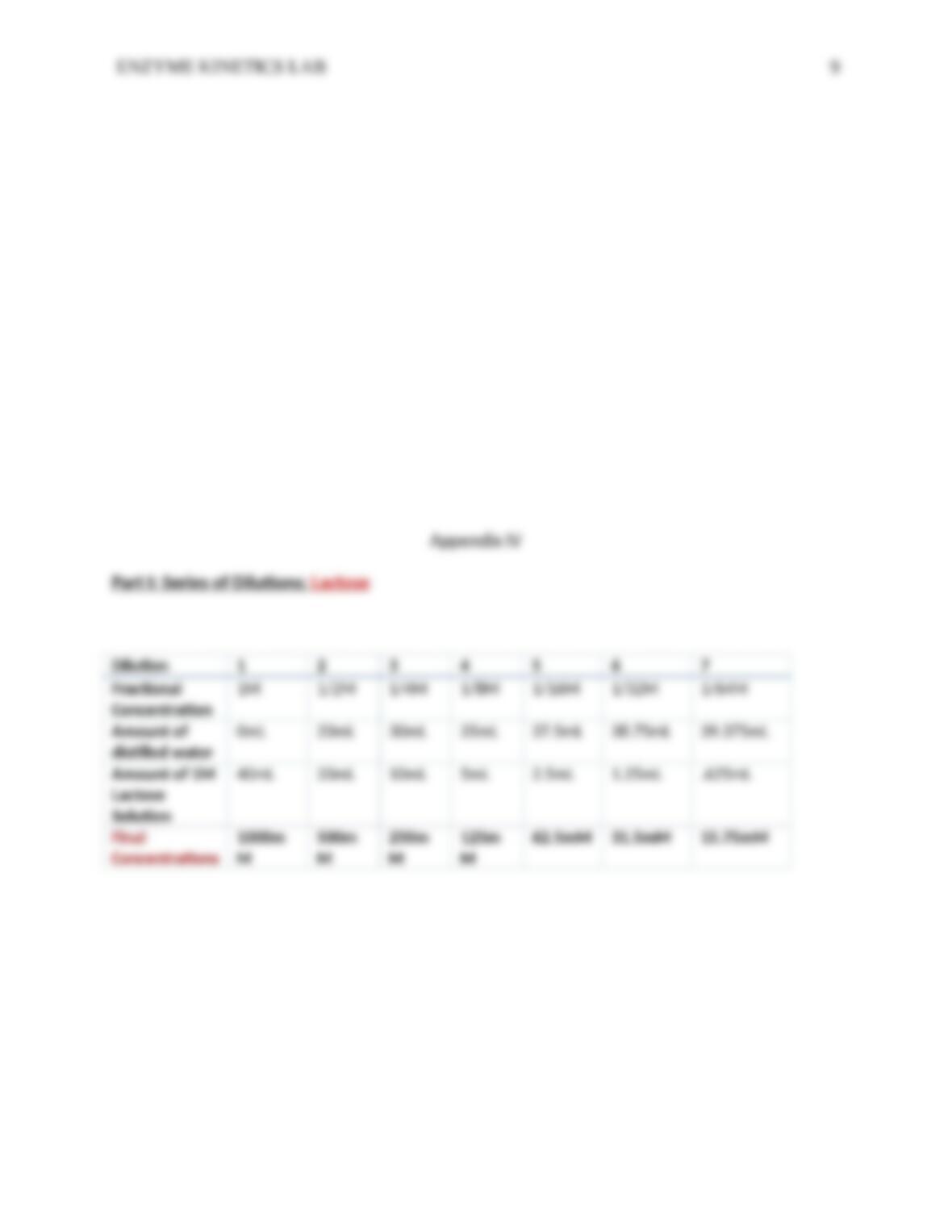
water). Step three; create a series of dilutions arranged and denoted in (Appendix-4). Label