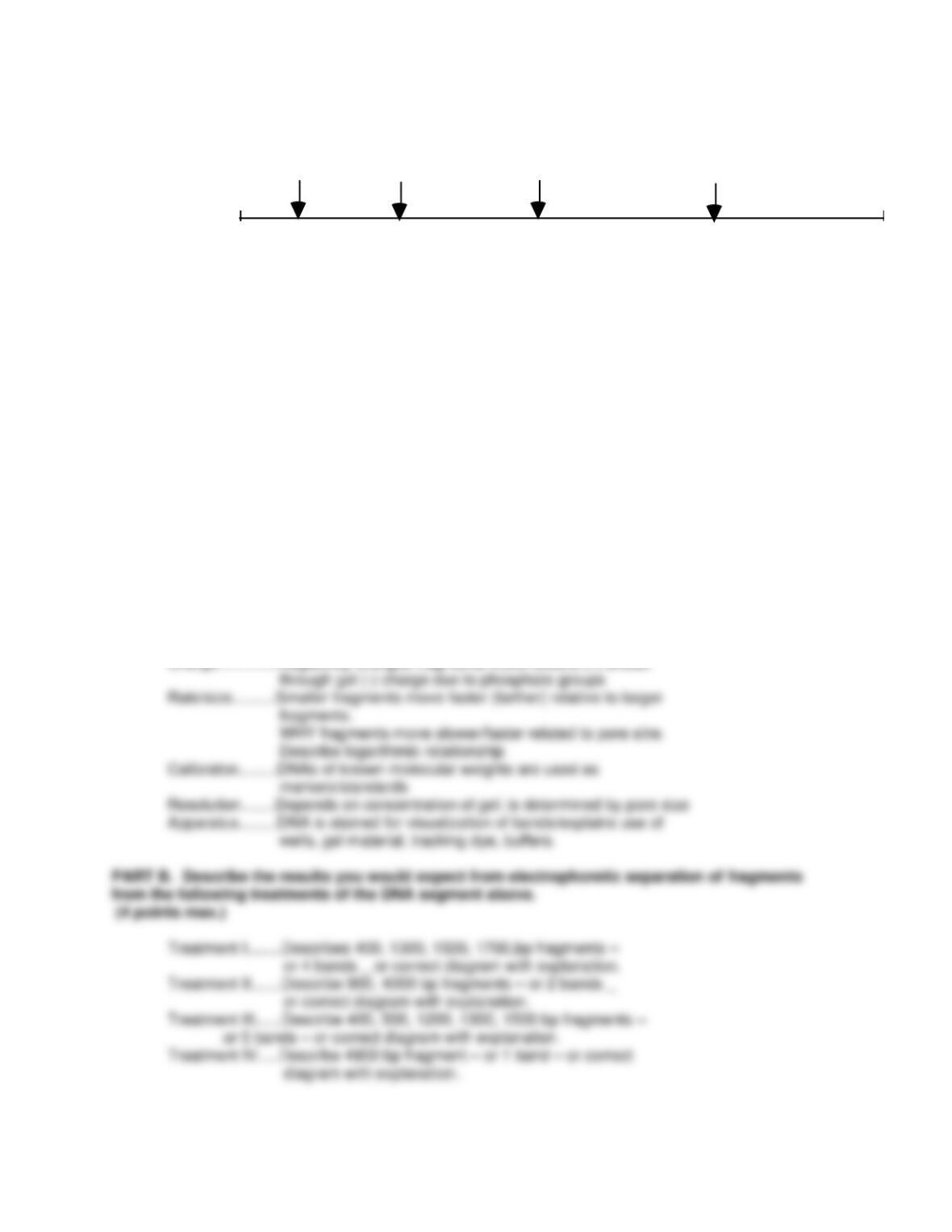
The diagram below shows a segment of DNA with a total length of 4,900 base pairs. The arrows indicate
reaction sites for two restriction enzymes (enzyme X and enzyme Y).
(A) Explain how the principles of gel electrophoresis allow for the separation of DNA fragments.
(B) Describe the results you would expect from electrophoretic separation of fragments from the
following treatments of the DNA segment above. Assume that the digestion occurred under appropriate
conditions and went to completion.
I. DNA digested with only enzyme X
II. DNA digested with only enzyme Y
III. DNA digested with enzyme X and enzyme Y combined
IV. Undigested DNA
(C) Explain both of the following:
(1). The mechanism of action of restriction enzymes
(2). The different results you would expect if a mutation occurred at the recognition site for
enzyme Y.
KEY:
PART A. Explain how the principles of gel electrophoresis allow for the separation of DNA
fragments. (4 points max.)
Electricity……….Electrical potential (charge, field) moves fragments
DNA Segment
Length (base pairs) 400 500 1,200 1,300 1,500
X X X
Enzyme Enzyme Enzyme Enzyme
Y