EDUCATION SYSTEMS OF THE PHILIPPINES AND JAPAN: A
COMPARATIVE STUDY
Lance Christian B. San Pedro
Kurt Aldrich B. Abarro
Christopher Gabriel M. Liao

Introduction
The Japanese education system was regarded as the longest, at 243, while the Philippines, has
200 days under the Basic Education Curriculum. The education systems of Japan and the
Philippines are different in terms of various aspects of education.
According to Johnson (1996), Japanese students spend 240 days on school, more than the 180
days of American students, at 60. Pawilen and Sumida (2005) noted that the goal of the science
curriculum of Philippines and Japan share the same concern in developing skills; however they
are different in terms of focus and emphasis. However, the aforementioned articles have not yet
brought their studies of comparing education systems in a broad manner. This includes the
academic subjects and the social, mental, and political issues in the respective curriculum.
This paper aims to do the following: compare the various aspects: school year length, school
grades, and the like of the Japanese and the Philippine education systems, and to scan for various
aspects of Japanese education system that the Philippines can learn from, and vice versa. The
elementary level (小学校 shōgakkō) until the middle school level (中学校 chūgakkō) for Japan
and the elementary to high school level for the Philippines are used as case studies for this
research.
Methodology
The aim of this research is to compare the Philippines and Japan’s education systems in a wider
extent: school grades, curriculum framework, and socio-economic issues, as well as scan for
positive aspects of Japanese education that the Philippines can learn from, and vice versa.
First, a brief history of Philippine and Japanese education was discussed. Next, the aspects of
education: primary language, academic subjects, school year length, and school grades, based on
factual details, were listed, explained, and discussed according to comparison. Third, the socio-
economic and mental issues of students under the two education systems were discussed as well.
Finally, positive aspects of the Japanese education system in which the Philippines can learn
from its present system were listed and discussed, and vice versa.
Qualitative (descriptive) and quantitative (statistical) data were used for this research.
Results and Discussion
To begin this part of the research paper, a brief history of the education of Philippines and Japan
are to be presented; then a definition of curriculum is stated, as well as stating a purpose for
creating a curriculum, followed by a discussion of ideologies of education of the two countries.
Next, a table of elementary and high school curricula of the basic education of Philippines and
Japan are to be presented, followed by explanations and discussions. Then, a comparison of the
framework of education is enumerated and discussed. Finally, various issues of the two systems:
academic, social, and the like, are to be explained and discussed, as well as comparisons in–
between.
History – Japan
During the feudal period, many private educational institutions already existed. These included
the terakoya (寺子屋), private temple schools, and special schools specialized for the samurai
class established by the daimyo (Encyclopedia Britannica, 1992). This implies that public
education in Japan never existed until the Meiji Restoration.
The Meiji Restoration brought Western ideals to Japanese education, as Encyclopedia Britannica
(1978) states that many of the points of the Japanese educational system were derived from the
European continental systems, notably the German system.
History – Philippines
Education in the Philippines was unstructured, informal, and devoid of methods before the
Spaniards arrived, instead making further emphasis on vocational education and less in academic
performance.
The colonization of the Spaniards brought a change to the unstructured education system, with a
transition from vocation-oriented education to religion-oriented education. However, education
was not for everyone, but rather for the elites; it was lifted when public education was introduced
by the Educational Decree of 1863.
Following the defeat of the Spaniards by the Americans, the education system was modified
under the Schurman Commission, and used English as the medium of instruction. In World War
II, emphasis on love for work was made by the Japanese occupants in the Philippines (Historical
Perspective of the Philippine Educational System, n.d.). This implies that the education of the
Philippines changed from time to time as colonizers changed, as well as changes in emphasis of
education.
The ideology of education
Education is a necessity of building a person’s character through developing one’s personality
uniquely, improving ability, independency, and pursuing a happy life; at the same time, it also
embarks on a mission to nurture the citizens who form the country and the society (MEXT, n.d.).
The Japanese treat education as very important, which is the reason why the country has the
highest literacy rates in the world (Grolier, 1990). In the case of Philippines, Filipinos have a
deep point of view of education, in which it is treated as the main street of further social and
economic mobility. This was materialized from the Americans due to their colonial rule, where
the ideal of democratic society in which individuals could get ahead through good educational
attainment (Country Studies, n.d.).
It can be inferred that Japan and the Philippines share the same point of view, in which education
is the road to further mobility of a country.
The core for the existence of society is education, and it is not an exaggeration to say that
Japan’s future depends on education itself, as the Ministry of Education of Japan says (n.d.). This
ideology of education is not for Japan alone, as it is also the core for Philippines and the other
countries.
Education has been looked into as the means of alleviating poverty, reducing crime, increasing
economic benefits, and ultimately upping the standard of living of the Filipino masses (Durban
& Catalan, 2012). This is somehow the same in the American ideal adopted by the Filipinos.
There are numerous definitions of curriculum, which can be confusing. In the wider route, the
term is used to refer all of the courses offered in a single school (WiseGeek, n.d.). The following
section lists down the curricula framework of Philippines and Japan.
Curriculum – Japan
What is the aim of organizing a curriculum? To attain the educational goals of local schools is
the target (Komatsu, 2002). This is not just the case of Japan’s schools only, but also for
Philippine schools.
The ministry of education, whose director is a member of the Prime Minister’s cabinet,
establishes the curricula of elementary, middle, and high schools (Ike, 1999)1. Table 1 shows the
elementary school curriculum of Japan, as stated by the Board of Education of Tokyo’s Shinjuku
Ward2.
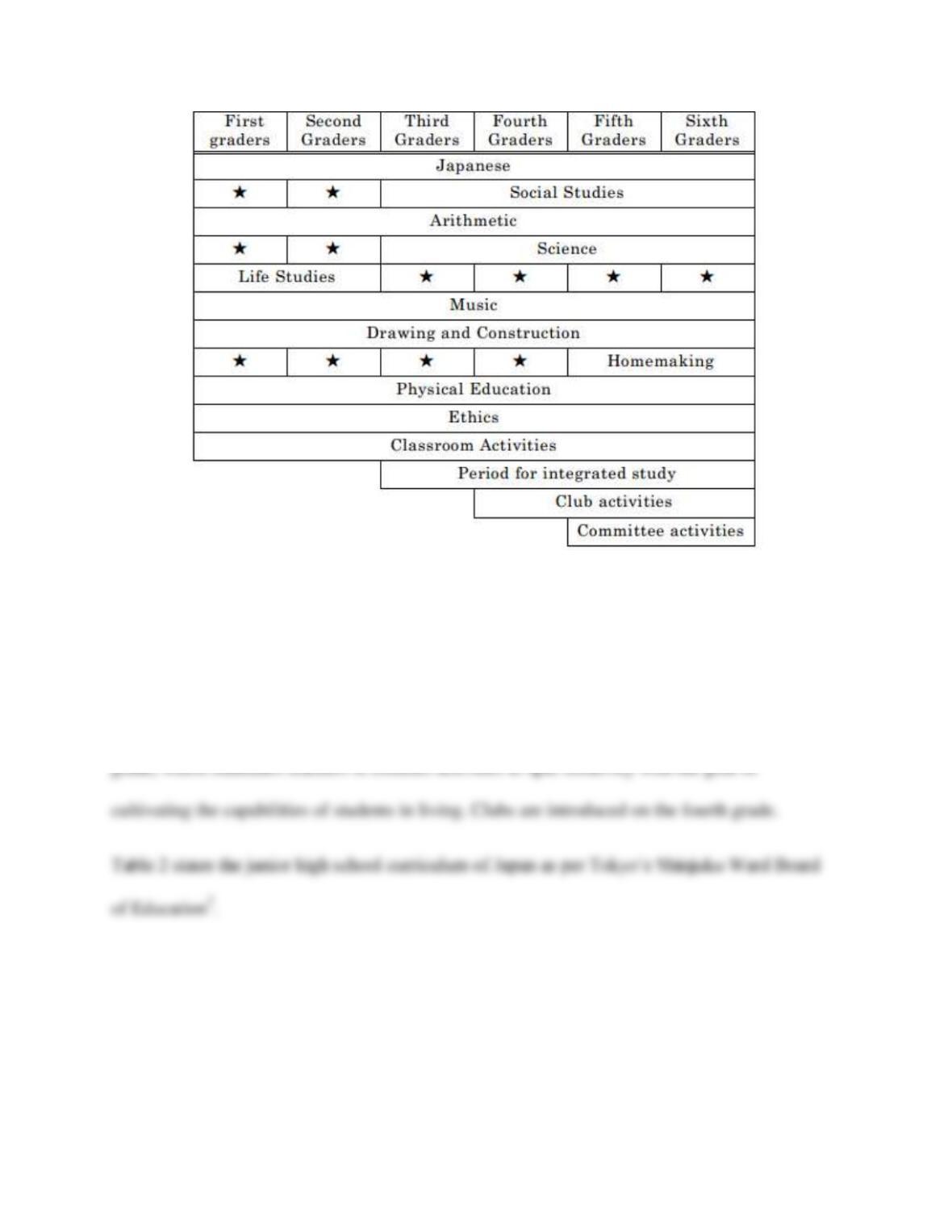
Table 1. Elementary school curriculum of Japan.
Social studies begins in the third grade. Life studies is from grades 1 and 2, and changed into
Science from grade 3 onwards. Home economics classes begin on the fifth grade, and is
integrated into technology classes on middle school. Integrated studies (IS) begins on the third