List of Contents
1. Country Analysis (Brunei)………………………………………………………………………… 2
2. Country Analysis (Ecuador)………………………………………………………………….…. 3
Brunei
3. Trade Policies………………………………………………………………………………..…..4-6
4. Analysis from GDP and TOT Graph………………………………………………………………7-11
5. Import-Substitution Industrialization (ISI) ………………………………………………………12-13
6. Export-Oriented Industrialization (EOI) …………………………………………………………14
Ecuador
7. Trade Policies………………………………………………………………………………….. 15
8. Analysis from GDP and TOT Graph………………………………………………………………16
9. Import-Substitution Industrialization (ISI) ………………………………………………………17
10. Export-Oriented Industrialization (EOI)…………………………………………………..……. 18-20
11. Comparing Brunei and Ecuador’s TOT and GDP…..………………………………………….. 21
12. Conclusion and Recommendation………………………………………………………….…. 22
13. References……………………………………………………………………………….………23-26
1

Trade Policies of Brunei
●ASEAN – 7 January 1984
Brunei joins to accelerate the economic growth, social progress and cultural development in the
region through joint endeavors in the spirit of equality and partnership in order to strengthen the
foundation for a prosperous and peaceful community of Southeast Asian nations, and to promote
regional peace and stability through abiding respect for justice and the rule of law in the
relationship among countries in the ASEAN. The second, third and fourth biggest imports of
Brunei is Malaysia, Thailand, and Indonesia subsequently. Brunei imposes tax returns of
domestic and foreign investors below the average ASEAN rate.
●Asia-Pacific Economic Cooperation (APEC) – 1989
APEC works have widened to include other areas such as climate change, food security as well
as anti-terrorism. Brunei chaired the APEC meeting in the year 2000 with its theme ‘Delivering
to the Community’. At this APEC meeting, leaders agreed to adopt the Brunei Goals to triple
internet access by 2005 and to ensure all groups within an economy to have access to the internet
by 2010.
●ASEAN Free Trade Area (AFTA)
Agreed at the 1992 ASEAN Summit in Singapore. The main objectives of the AFTA are to
create a single market and an international production base; attract foreign direct investments;
and expand intra-ASEAN trade and investments.
● East ASEAN Growth Area (BIMPT-EAGA – 24 March 1994
BIMP-EAGA cooperation aims to increase trade, tourism, and investments by:
●Facilitating the free movement of people, goods, and services;
●Making the best use of common infrastructure and natural resources; and
●Taking the fullest advantage of economic complementation.
4

Ecuador
●Population – 16.62 million (2017)
●GDP – 103.1 billion USD (2017)
●GDP Per Capita – 6,198.95 USD (2017)
●Top Exports(2017)
– Crude Petroleum($5.63B)
– Bananas ($3.38B)
– Crustaceans ($3.06B),
– Processed Fish ($1.18B)
– Cut Flowers ($846M)
●Top Imports(2017)
– Refined Petroleum ($1.7B)
– Coal Tar Oil ($1.1B)
– Cars($921M)
– Packaged Medicaments ($653M)
– Broadcasting Equipment ($390M).
Taken from OEC,2017
3

Trade Policies of Brunei
●ASEAN – 7 January 1984
Brunei joins to quicken the monetary development, social advancement and social improvement
in the locale through joint undertakings in the soul of uniformity and association so as to
reinforce the establishment for a prosperous and tranquil network of Southeast Asian countries,
and to advance provincial harmony and steadiness through tolerating regard for equity and the
standard of law in the relationship among nations in the ASEAN. The second, third and fourth
greatest imports of Brunei is Malaysia, Thailand, and Indonesia in this manner. Brunei forces
assessment forms of local and remote speculators underneath the normal ASEAN rate.
●Asia-Pacific Economic Cooperation (APEC) – 1989
APEC works have augmented to incorporate different territories, for example, environmental
change, nourishment security just as hostile to psychological warfare. Brunei led the APEC
meeting in the year 2000 with its topic ‘Conveying to the Community’. At this APEC meeting,
pioneers consented to embrace the Brunei Goals to significantly increase web access by 2005
and to guarantee all gatherings inside an economy to approach the web by 2010.
●ASEAN Free Trade Area (AFTA)
Agreed at the 1992 ASEAN Summit in Singapore. The main objectives of the AFTA are to
create a single market and an international production base; attract foreign direct investments;
and expand intra-ASEAN trade and investments.
● East ASEAN Growth Area (BIMPT-EAGA – 24 March 1994
BIMP-EAGA cooperation aims to increase trade, tourism, and investments by:
●Facilitating the free movement of people, goods, and services;
●Making the best use of common infrastructure and natural resources; and
●Taking the fullest advantage of economic complementation.
4

●Multilateral Agreement on the Liberalization of International Air Transportation
(MALIAT) -1 May 2001
●Trans-Pacific Strategic Economic Partnership Agreement – 2005
Brunei stored its Instrument of Provisional Application to New Zealand as the vault of the
Agreement on 12 June 2006. The Agreement came into power for Brunei on 12 July 2006 and
will realize vital advantages for each of the four accomplices, Brunei, Chile, New Zealand, and
Singapore, and in actuality construct a scaffold between Latin America, the Pacific, and Asia. It
will support Brunei, Chile, Singapore, and New Zealand to pool their ability, thoughts,
innovation, and assets to improve their aggressiveness on the worldwide market. The Agreement
will likewise help advance shared targets in APEC and the WTO. The P4 additionally has side
understandings, in particular the Environment Cooperation Agreement and Labor Cooperation
Memorandum of Understanding, to mirror a mutual want to energize and advance sound work
and condition rehearses. These understandings set up components for on-going participation and
exchange on work and condition issues.
●Brunei – Japan Economic Partnership Agreement (BJEPA) – 2007
The Agreement is would have gotten a kick out of the chance to overhaul Brunei Darussalam’s
hypothesis climate and enable Foreign Direct Investment (FDI) through progressively
unmistakable consistency and straightforwardness. Market access between Brunei Darussalam
and Japan will in like manner be improved similar to merchandise (through the decline of import
obligations) and administrations. This Foreign Trade Agreement is relied upon to guarantee a
steady supply of flammable gas and other vitality for Japan. Japanese duties on horticultural and
fishery items from Brunei, including asparagus, mangoes, durian, and shrimp, likewise will
arrive at a prompt end. Brunei got the opportunity to dispose of the present 20 percent tax on
vehicles and practically all car parts from Japan inside three years.
5

●Trans-Pacific Partnership -2016
The 11 countries signing on to the new CPTPP pact are Australia, Brunei, Canada, Chile, Japan,
Malaysia, Mexico, New Zealand, Peru, Singapore, and Vietnam. Canadian investment into
Brunei’s aviation and pharmaceuticals sectors, the CPTPP would facilitate FDI into new sectors
such as ICT, clean technology and food processing. This is a key selling point for Brunei — still
trying to diversify its economy away from oil and gas — which has recorded negative growth for
the past three years. The Peterson Institute for International Economics forecasted that by 2030
Brunei’s GDP will grow by over two percent under the CPTPP, compared to six percent growth
under the initial TPP agreement(Bandial,2018).
●ASEAN-Australia-NZ FTA – AANZFTA
Regional free trade agreements with New Zealand. Strong defense relationship based around
training. Joint military training exercises and New Zealand provides training assistance under the
Mutual Assistance Programme (MAP), which also gives troops opportunities to train in Brunei’s
jungle. New Zealand work with Brunei on regional issues through the Association of Southeast
Asian Nations (ASEAN) and in the East Asia Summit (EAS) and APEC.
Tariff Elimination
Powerful on 1 January 2010, Brunei with five other ASEAN Member States (which are
Malaysia, Indonesia, the Philippines, Singapore, and Thailand) is a finished unhindered
commerce region. These nations have disposed of import obligations on 99 percent of items in
the Inclusion List (aside from the items recorded in the Sensitive and Highly Sensitive Lists).
The ASEAN-6 has 99.20 percent of tax lines in the Inclusion List at 0% import obligation. This
implies just 0.35 percent of the levy lines in the Inclusion rundown have import obligations.
Subsequently, on the normal, ASEAN part states have 96.01 percent tax lines at 0% import
obligation as per the ATIGA Tariff Schedule of 2016.
6
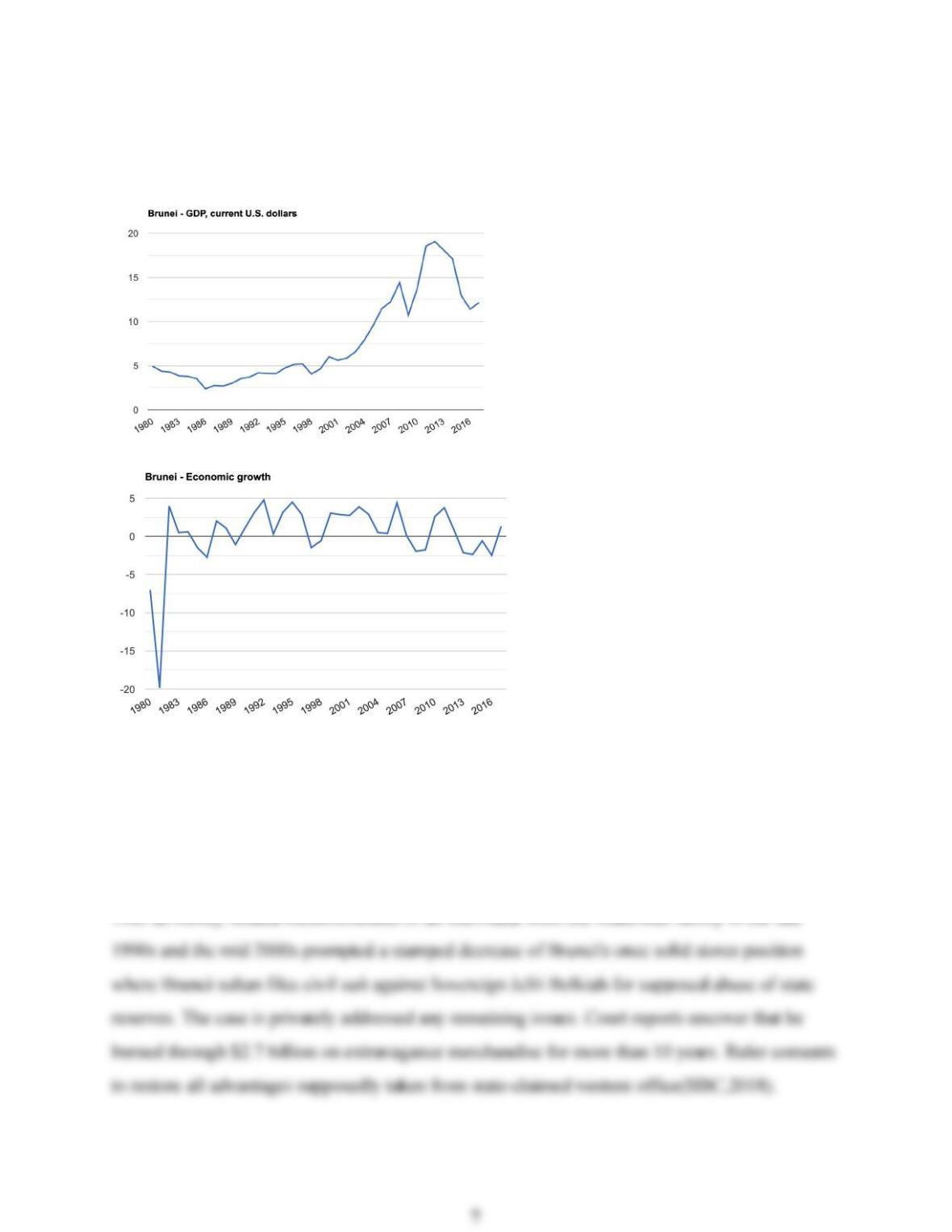
Analysis from GDP and TOT Graph (Brunei)
Percentage change in GDP Growth
Brunei’s Gross Domestic Product was accounted for at 12.885 USD in Dec 2017. This records an
expansion from the past number of 12.236 USD for Dec 2016. Brunei’s Gross Domestic Product
information is refreshed yearly, averaging 6.557 USD from Dec 1989 to 2017. The information
achieved a record-breaking high of 18.591 USD in 2012 because of outside interests in different
areas separated from oil and gas additionally raised oil costs and a record low of 2.985 USD in