Beszterda 1
Emilia Beszterda
Professor Celentano
International Business
3/20/2017
Economy of China – ReDo
Introduction
China’s socialist market economy is the world’s second largest economy by nominal
GDP, and the world’s largest economy by purchasing power parity. Until 2015 China was the
world’s fastest-growing major economy, with growth rates averaging 10% over 30 years. Due to
historical and political facts of China’s developing economy, China’s public sector accounts for a
bigger share of the national economy than the burgeoning private sector.
China is a global hub for manufacturing, and is the largest manufacturing economy in the
world as well as the largest exporter of goods in the world. China is also the world’s fastest
growing consumer market and second largest importer of goods in the world. In addition, with
being a net importer of services products. Being one of the largest trading nations in the world,
playing the most important role in international trade, and increasingly engaging in trade
organizations and treaties in recent years, China has become a member of the World Trade
Organization in 2001.
Current Status of Chinese Economy
Economic growth soared in the last few decades mainly due to the country’s increasing
integration into the global economy and the government’s bold support for economic activity.
However, the successful economic model that lifted hundreds of millions out of poverty and
fueled the country’s astonishing economic and social development has also brought many
Beszterda 2
challenges. Severe economic imbalances, mounting environmental issues, rising economic
inequality and an aging population are the key questions that the new administration lead by
President Xi Jinping will have to tackle in the near future in order to ensure the country’s
sustainability.
Overall, China has been through a long period of economic downturn even before 1978,
and has recently become one of the world’s major economic powers, following the
implementation of economic reform from 1979. China shows a great development potential from
its remarkable economic growth rate in the last couple of years.
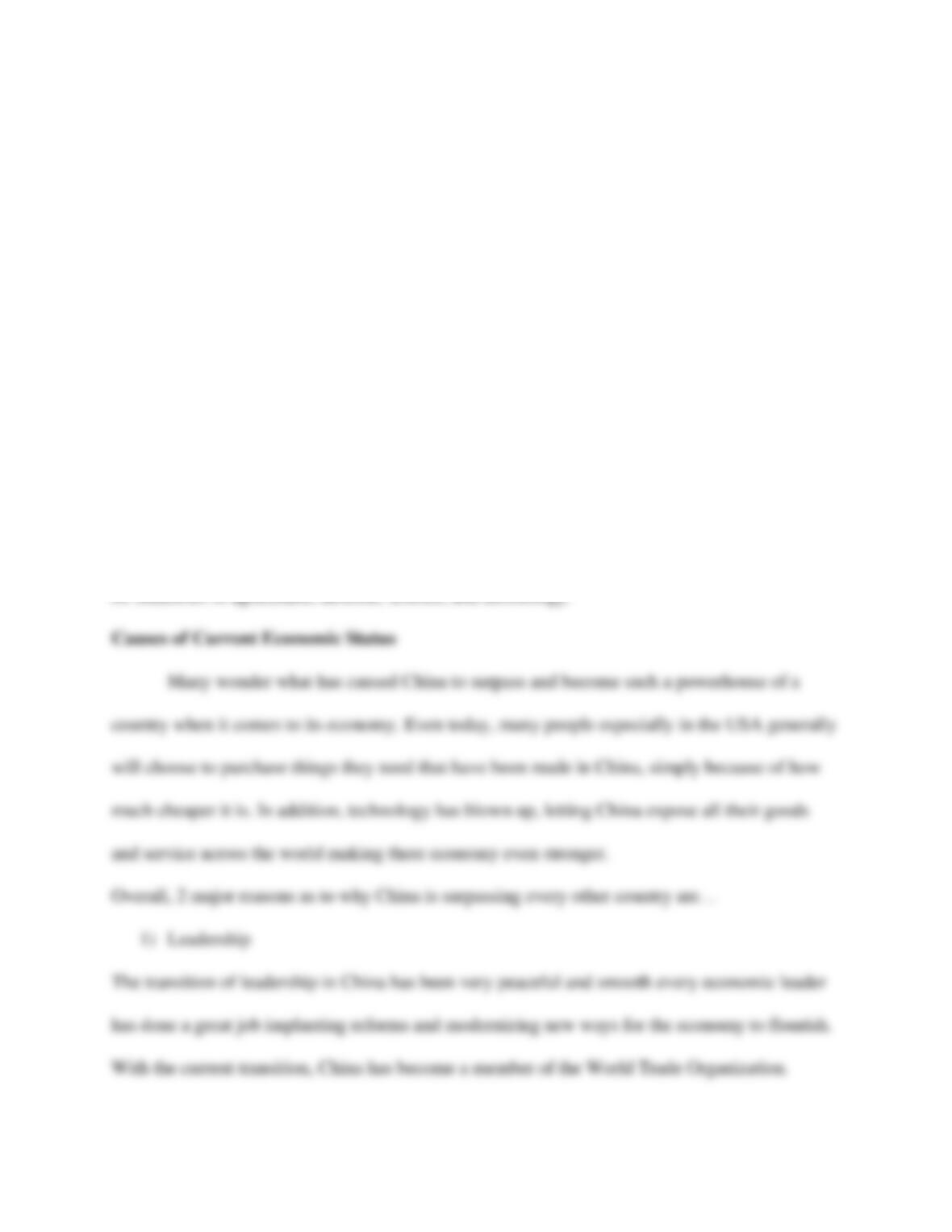
See (Figure 1) for an overview of China’s economy from 2012-2015, gives a brief
summary of where the Chinese economy is currently.
Figure 1
(Explanation below)
Beszterda 3
These numbers are the way they are at due the “five-year-plan” strategy in order to
achieve continuous economic development. The Thirteenth Five-Year Plan (2016–2020) is
currently being implemented.
For nearly 30 years China has indeed been growing, thrusting its citizens into prosperity
and its goods across the world. Between 1978 and 2005, China’s per capita GDP had grown from
$153 to $1284, while its current account surplus had increased over twelve-fold between 1982
and 2004, from $5.7 billion to $71 billion. During this time, China had also become an industrial
powerhouse, moving beyond initial successes in low-wage sectors like clothing and footwear to
the increasingly sophisticated production of computers, pharmaceuticals, and automobiles.
Overall these numbers above in Figure 1 shows what makes China the powerhouse it is.
The Chinese GDP went from ninth to second in the world standings. The reform focused mainly