McGraw-Hill/Irwin Copyright © 2013 by The McGraw-Hill Companies, Inc. All rights reserved.
Cost Allocation: Departments, Joint
Products, and By-Products
Chapter Seven

7-4
The Strategic Role of
Cost Allocation
!Determine accurate departmental and product costs as a basis
for evaluating the cost efficiency of departments and the
profitability of different products
“Motivate managers to exert a high level of effort to achieve the
goals of top management
#Provide the right incentive for managers to make decisions that
are consistent with the goals of top management
$Fairly determine the rewards earned by managers for their effort
and skill and for the effectiveness of their decision–making

7-5
Cost Allocation Bases
–The most objective basis for cost allocation exists
when a cause–and–effect relationship can be
determined, such as the relationship between
machine breakdowns and maintenance costs
–Other alternatives exist in the absence of cause–
and-effect relationships, such as ability-to–bear
and benefit received

7-6
Ethical Issues in Cost
Allocation
•An ethical issue arises when costs are allocated to
products or services that are produced for both a
competitive market and a public or governmental
entity
–The latter often purchases on a cost–plus basis creating an
incentive to shift costs from the competitive products to
cost–plus–based products and contracts
•An equity or fair–share issue arises when a
governmental unit reimburses the costs of a private
institution or when it provides a service to the public
for a fee–no single measure of equity exists

7-7
Ethical Issues in
Cost Allocation (continued)
•A third ethical issue is the effect 0f the chosen
allocation method on the costs of the products sold
to or from foreign subsidiaries
–By increasing the costs of products purchased in high–tax
countries or in countries where the firm does not have
favorable tax treatment, the firm can reduce its overall tax
liability
–International tax authorities watch the cost–allocation
methods of multinational firms very closely for this reason

7-8
Overhead Allocations:
Three General Approaches
Three general approaches for allocating overhead
costs to products:
–The volume–based approach allocates overhead from a
single cost pool
–The departmental approach allocates overhead to
production departments, and then from production
departments to products
–The activity–based approach allocates overhead to
production activities, and then from production activities
to products
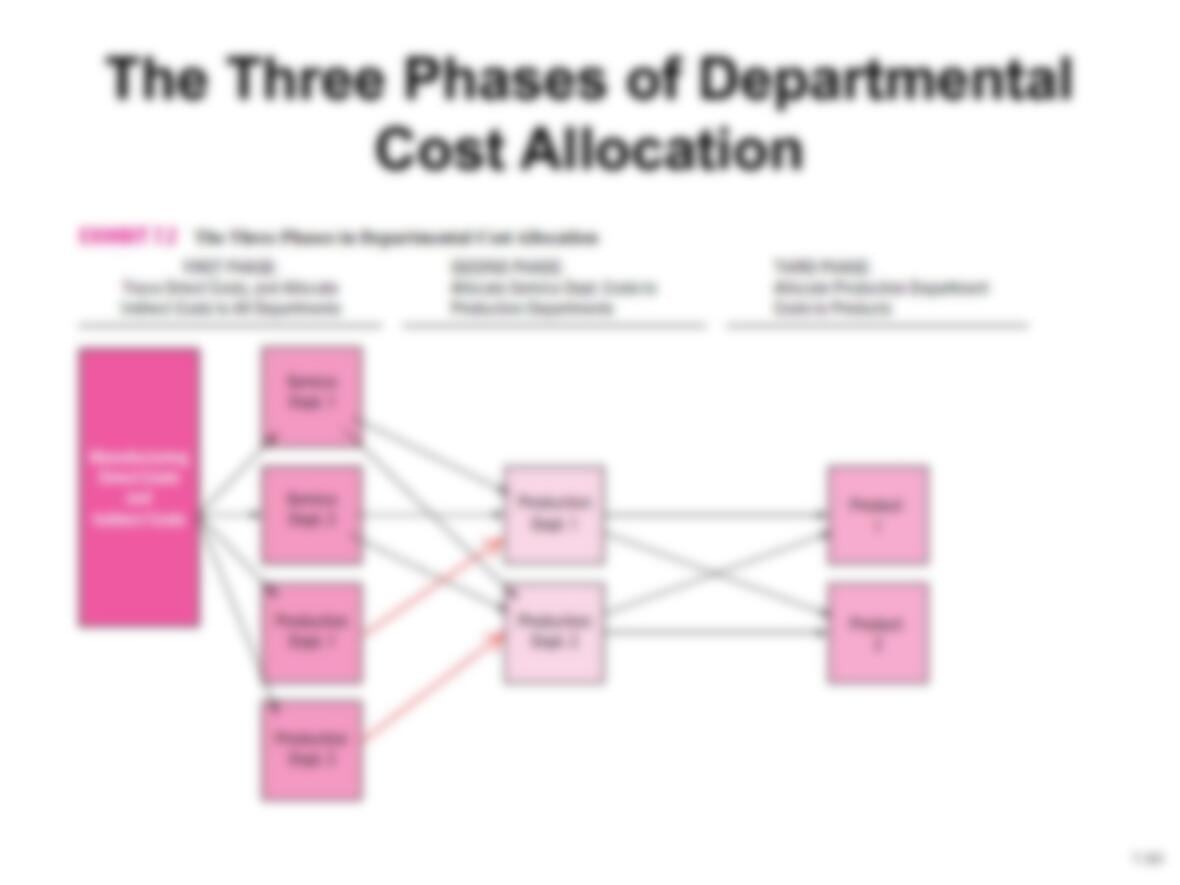
The Departmental Approach
The departmental approach classifies manufacturing
departments into production and service departments
This approach involves three phases:
!Trace all direct overhead costs and allocate common