Question: Explain the concept of deadweight loss, and how it is used in economic
analysis. Illustrate this concept by evaluating the impact on economic efficiency of
government intervention in the market.
Introduction
For many decades, a market is established when buying and selling occurs. Prices fluctuate
due to the supply and demand, however, as time goes by resources are being used up,
therefore, scarce resources are getting more expensive. Countries growing at different rates
may find it hard to adapt to the new pricing of the goods and services. Policies are
introduced to curb the overwhelming demand of the good or service. At equilibrium,
maximum economic efficiency is achieved. Economic efficiency refers to a market
outcome in which the marginal benefit to consumers of the last unit produced is equal to
its marginal cost of production, and in which the sum of consumer surplus and producer
surplus is at a maximum. (O’ Brien, 2011) .
In the rest of the work, the concept of deadweight loss and how it is used in economic
analysis will be addressed. Policies executed often are the intervention of government to
sooth the market. How will government intervention affects deadweight loss? This issue
will be addressed.
Dead Weight Loss
Dead Weight Loss is often referred to Harberger Triangle or a loss in economic efficiency
that can occur when equilibrium for a good or services is not Pareto optimal. Economy
efficiency is at the maximum when there is no government intervention. However, when
government intervention occurs such as introduction of price floor, price ceiling and
taxation to goods, deadweight loss occurs.
Price Floor
Price floor refers to the minimum pricing of the good a producer may receive. In 2010,
India introduced a price floor to wheat to protect growers at Rupee 1100 per quintal from
the initial Rupee 640 per quintal. The graph below shows the price floor of wheat in India.
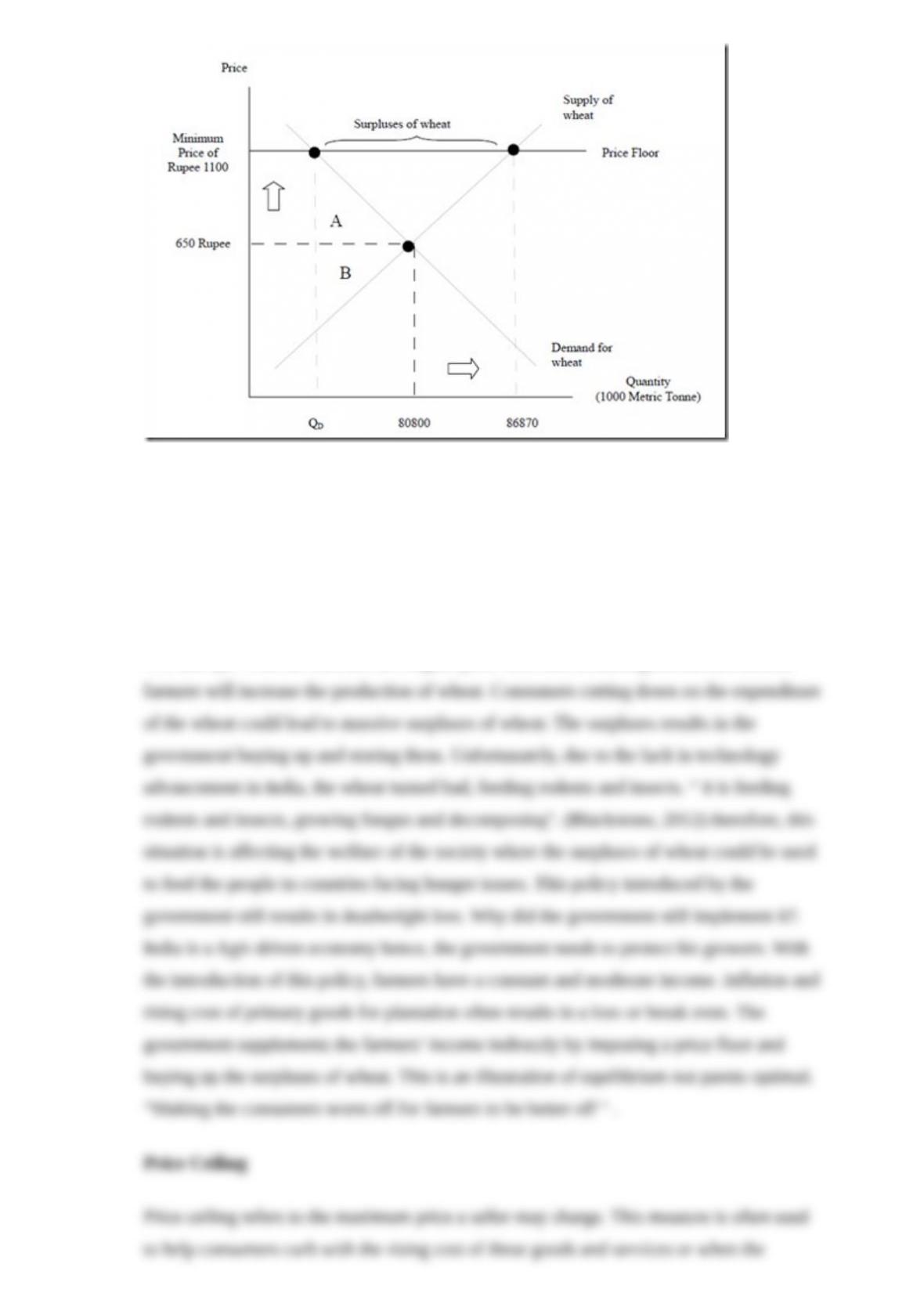
As a result of the price floor of wheat at rupee 1100, the demand of wheat decreases from
80,080,000 to Qd. The supply of wheat increased from 80,080,000 to 86,870,000 tonnes.
This creates a surplus of 6,070,000 tonnes of wheat hence, resulting in deadweight loss. A
and B triangle shows the deadweight loss arising from the surplus of wheat and decreased
in demand for wheat. The maximum efficiency of an economy is at equilibrium denoted
WE and QE. With the increase in a higher price floor and technological advancements,