3/19/21
1
Project Management
Class – 9
Project
Risk Management
1
Uncertainty & Risk Analysis
ØProjects are all about uncertainty:
§Time required to complete a project
§Availability and cost of key resources
§The whims of clients
§Actions taken by competitors
ØEffective project management requires an ability to deal with
uncertainty
ØCan uncertainty be eliminated?
2
3/19/21
2
Learning Outcomes
ØIdentify project risks
ØDetermine quantitative or qualitative value of project risks
and prioritize them
ØPropose plans to mitigate such risks
ØMonitor and control the risks
ØBudget uncertainty and project risk management
3
Project Risk Management
According to PMBOK® Guide:
ØProject risk: an uncertain event or condition that, if it occurs, has a
positive or negative effect on at least one project objective
ØRisk management: the processes of identifying, analyzing, monitoring
and responding to project risk in order to
§Maximize probability and consequences of positive events
§Minimize probability and consequences of adverse events
4
3/19/21
3
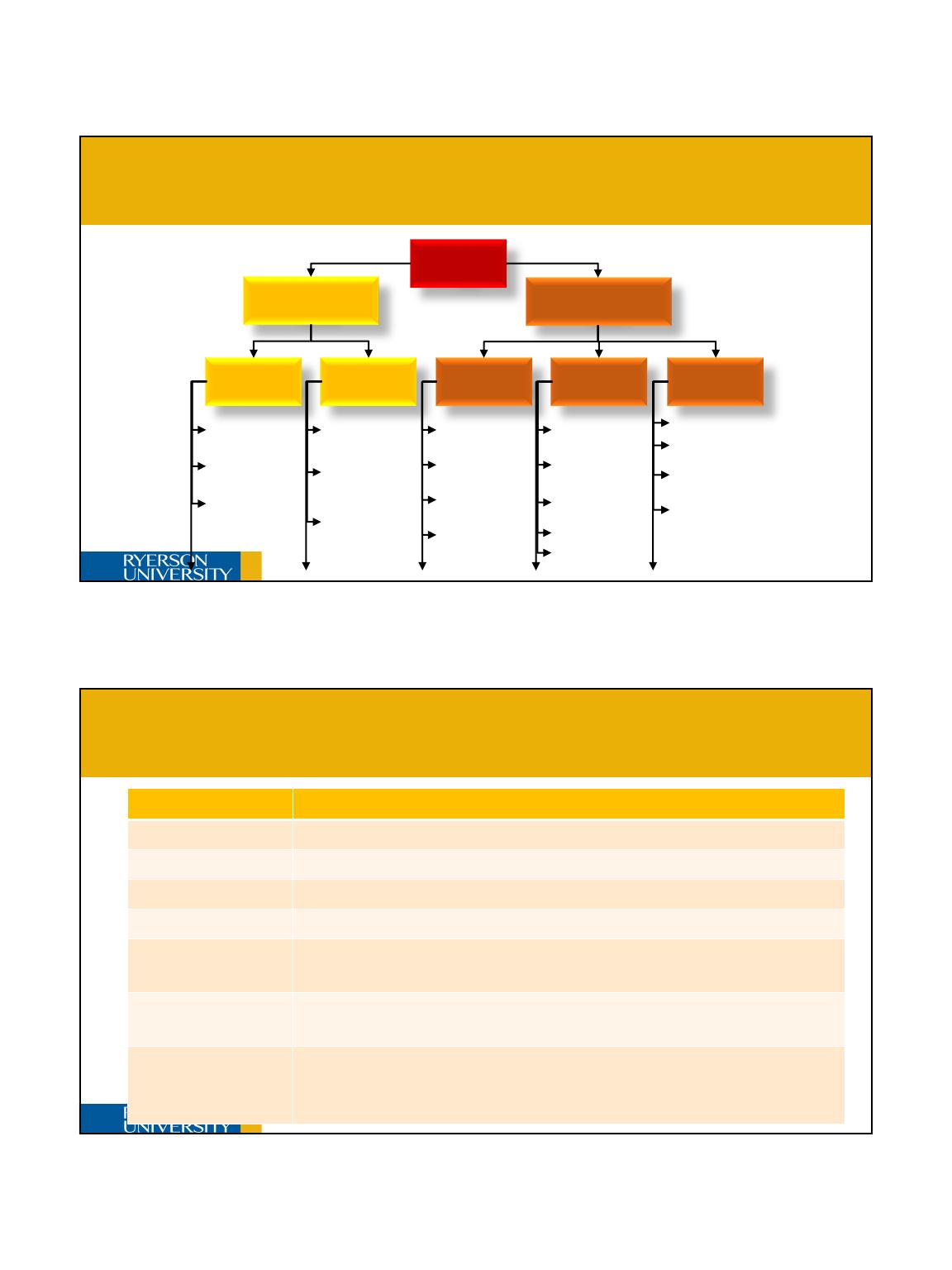
Risk Categories
Sources of
Risk
Outside the PM’s
Control
Within the PM’s
Control
Unpredictable Predictable Non–Tec hn ical Tec hnic al Legal
Government
Regulations
Natural
Hazards
Acts of
God
External Internal
Cost of
Money
Availability
of Raw
Materials
Quality
of Inputs
from Suppliers
Labor
Stoppages
HR
Availability
Health &
Safety
Cash
Flow
Technological
Change
Design
Problems
Technical
Operations
Planning
Maintenance
Licenses
Law Suits
Subcontractors’
Performance
Compliance
with Specs
5
Risk Categories Examples
Category
Example
Technical
Failure to meet customer performance requirements
Schedule
Vendor delay in delivery of critical equipment
Cost
Material cost escalate more than anticipated
Human resources
May not have people available when required to staff the project
External
Inclement weather
Changes in government regulations
Sponsor/customer
Delays in approval
Change
in customer preferences
Other
Ø
Encountering more than expected rock formations when
excavating
ØLabor strike may occur during the peak of a construction project
6

3/19/21
4
Risk Management Breakdown into Sub–processes
1. Risk identification: finding those risks that might affect the project
2. Qualitative risk analysis: evaluating the seriousness of the risk and the
likelihood it will affect the project
3. Quantitative risk analysis: developing measures for the probability of the
risk and its impact on the project
4. Risk response planning: finding ways of reducing negative impacts on the
project as well as enhancing positive impacts
5. Risk monitoring and control: maintaining records of and evaluating the sub-
processes above in order to improve risk management
7
Risk Identification
Scenario analysis
ØScenario analysis
§Well-known method for identifying risk
§Involves envisioning likely scenarios and resulting outcomes
§These types of risk can often be identified and evaluated by project
stakeholders with previous experience in similar projects
§The following data should be obtained:
üThe probability of each risk event occurring
üThe range of possible outcomes
üThe probability of each outcome
üThe expected timing of each outcome
8
3/19/21
5
Risk Identification
Failure Mode and Effect Analysis (FMEA)
ØIt’s a structured approach to help identify, prioritize, and better
manage risk.
ØFMEA can be applied to projects using the following six steps:
1. List ways project might fail
2. List consequences and evaluate its severity (S: severity)
3. List cause and likelihood (L: likelihood)
4. Estimate the ability to detect each failure (D: detectability)
5. Calculate the Risk Priority Number (RPN)
6. Sort the potential failures by their risk priority number
9
FMEA Example
ØThe following table shows the results of a FMEA conducted to assess the risk
of a new drug development project at pharmaceutical company.
Failure
S
(Severity)
L
(Likelihood)
D
(Detectability)
RPN
Not effective
8 6 5
240
Not safe
8 4 5
160
Drug interacts with other drugs
6 3 8
144
Beat to market
7 3 2 42
Can’t produce in mass quantities
6 4 4 96
10

3/19/21
6
FMEA Example (Cont.)
ØThe most significant risk is the risk of developing a new drug that is not
effective.
ØIt is unlikely that much can be done to reduce the severity of this outcome
ØSteps can be taken to reduce the likelihood of the outcome or increase its
detectability:
§Advanced computer technologies can be utilized to generate chemicals
with more predictable effects
§Earlier human clinical and animal trials can be used to help detect the
effectiveness of new drugs sooner
§If both L and D could each be reduced by one, the overall RPN would be
reduced from 240 to 160.
11
ØInterviewing is a fact–finding technique for collecting information in
face–to-face, phone, e-mail, or instant-messaging discussions
ØInterviewing people with similar project experience is an important
tool for identifying potential risks
§What are your company’s top risks, how severe is their impact and how likely
are they to occur?
§Who owns the top risks and is accountable for results, and to whom do they
report?
§What is the risk threshold in your projects?
§How effective is your company in managing its top risks?
Risk Identification
Interviewing
12
3/19/21
Risk Identification
Brainstorming
ØA process for teams to generate ideas and to find solutions on project issues
and problems.
ØIt can be accomplished either in a structured or in an unstructured way:
§Structured: When team members provide ideas in turn
§Unstructured: When team members provide ideas at random
ØWhat to do
1. Gather team members in a conference room
2. Make sure there is whiteboard, and colored markers
3. Involving all members of the team will create more input, and more input is
better
4. Team members need to spend time on idea generation before each
brainstorming session