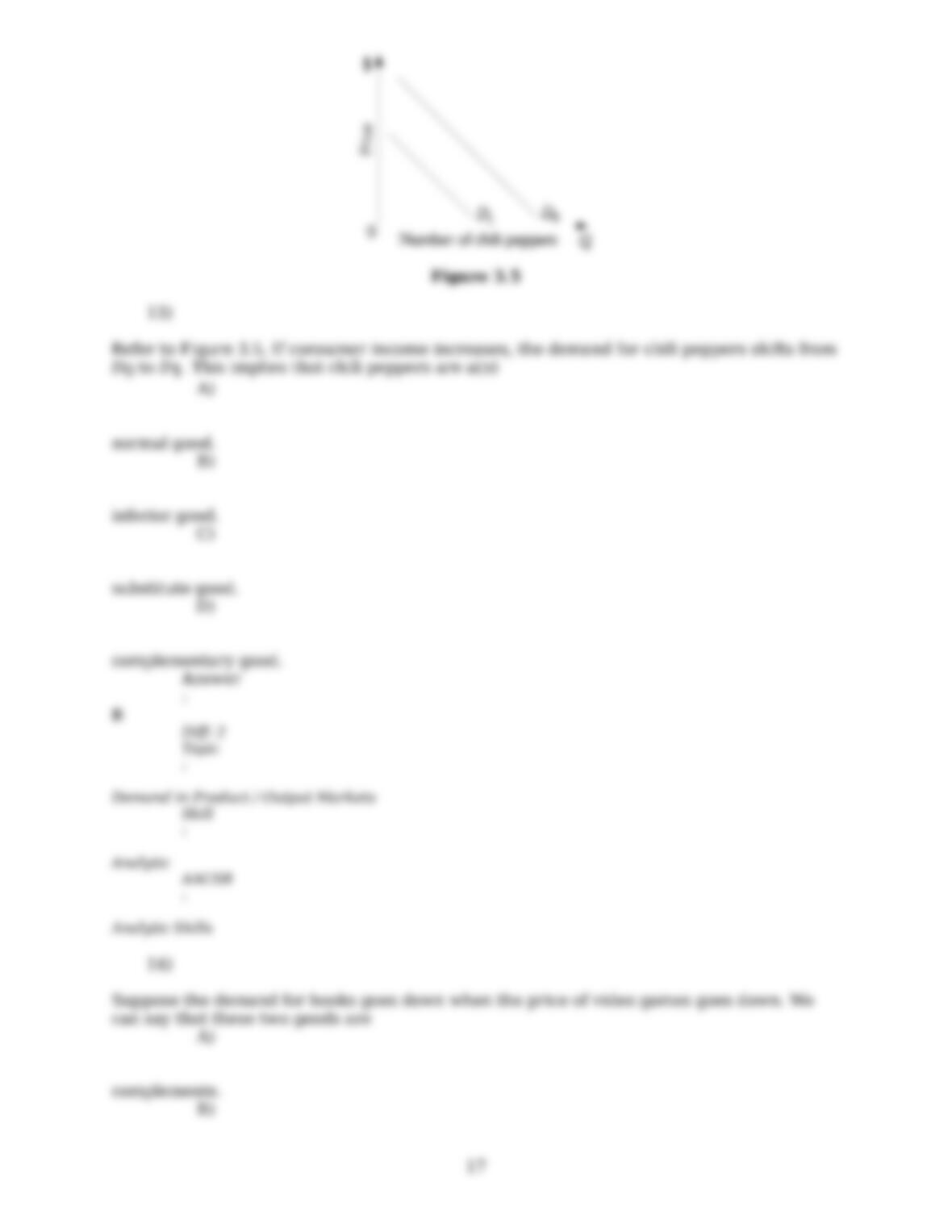
Principles of Macroeconomics, 9e – TB1 (Case/Fair/Oster)
Chapter
3
Demand, Supply, and Market Equilibrium
3.1
Firms and Households: The Basic Decision Making Units
1
Multiple Choice
1)
Michael Dell was the first individual who sold computers by mail order. The company
founded by Dell is now one of the largest and most successful computer companies in the
United States. Michael Dell would be classified as a(n)
A)
entrepreneur.
B)
opportunist.
C)
monopolist.
D)
socialist.
Answer
:
A
Di: 1
Topic
:
Firms and Households
Skill
:
Conceptual
2)
Firms are organizations that
A)
take advantage of the public.
B)
1
transform resources into products.
C)
transform outputs into inputs.
D)
consumer outputs.
Answer
:
B
Di: 1
Topic
:
Firms and Households
Skill
:
Definition
3)
An entrepreneur is a person who does all of the following EXCEPT
A)
assumes the risk of a firm.
B)
organizes and manages a firm.
C)
turns a new idea or product into a business.
D)
always makes a profit.
Answer
:
D
Di: 1
Topic
:
Firms and Households
Skill
:
Definition
4)
Why do firms engage in the activity of production?
A)
2
to help society advance technologically
B)
to participate in the circular 1ow
C)
to acquire profits
D)
to develop a supply schedule
Answer
:
C
Di: 1
Topic
:
Market Equilibrium
Skill
:
Conceptual
AACSB
:
reflective Thinking
3
2
True/False
1)
Economists would classify the Boston Symphony Orchestra as a firm.
Answer
:
TRUE
Di: 2
Topic
:
Firms and Households
Skill
:
Conceptual
AACSB
:
reflective Thinking
2)
Households are the consuming units of the economy.
Answer
:
TRUE
Di: 1
Topic
:
Firms and Households
Skill
:
Definition
3)
Entrepreneurs are unnecessary in a market economy and their profit is unearned.
Answer
:
FALSE
Di: 1
Topic
:
Firms and Households
Skill
:
Conceptual
3.2
4
Input Markets and Output Markets: The Circular Flow
1
Multiple Choice
1)
In input or factor markets
A)
consumers purchase products.
B)
firms supply goods.
C)
households supply resources
D)
households demand goods.
Answer
:
C
Di: 1
Topic
:
Input Markets and Output Markets
Skill
:
Conceptual
2)
A factor market is
A)
where goods are exchanged.
B)
where resources are exchanged.
C)
where goods are made.
D)
organized by government.
Answer
:
5
B
Di: 1
Topic
:
Input Markets and Output Markets
Skill
:
Definition
3)
In an output market
A)
consumers purchase products.
B)
firms purchase resources.
C)
households earn income.
D)
land, labor and capital may be exchanged.
Answer
:
A
Di: 2
Topic
:
Input Markets and Output Markets
Skill
:
Conceptual
4)
Among the factors of production are
A)
capital.
B)
wages.
C)
income.
D)
6
all of the above
Answer
:
A
Di: 2
Topic
:
Input Markets and Output Markets
Skill
:
Fact
2
True/False
1)
Factors of production are traded in the product market.
Answer
:
FALSE
Di: 1
Topic
:
Input Markets and Output Markets
Skill
:
Conceptual
2)
Households are paid income for the resources they supply in an input market.
Answer
:
TRUE
Di: 1
Topic
:
Input Markets and Output Markets
Skill
:
Conceptual
3)
Labor is demanded by firms in an output market.
Answer
:
FALSE
Di: 1
Topic :
7
Input Markets and Output Markets
Skill
:
Conceptual
3.3
Demand in Product / Output Markets
1
Multiple Choice
1)
Which of the following is held constant along the demand curve?
A)
price of the good
B)
quantity
C)
income
D)
both A and B
Answer
:
C
Di: 1
Topic
:
Demand in Product / Output Markets
Skill
:
Conceptual
AACSB
:
reflective Thinking
2)
Which of the following will NOT cause a shift in the demand curve for compact discs?
A)
a change in income
B)
8
a change in wealth
C)
a change in the price of downloadable online music
D)
a change in the price of compact discs
Answer
:
D
Di: 1
Topic
:
Demand in Product / Output Markets
Skill
:
Conceptual
AACSB
:
reflective Thinking
3)
The “law of demand” implies that
A)
as prices fall, demand increases.
B)
as prices rise, demand increases.
C)
as prices fall, quantity demanded increases.
D)
as prices rise, quantity demanded increases.
Answer
:
C
Di: 2
Topic
:
Demand in Product / Output Markets
Skill
:
Definition
4)
9
According to the law of demand, as prices rise, ceteris paribus
A)
demand increases.
B)
demand decreases.
C)
quantity demanded decreases.
D)
quantity demanded increases.
Answer
:
C
Di: 2
Topic
:
Demand in Product / Output Markets
Skill
:
Definition
5)
According to the law of demand there is ________ relationship between price and quantity
demanded.
A)
a positive
B)
a negative
C)
either a positive or negative
D)
a constantly changing
Answer
:
B
Di: 1
Topic
:
Demand in Product / Output Markets
Skill
:
10
Conceptual
6)
As an individual consumes more of a product within a given period of time, it is likely that
each additional unit consumed will yield
A)
successively less satisfaction.
B)
successively more satisfaction.
C)
the same amount of satisfaction.
D)
less satisfaction for a while and then start to add more satisfaction.
Answer
:
A
Di: 2
Topic
:
Demand in Product / Output Markets
Skill
:
Conceptual
AACSB
:
reflective Thinking
11
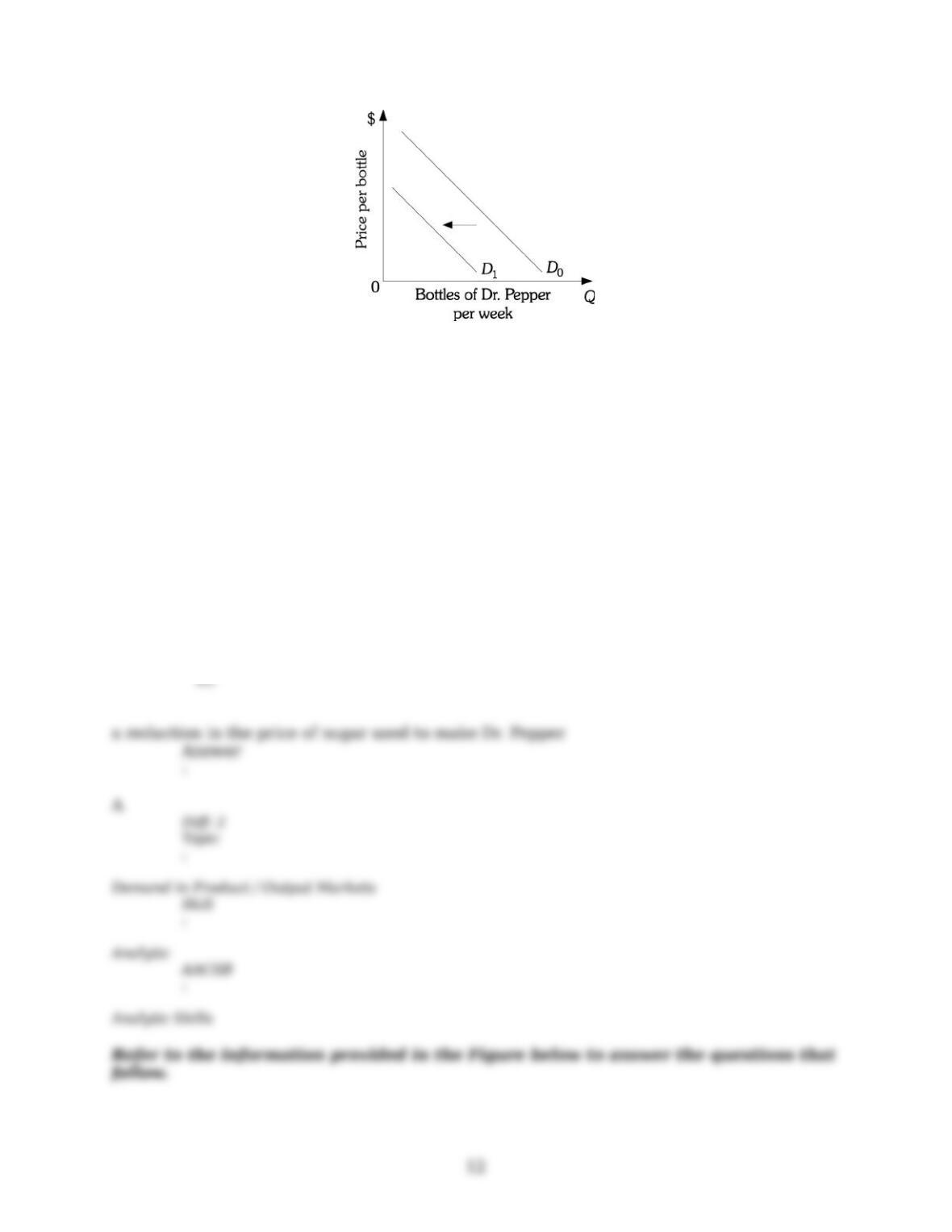
Refer to the information provided in the Figure below to answer the questions that
follow.
Figure 3.1
7)
Refer to Figure 3.1. Which of the following would be most likely to cause the demand for
Dr. Pepper to shift from D0 to D1?
A)
a decrease in income, assuming that Dr. Pepper is a normal good
B)
an increase in the price of 7–UP, assuming 7–UP is a substitute for Dr. Pepper
C)
a decrease in the price of Dr. Pepper