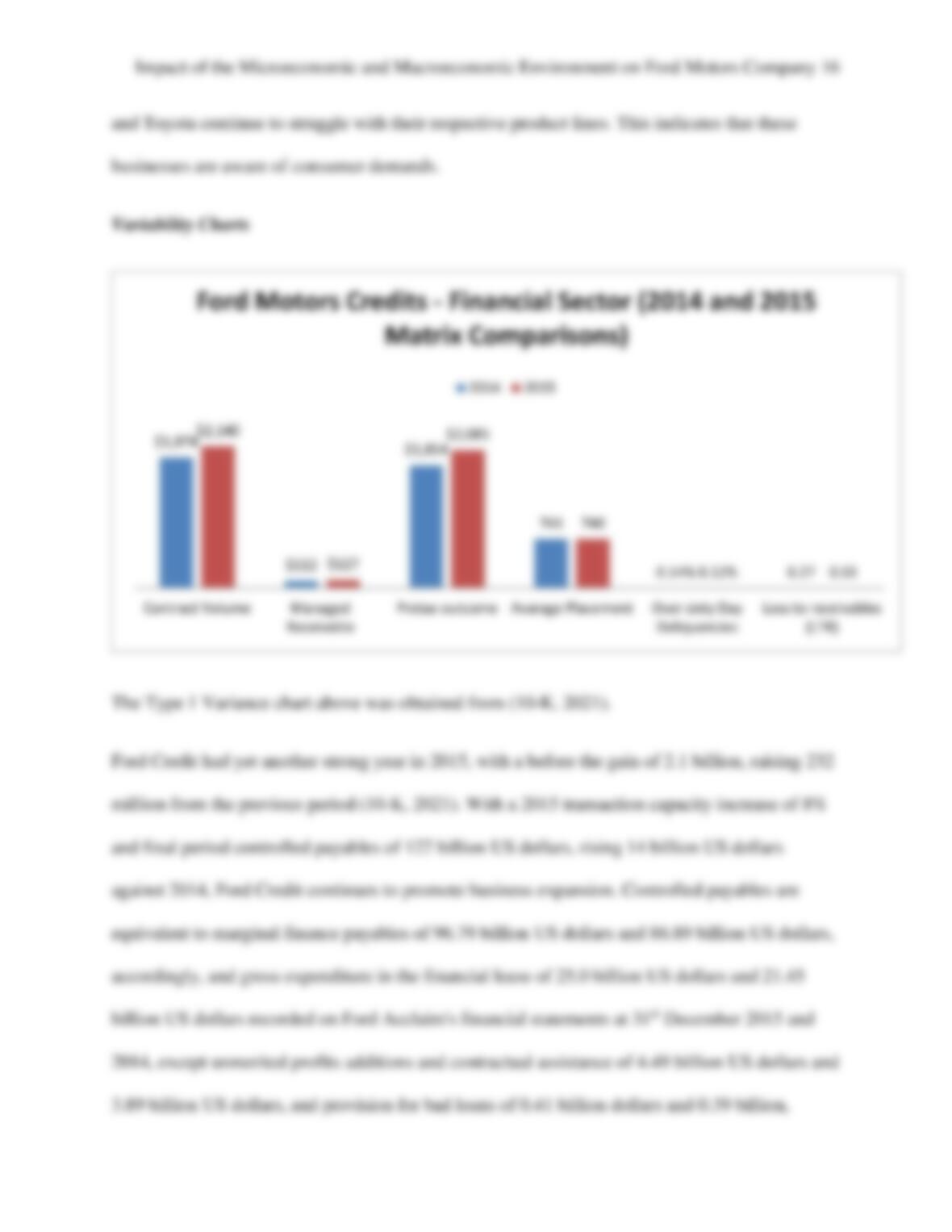
Impact of the Microeconomic and Macroeconomic Environment on Ford Motors Company 1
IMPACT OF THE MICROECONOMIC AND MACROECONOMIC ENVIRONMENT ON
FORD MOTORS COMPANY
By [Name]
Course
Professor’s Name
Institution
Location of Institution
Date
Impact of the Microeconomic and Macroeconomic Environment on Ford Motors Company 2
Impact of the Microeconomic and Macroeconomic Environment on Ford Motors Company
Introduction
1. Micro-Economics
Microeconomics denotes the systematic education of organizational features and the
utilization of their limited assets. According to (Acemoglu, 2012) the definition of
Microeconomics elucidates how an organization’s operation is impacted by the existing
situations in the market (business environment). Microeconomics predominantly scrutinizes a
company’s policies and implementation choices of factors affected by product demand and
logistics (product distribution). (Bertola et al, 2014) argued that the distribution and consumers’
need for a product are influenced by production and customers’ expenditure. As a result, for a
firm to adequately address the numerous challenges affecting them, it is vital to scrutinize and
comprehend the impact of microeconomics on their operation with the help of the appropriate
strategies,
This section of the case study of Ford Motors Company aims to discuss the influence of
microeconomics factors on business operations. Additionally, using the bottom-up approach, the
task would highlight Ford Motor’s background, including the impact of competition on the firm’s
performance from other global car manufacturers and examining the firm’s supply and demand.
Finally, the market analysis and production cost changes of Ford Motors from the influence of
microeconomic (price flexibility and pricing strategies) and recommendations for improved
operations at Ford Motors in the current market (2021).
Impact of the Microeconomic and Macroeconomic Environment on Ford Motors Company 3
Ford Motor Historical Background
Ford Motors Industry, established by Henry Ford in 1903, deals in the manufacturing of
automobiles (Lambert et al, 2018). The company’s management has been in the Ford family to
date and is often described as a “cartel” operation. The company experiences a significant
amount of market pressures from Volkswagen, Toyota, and Jeep, which deal with vehicle
manufacturing. The company has created a solid global brand through the production of
numerous vehicle models. For example, in 1906, the company made a huge impact in the vehicle
manufacturing sector from the creation of Model T. The car model transformed vehicle
production by catering to the middle and low-class demographics that form most of the
population. Furthermore, Ford Motors Corporation was amongst the initial universal
manufacturing industries to distribute World War I vehicles and aircraft.
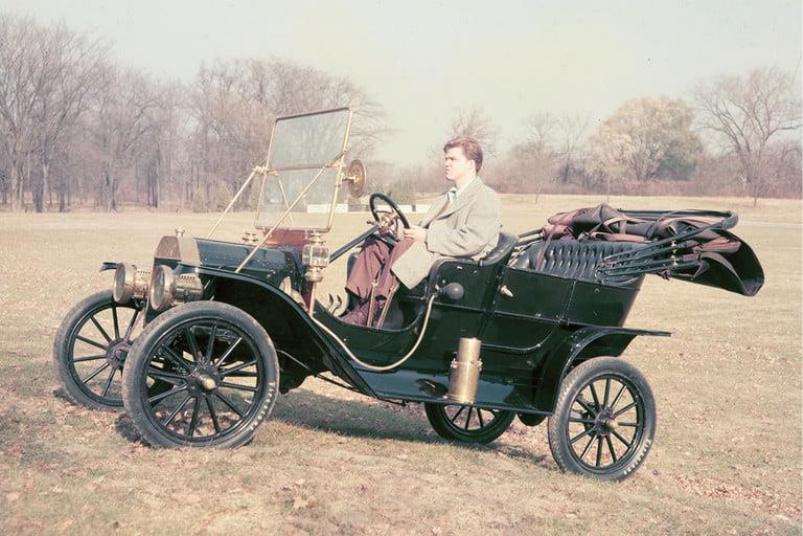
Model T Car:
Impact of the Microeconomic and Macroeconomic Environment on Ford Motors Company 4
Ford Model T, image obtained from (The Best Ford Cars of All Time | Model T, Thunderbird,
and More | Digital Trends, 2021)
The Model T vehicle produced by Ford in 1908 was a game-changer in the vehicle
manufacturing sector due to its affordability. The model was estimated to cost 260 US dollars
which currently is 3 664 US dollars, by 1925 (The Best Ford Cars of All Time | Model T,
Thunderbird, and More | Digital Trends, 2021).
Ford Motors Company gained global access through their Canadian branch established
in 1904 that enabled the entrance into the commonwealth market. However, according to
(Gillepsie et al, 2014), Ford Motors Corporation started to experience competition in their
territory after 1956 when Toyota Motors entered the United States of America with their vehicle
models. Because of the entry of Toyota Motors in Ford’s dominion, numerous industries
infringed the market with advanced vehicle models forcing Ford Motors to restructure their
organizational operation. Due to multiple challenges and reducing market shares, Ford Motors
started to experience hurdles in the 21st century. According to studies, amplified production
price, the introduction of pension plans were among the reasons for Ford Motors’ reduced
demands and increased operational costs. In 1996, Ford Motors Company administrators
launched the “Ford Focus 200” to streamline and reconstruct their operations into more
sophisticated strategies. The “Ford Focus 200” seemed to work in the company’s favour until
they recorded an elevated operational cost as opposed to their competitors. As a result, Alan
Mulally was appointed as the company’s CEO in 2006 to retrieve the corporation’s former glory.
Through the collaboration with the management panel, the industry was reprieved to the third
position (Higgins et al, 2020). The CEO of Ford Motors Limited has played an essential role in
saving the company from losses till this date, according to the statistics of 2015.

Impact of the Microeconomic and Macroeconomic Environment on Ford Motors Company 5
Ford Motor Company Management since its Establishment
Principal Executive Mangers at Ford Timeline:
1910 to 1920
William Durant
1923 to 1937
Alfred Sloan
1946 to 1953
Charles Wilson
1953 to 1958
Harlow H. Curtice
1958 to 1967:
Frederic Donner
1967 to 1971
James Roche
1972 to 1974:
Richard Gerstenberg
1974 to 1980
Thomas Murphy
1981 to 1990
Roger Smith
1990 to 1992
Robert Stempel

Impact of the Microeconomic and Macroeconomic Environment on Ford Motors Company 6
1992 to 2000
John Smith
2003 to 2009
Richard Wagoner
2014 to Date
Mary Barra
This information was obtained from (Odom, 2017).
Demand Curve and Midpoint Elasticity
A demand curve is described as a visual representation that highlights the quantity or
quality of merchandise and services purchased of an organization against the price. The demand
curve shows the relationship between unit and price, hence aids in calculating a demanding
program (Gillespie, 2014). The demand curve dictates the quantity of a product that is likely to
be bought at varying costs. For instance, the affordable 1906 Ford Model T enabled the industry
to acquire a significant market status, especially in the United States of America (Acemglu,
2012). The demand curve consists of the x and y-axis, indicating units and cost of a product
respectfully. Due to the company’s strategy to focus on the middle and lower class citizens of
America, the demand curve for Model T was high. With time the consumers started to embrace
innovative changes in the motor sector due to the competition posed on Ford’s Model T by
industries like Toyota, which produced more sophisticated vehicles (Ho et al, 2017).
Pricing Strategy of Ford Motors
Despite numerous challenges, Ford Motors Company’s primary goal is to gain influence
across all the regions in the globe (for instance, Europe and America). In order to achieve this
Impact of the Microeconomic and Macroeconomic Environment on Ford Motors Company 7
objective, the company only supplied its merchandise through authentic retailers. From 1998,
Ford Motors developed a supply pathway named “Ford Retail Network,” renamed “Auto
Collection,” to evolve dealers’ appropriate strategies. The strategy was linked with establishing a
second logistic network capable of challenging the AutoNation supply chains. In 1999, Ford
Motors disserted the strategy and focused on selling off automobiles online. The state of Texas
greatly opposed the sell-off lease due to the posing of a manufacturing firm as retailers. (Bertola
et al, 2014) claimed that the development of “FordDirect.com” was a corporative ingenuity with
the suppliers.
The dealers were responsible for filling in the papers and supplying cars to consumers
online during this period. Besides (Bertola et al, 204) indicated that the project
“FordDirect.com” helped guide Ford vendors cheaply. Due to this reason, the corporation holds