Law of Diminishing Marginal Utility: Concept,
Assumption, Causes and Issues
Liebhafsky stated the principle in the following way:
The satisfaction acquired from additions to one’s stock of a good diminishes.
In the words of Marshall:
“The additional benefit which a person derives from a given increase of his stock of a thing
diminishes with every increase in the stock that he already has.” It means that more one has
of anything; less important to him is any one unit of it.
The Law of Diminishing Marginal Utility, as defined above, is derived from one of the
characteristics of human wants. It is observed that although a person cannot satisfy all of his
wants, he can satisfy one of these provided he has the means to do it. As he gets more and
more of a thing (say, an apple or tea), his intensity of desire for that thing gradually
diminishes, indicating that additional utility decreases as its total stock increases.
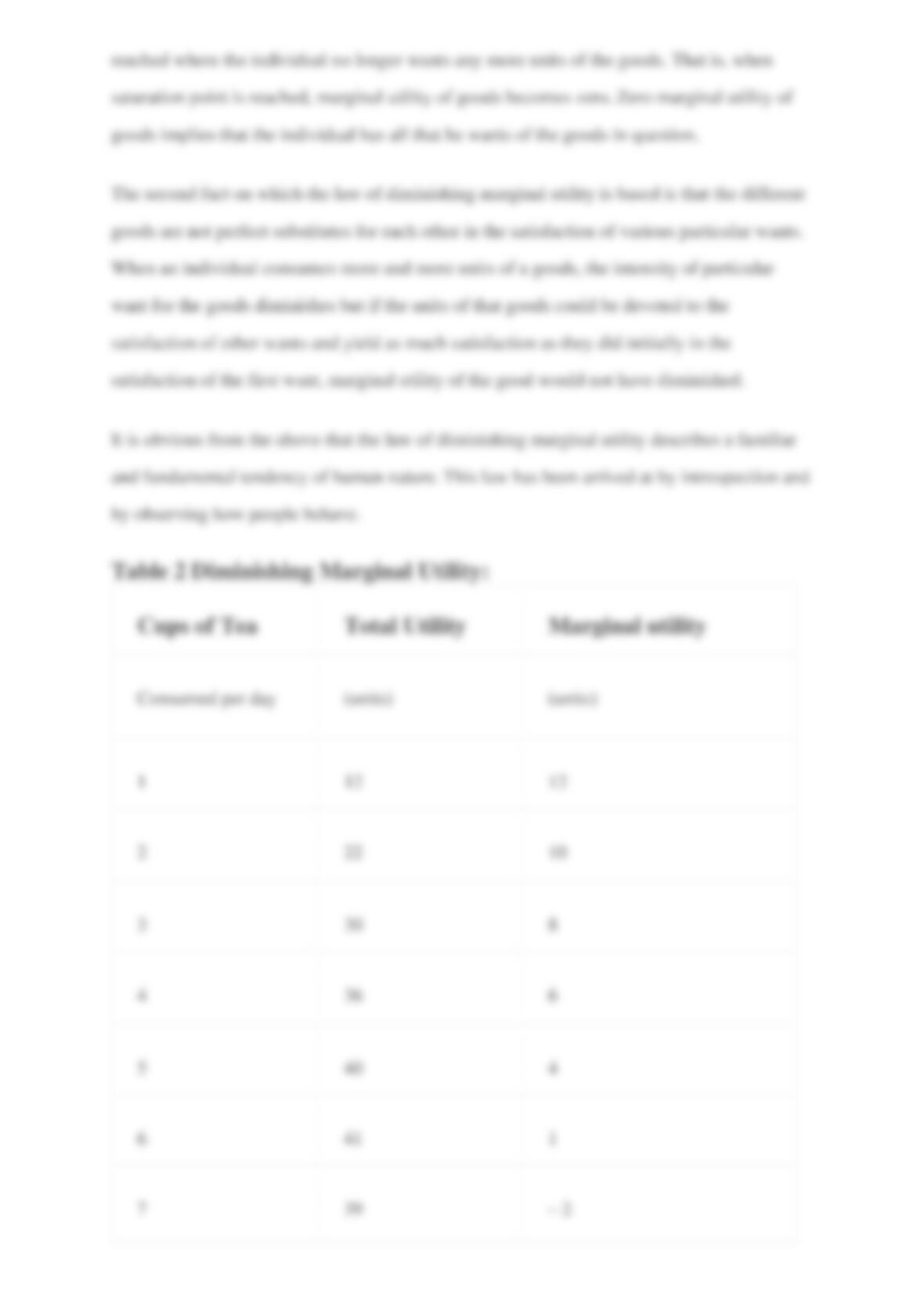
As the consumption of a commodity increases the consumer’s TU also increases. He gets
greater satisfaction as he eats more and more chocolates.
But as the consumption of chocolates increases his desire or inclination for every extra unit
will gradually fall. In other words, his psychological capacity to appreciate every extra unit
will gradually diminish. So every extra unit will add less and less to his total satisfaction. In
other words, the rate of increase in TU will fall. In our example the second chocolate gives
less satisfaction than the first one.
And a sixth one begins to make the consumer feel ill—total satisfaction from the assumption
consumption of chocolate falls. From this emerges one famous law of economics, known as
the Law of Diminishing Marginal Utility.
This law can be stated thus:
“The more one consumes of one commodity during any period of time the less satisfaction
one gets from consuming an additional unit of it”.
As one adds to his (her) weekly consumption of chocolate, each additional unit adds to his
TU or total satisfaction, but each unit adds less utility than the one before it.
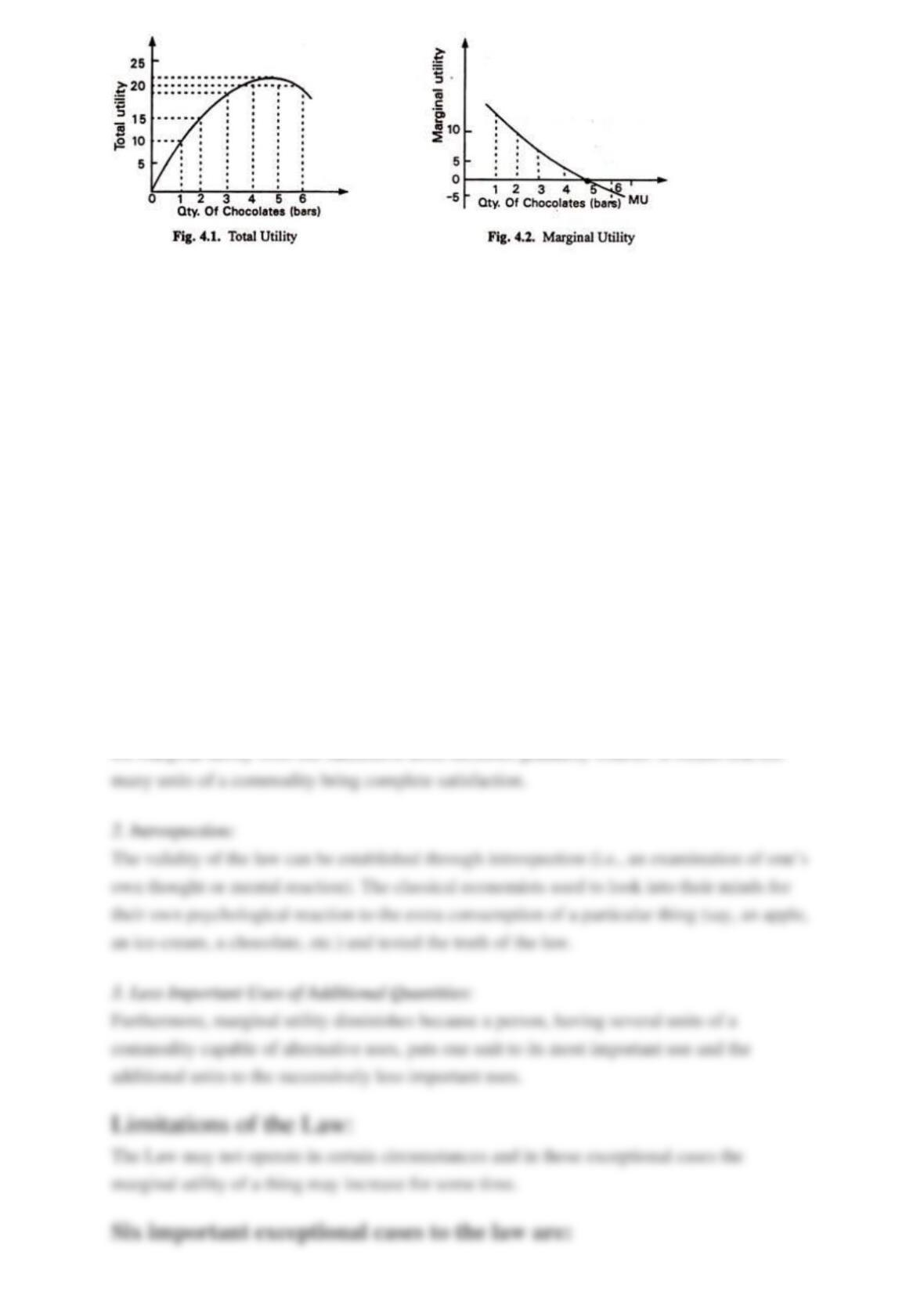
Utility schedule presented in Table 4.1 can be represented diagrammatically. See Fig. 4.1. In
Fig. 4.1 our representative consumer Mr. John is seen to add to his total satisfaction as he
increases weekly purchase of chocolate until he is buying 5 units (bars) per day. A 6th bar per
week gives him disutility or dissatisfaction.
Fig. 4.2 (which is derived from Fig. 4.1) illustrates the Law of Diminishing MU. This
indicates that the additions to TU of chocolate became less as more bars per day are
purchased. It is clear that the MU of the six bars per day is negative, i.e., the sixth bar causes
a decrease in TU.
Assumptions of the Law:
The Law of Diminishing Marginal Utility is based on the assumptions:
1. The utility that a consumer gets can be measured and expressed in numbers (units).
Moreover, the units of the commodity must be properly defined.
2. The maximum price a consumer is ready to pay for the commodity depends on its marginal
utility to him.
3. The taste and preference of the consumer remain unchanged during the period of
purchases.
4. The initial amount of consumption is sufficient to give the consumer full satisfaction.
Causes of Diminishing Marginal Utility:
Three important causes of the diminishing marginal utility are:
1. Satisfaction of a Particular Want:
Although human wants are unlimited, a particular want is limited. So, it can be satisfied. As a
person consumes more and more of a commodity, his indication becomes less and less. So,