Justo Cabanas, Eduardo
01/29/17
ECO 2000
Professor: Gloger
The Law of Supply and Demand
Economics is a tough subject to understand because of all the factors that play into it such
as, supply and demand. The law of supply and demand states that “the quantity of a good
supplied (i.e., the amount owners or producers offer for sale) rises as the market price rises, and
falls as the price falls. Conversely, the law of demand says that the quantity of a good demanded
falls as the price rises, and vice versa” (Ehrbar, Al, P1). This type of concept is hard to grasp on
it on the first try, so to have a better understanding of how supply and demand works there are
three ways to break it down. First is being able understand the theory of supply and demand, two
how to read supply and demand graphs, and finally three how it applies to real world problems.
In economic theory, the law of supply and demand is considered one of the fundamental
principles of understanding economy because it is the explanation of
how producers decide on how much their products are worth. The first
thing people should know is law of demand which states that “there is
an inverse relationship between price and quantity demanded” (Ehrbar,
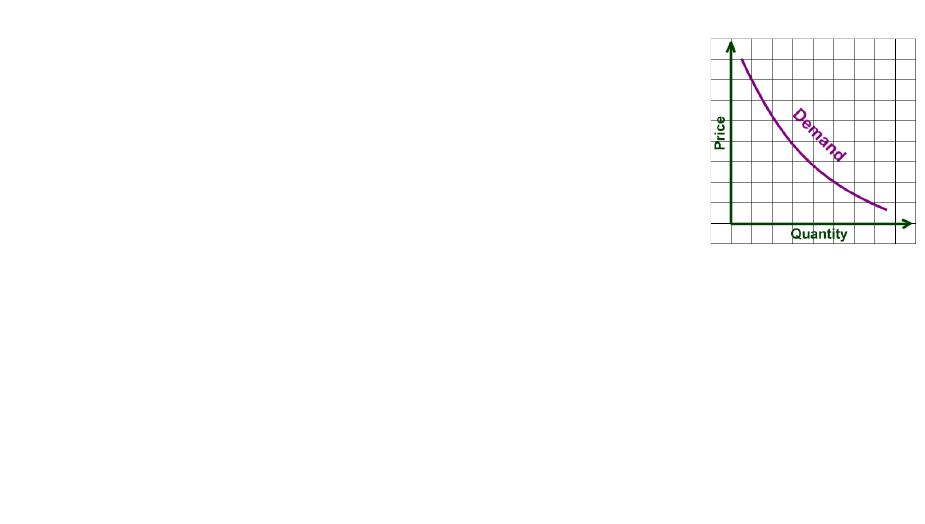
Al, P1). That means that when the price goes down the quantity demanded increases. For
example, when the price of milk goes down, the quantity consumers buy will increase. When
demonstrating the demand of milk, it would show a demand curve which looks like a downward
slope curve showing the law of demand. Now, there are three reasons why the demand curve is
downward sloping. It is the substitution effect, income effect, and law of diminishing Marginal
Utility. The substitution effect says that if the price of one good (milk) rises it would make the
consumers more willing to buy another good (orange juice). Furthermore, the income effect says
that when the price goes down, people would buy more milk because their purchasing power has
increase. For instance, if a person goes to the store and sees that a gallon of milk costs one dollar,
the person will buy more because the dollar is worth more and that person can buy multiple
gallons of milk for less (Graddy, p 87). Additionally, it could go the other way if the price of
milk increases, people would buy less milk because the value of the dollar decreases, and it
would not get them enough to buy multiple gallons of milk. The last factor of demand is known
as the law of diminishing marginal utility. Diminishing marginal utility is when consumers buy
too much of a good (milk), and then over time they begin to
lose interest on it because they are not getting the