1
Contemporary Models of
Development and
Underdevelopment
Lecture 4
Todaro & Smith: Chapter 4

2
Introduction
❑What We Still Need to Explore
• What makes development possible (as witnessed in
East Asia)? What are the catalysts or drives of
development?
• We now know “development is possible but extremely
difficult to achieve.” But do we know enough about why?
• What makes development so hard to achieve (as witnessed
in sub-Saharan Africa)?
What are the impediments to economic development?
What are the locally binding constraints?
• What assumptions of the conventional neoclassical
models are most unrealistic?

3
• What is the potential role of the government?
Will ‘deep intervention’ by the government always work?
What are the constraints on the effectiveness of the
government’s role in development?
What if the government itself becomes a player in an
underdevelopment trap?
• Is there a ‘one-size-fits-all’ kind of development policy?
Why or why not?
• How can we identify the binding constraints on national
growth and the policy priorities to address them?

4
❑Major Themes of Contemporary Models
• How can we incorporate problems of coordination
among economic agents in modeling a market economy
in a developing-country context?
• How can we also adequately address situations where
we face:
– increasing returns to scale
– production process with a finer division of labor and a
larger number of sophisticated tasks
– the availability of new knowledge and information
externalities
– imperfect forms of industrial organization

5
❑A Key Feature of the Contemporary Models
• Contemporary models, or the new theories of economic
development, incorporates work in the “new institutional
economics”, such as that of Nobel laureate Douglas C.
North.
• Douglas North emphasized the importance of economic
institutions in the analysis of economic development.
☼Economic Institutions
“Humanly devised” constraints that shape interactions
(or “rules of the game”) in an economy, including
constitutions, laws, contracts, and market regulations,
plus informal rules reflected in norms of behavior and
conduct, values, customs, and generally accepted way
of doing things.

6
❑Concept of Coordination
• Definition:
A textbook definition (broad):
– the act of working together harmoniously
A narrow definition
–the act of managing interdependence between activities
performed to achieve a goal.
Underdevelopment As a Coordination
Failure

7
Components of
Coordination Associated Coordination
Process
Goals ▫Identifying goals
Activities ▫Mapping goals to activities
(goal decomposition)
Actors ▫Selecting actors
▫Assigning activities to actors
Interdependence
(goal-
relevant relationships
between activities)
▫“Managing” interdependence
Components of Coordination
Source: Thomas Malone and Kevin Crowston, “What is Coordination Theory and How Can It Help Design
Cooperative Work Systems”, Proceedings of the Conference on Computer Supported Cooperative Work,
1990

8
• Many newer theories of economic development that
became influential in the 1990s and afterwards
recognized and emphasized the following:
– There are strong complementarities among inputs (labor
and capital) in the production process (within firm, and
across firms and industries)
– Due to complementarities, investments must be
undertaken by a large number of economic agents in
order for the results to be profitable enough for individual
investors.
– Therefore, without some kind of coordination,
investments may never happen and the economy may be
trapped in underdevelopment.
❑Background of the New Theories

9
• The new theories, therefore, highlighted the necessary
condition to get sustainable development under way.
– Several things must be present, fit together and work well
enough together at the same time.
– For the above to happen, coordination is important.
• Thus their approach to analysis of development and
underdevelopment is often called ‘coordination failure’
approach.

10
☼Complementarity
A situation of mutual reinforcement through positive
spillover effects or joint externalities where an
action taken by one firm, worker, or organization
increases the incentives for other agents to take
similar action. Complementarities often involve
investments whose return depends on investments
being made by other agents.
☼Coordination Failure
A situation in which the inability of agents to coordinate
their behavior (choices) leads to an outcome
(equilibrium) that leaves all agents worse off than in an
alternative situations that is also an equilibrium

11
□Absence of Coordination and Bad Equilibrium
1) A high-tech firm, using specialized skills, is
considering relocation to a new area.
2) Workers in the candidate area consider acquiring
those skills.
3) Without proper coordination (such as government
intervention), 1) and 2) will not be brought together.
4) With the above problem prevailing, the economy
can be stuck in a bad equilibrium.
☞This is like a case of “chicken and egg” problem.
Which comes first, the skills or the demand for
skills? Often, the complementary investments
must come at the same time through coordination.

12
☼Middle-income Trap
Countries develop to reach middle-income status but
chronically fail to reach high-income status, often due
to low capacity for original innovation or for absorption
of advanced technology.
The problem may be compounded by high inequality,
high corruption, or other market failures, particularly
those affecting capital markets. The issue of changing
behavior to “modern ways of doing things” may also
be a cause of overall inefficiency.

13
□Underdevelopment Trap
A poor rural area remains stuck in underdevelopment
trap because…
1) Farmers have little incentives to do specialized
farming without any catalysts (such as middlemen)
for commercialization of their output.
2) But middlemen will not emerge when farmers prefer
to continue to produce their staple crop for household
consumption or sale within the village.
3) The preferred equilibrium may not be achieved.
☞A multi-year government intervention program is
needed here that generates a sufficient number
of concentrated produces with whom a middleman
(or an agricultural cooperative) can work
effectively.

14
□Upgrading Skills or Technology in Developed Countries
1) The value of upgrading (skills, computer software,
etc.) depends on similar upgrading by other agents
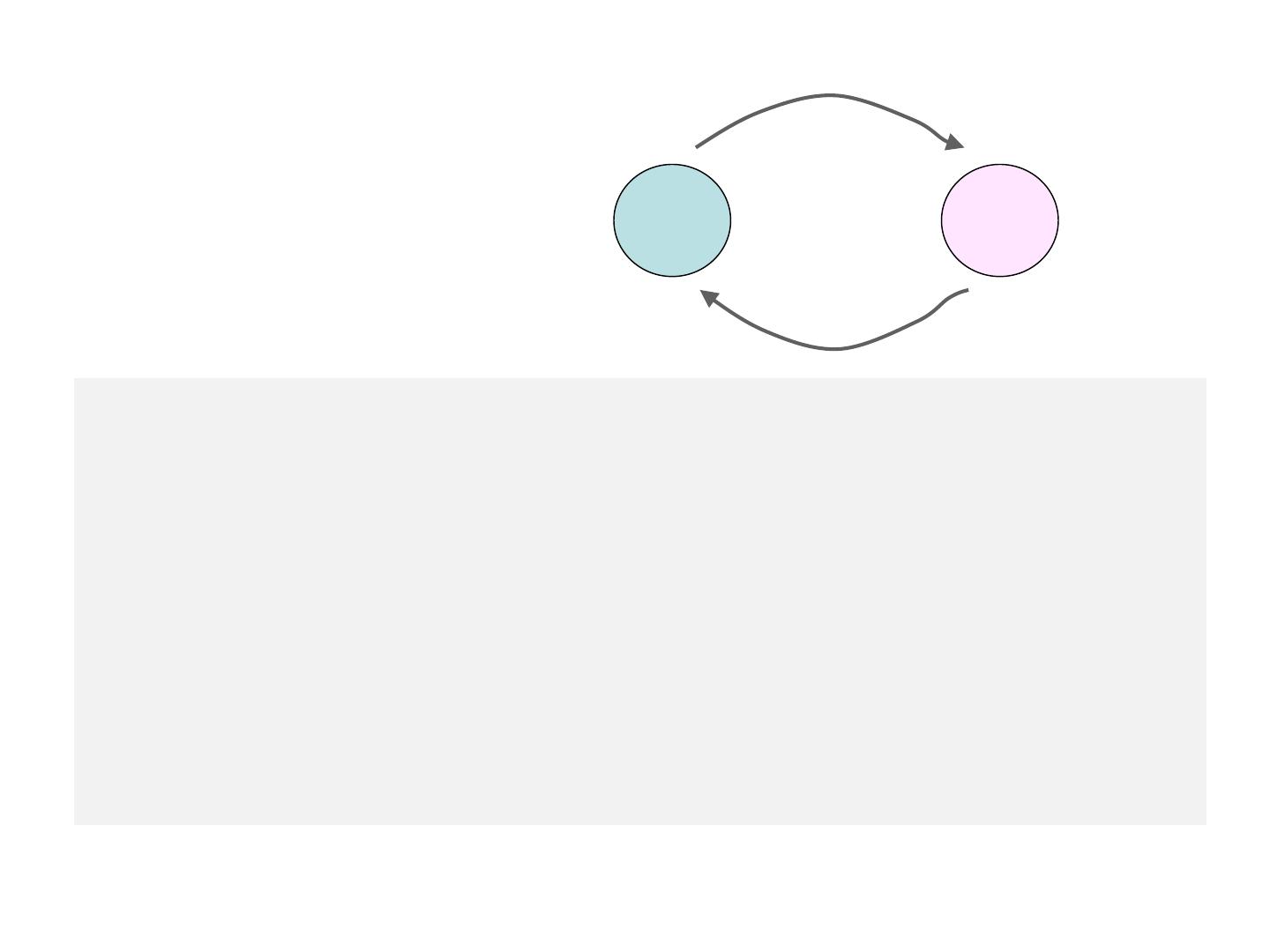
(upgrading gives rise to circular causation of
positive feedback among agents; called a “network
effect”, or “joint externalities”)
For a new or modernizing firm, for example, the value
of investment in new technologies depends on whether
a sufficient number of others also invest or not.
2) Everyone has an incentive to underinvest, i.e., better
off waiting for someone else to make the first move.
3) The preferred equilibrium may not be achieved.
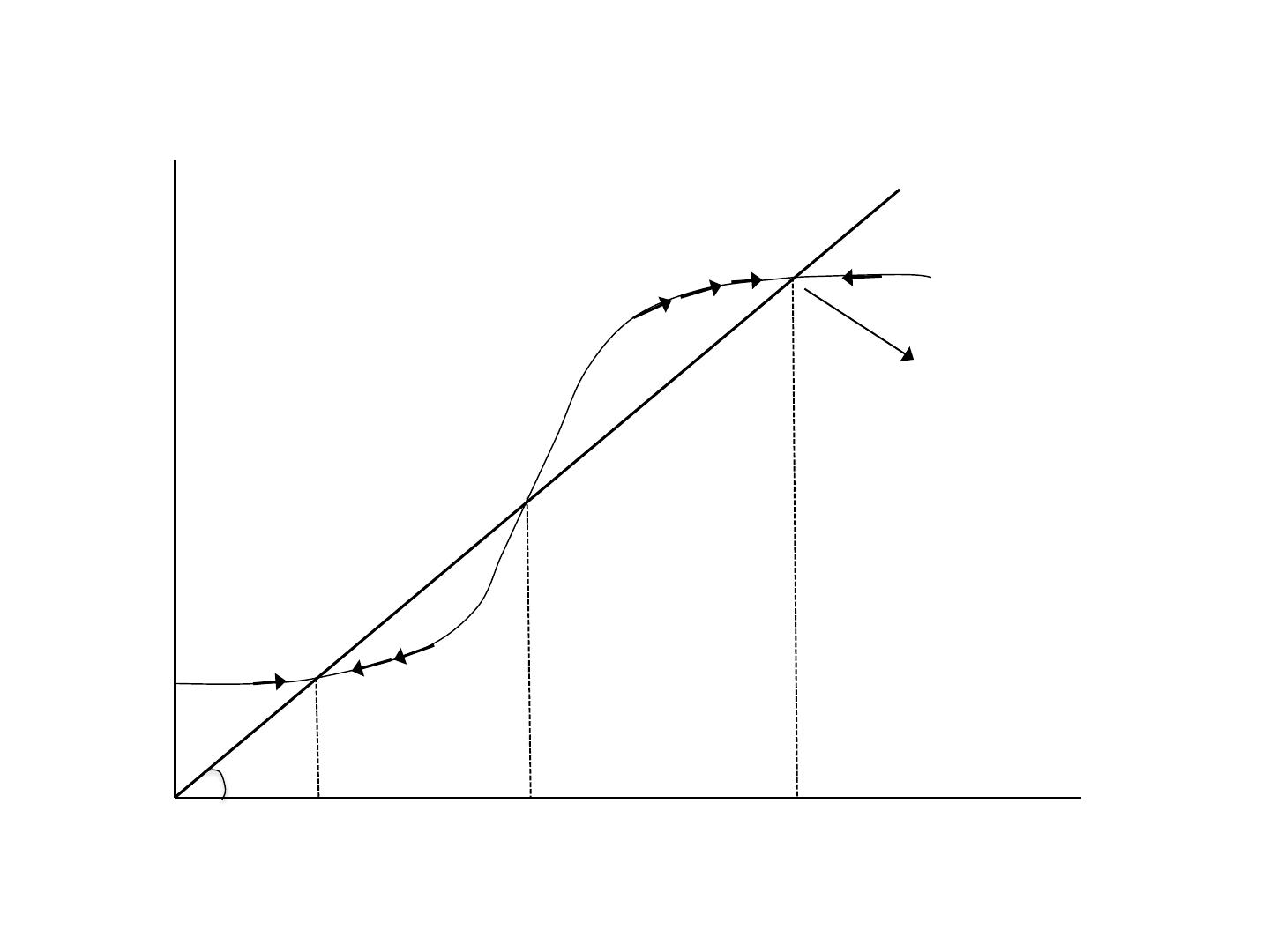
4) A big push, or deep intervention by the government
can move the economy to a preferred equilibrium.
15
✚
✚
Circular Causation of
Positive Feedback
☼Deep Intervention
A government policy that can move the economy to a
preferred equilibrium or even to a higher permanent
rate of growth, which can then be self-sustaining so
that the policy need no longer be enforced because
the better equilibrium will then prevail without further
intervention. The deep intervention may move a
country from a bad to good equilibrium.

16
• Where-to-meet dilemma:
A situation where all parties would be better off
cooperating than competing but lack information (or
centralized coordination system) about how to do so.
If cooperation can be achieved somehow, then there is no
subsequent incentive to defect or cheat.
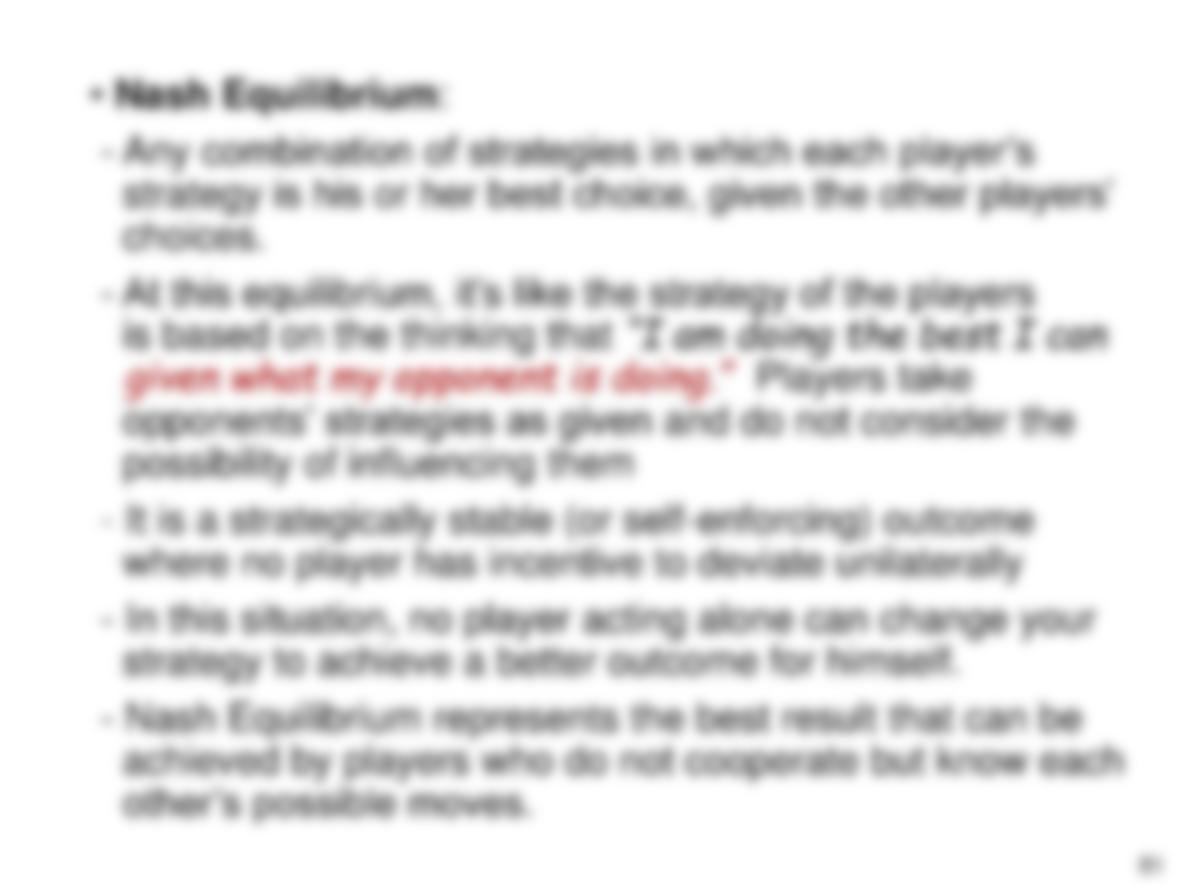
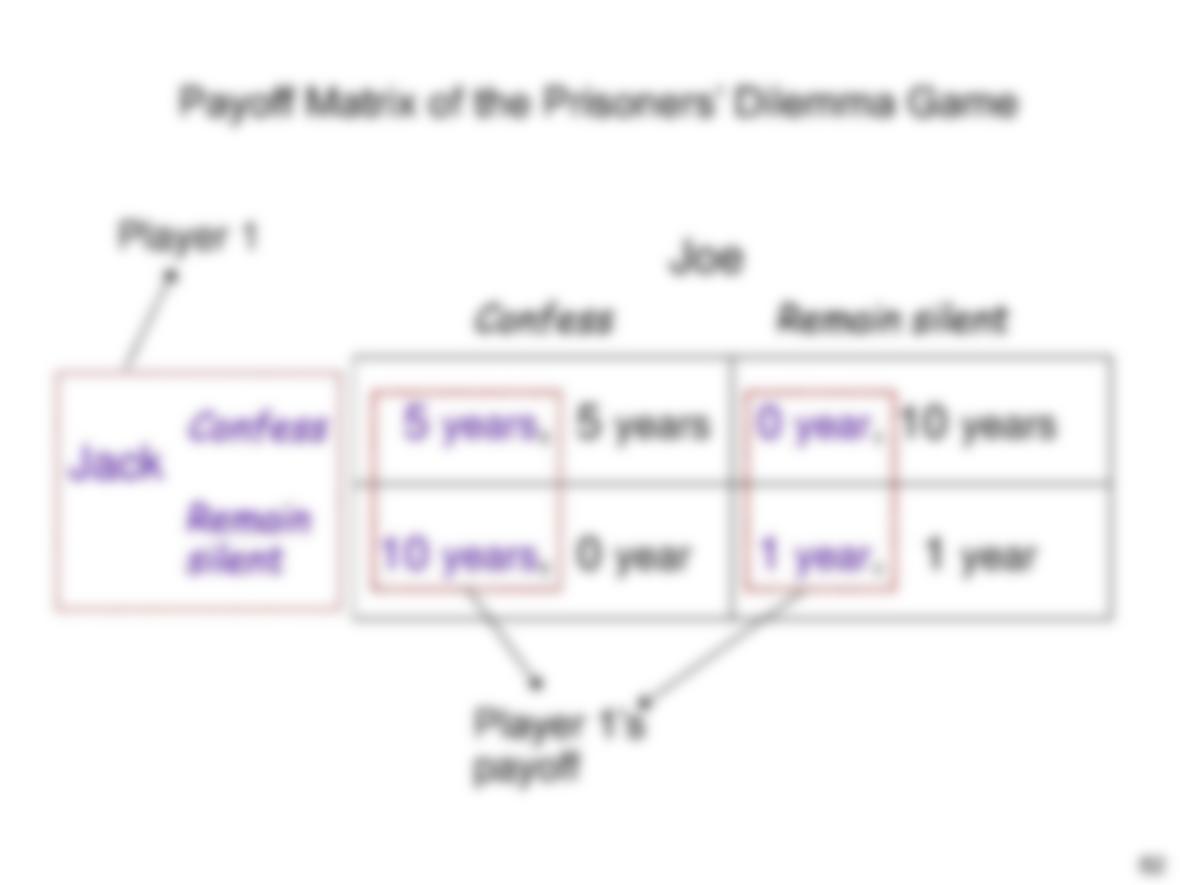
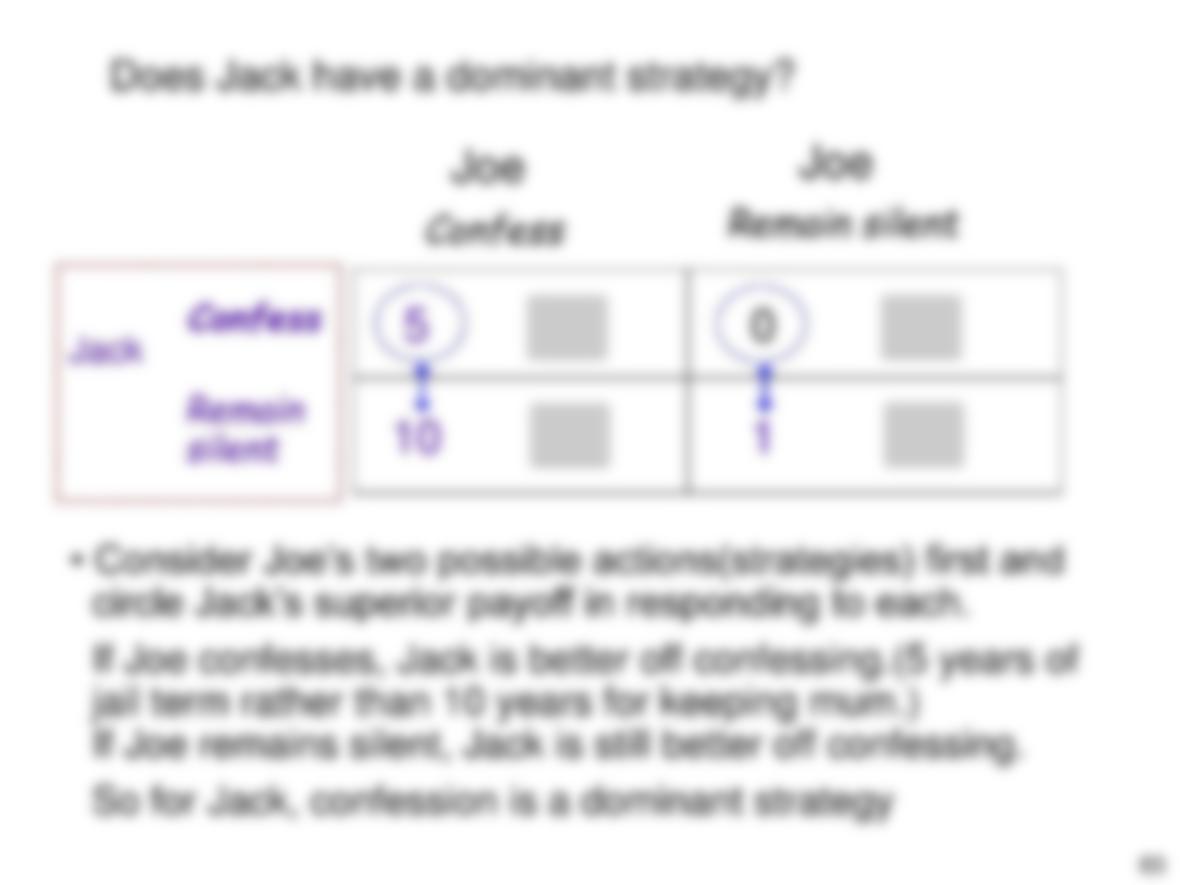
❑Coordination Problems: Game-theoretic View
• Prisoners’ dilemma:
A situation in which all parties would be better off
cooperating than competing but once cooperation has
been achieved, each party would gain the most by
cheating, provided that others stick to cooperative
agreements –thus causing any agreement to unravel.

17
Exercise 1 Prisoners’ Dilemma
• Two firms competing in the same market:
They gain a competitive advantage by polluting but
reducing pollution is in their best interest long-term.
– They both reduce pollution (internalize the costs
of environmental damage) ; payoff = 3 each
– Firm A does not pollute but firm B does
; payoff = 1 for A and 4 for B
– Firm A pollutes but Firm B does not
; payoff = 4 for A and 1 for B
– They both pollute ; payoff = 2 each
• The Tragedy of the Commons
– Consider the problem of environmental damage by firms
– Note that environment is a common resource property
(See Ch. 10)

18
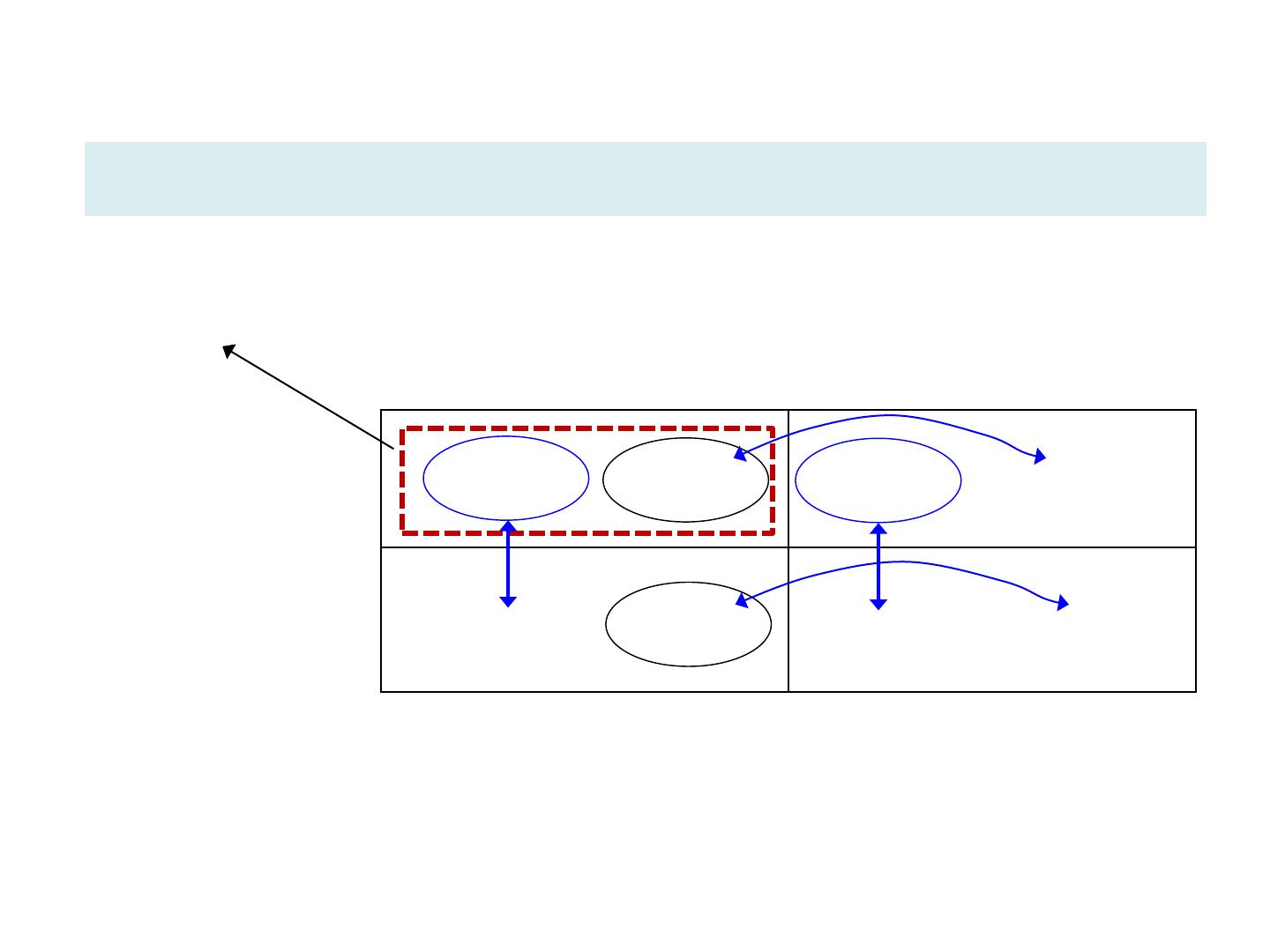
3, 3 1, 4
4, 1 2, 2
Cooperate
Defect
Firm B
Firm A
Cooperate Defect
To Pollute or Not to Pollute
• Most businesses do not “internalize (pay for)” the costs of
environmental damage when they do not have to.
This gives rise to abusive use of the “common property
resource” – the environment here – a problem known as
‘the Tragedy of the Commons’.

19
Exercise 2 (A Pure Coordination Game)
Find Nash Equilibrium in the following game.
• Two players want to meet in one of two places, player 1
choosing between Top and Bottom, player 2 choosing
between Left and Right. Each is indifferent to their two
options.
– In each box, the first and second numbers denote payoffs
of players 1 and 2, respectively.
– Player 1 prefers Top to Bottom if he knows that Player 2
plays Left; he prefers Bottom if he knows Players 2 plays
Right.
– Similarly, Player 2 prefers Left if she knows that Player 1
plays Top; she prefers Right if she knows Player 1 plays
Bottom.
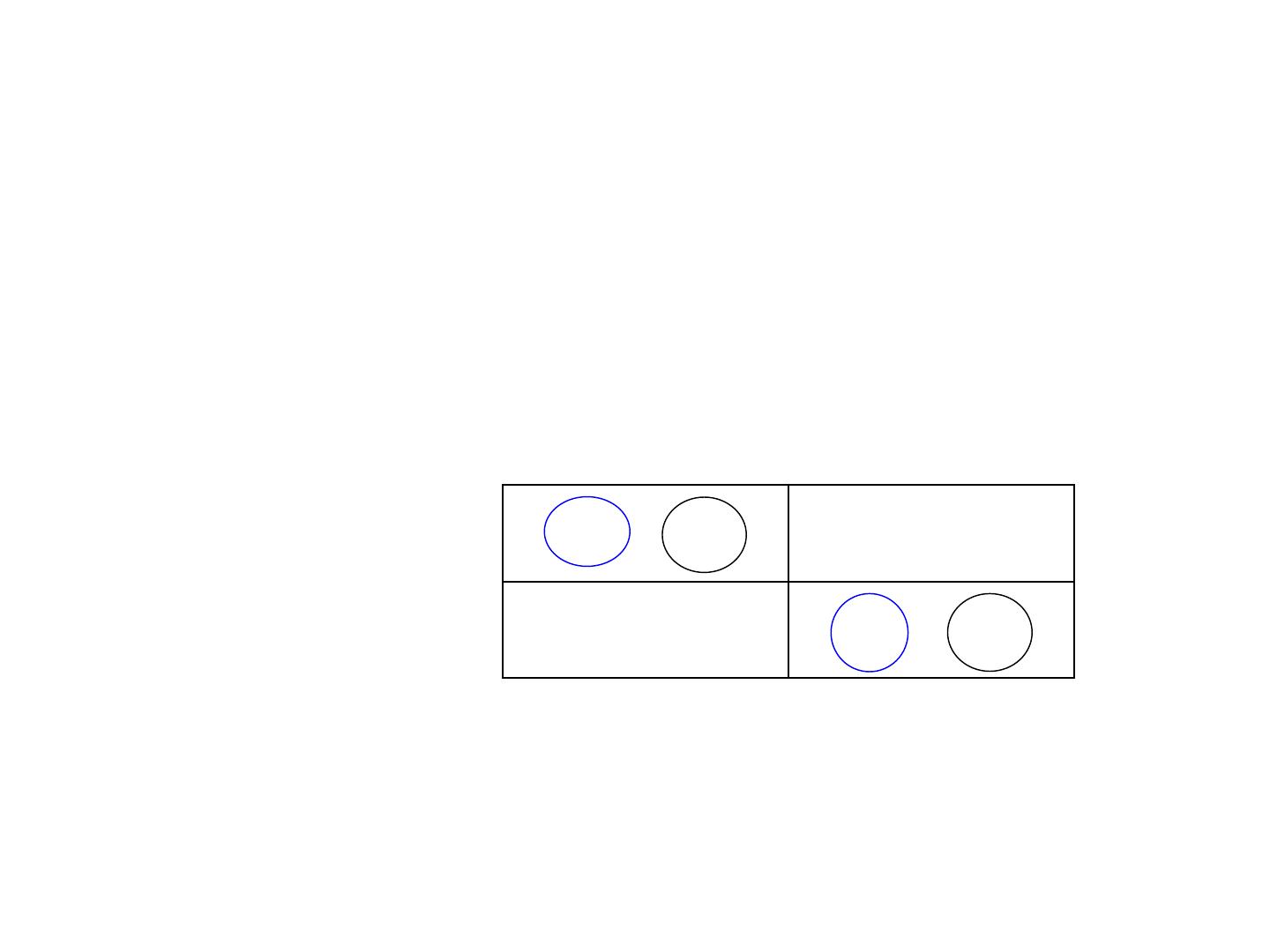
20
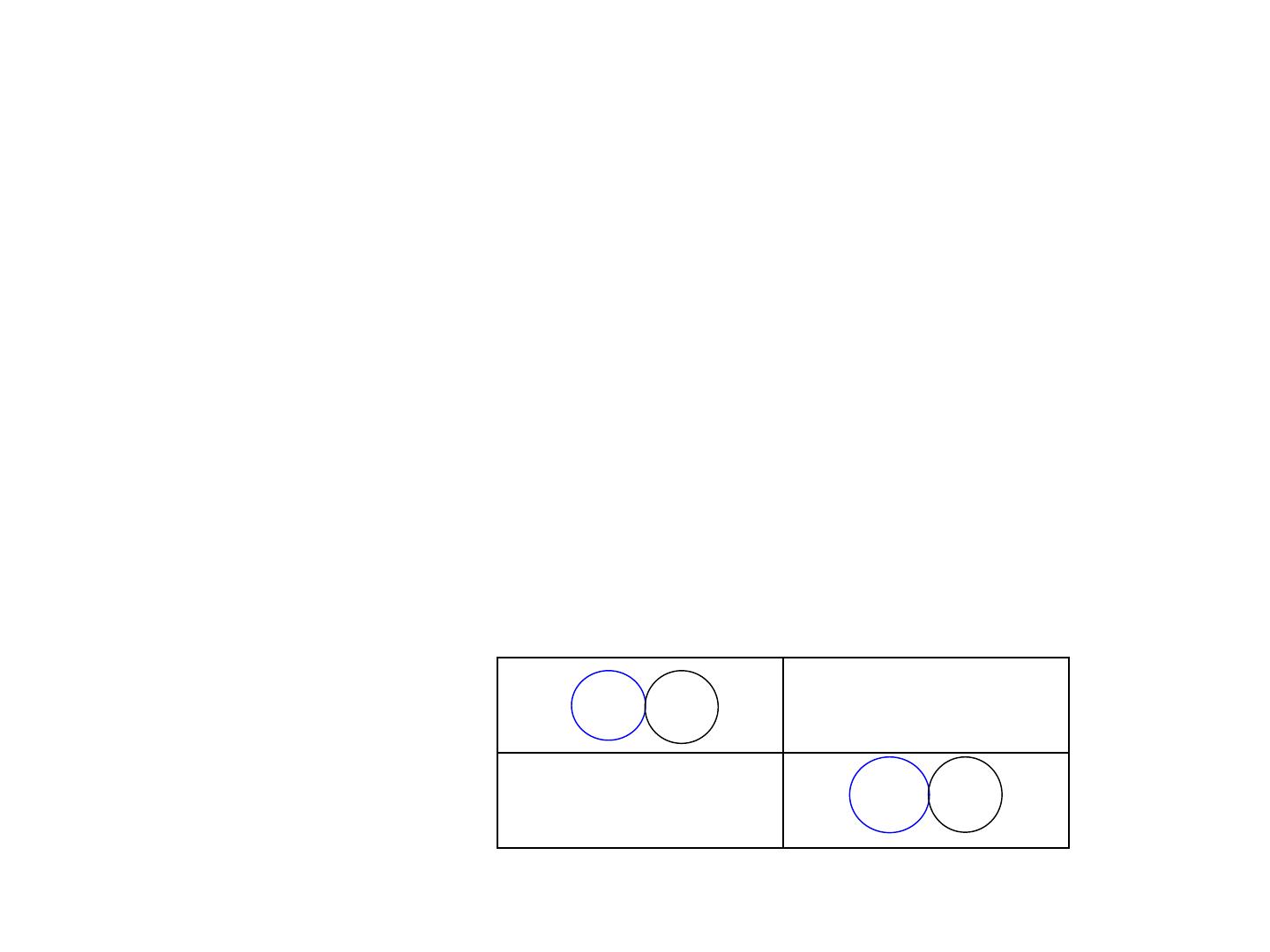
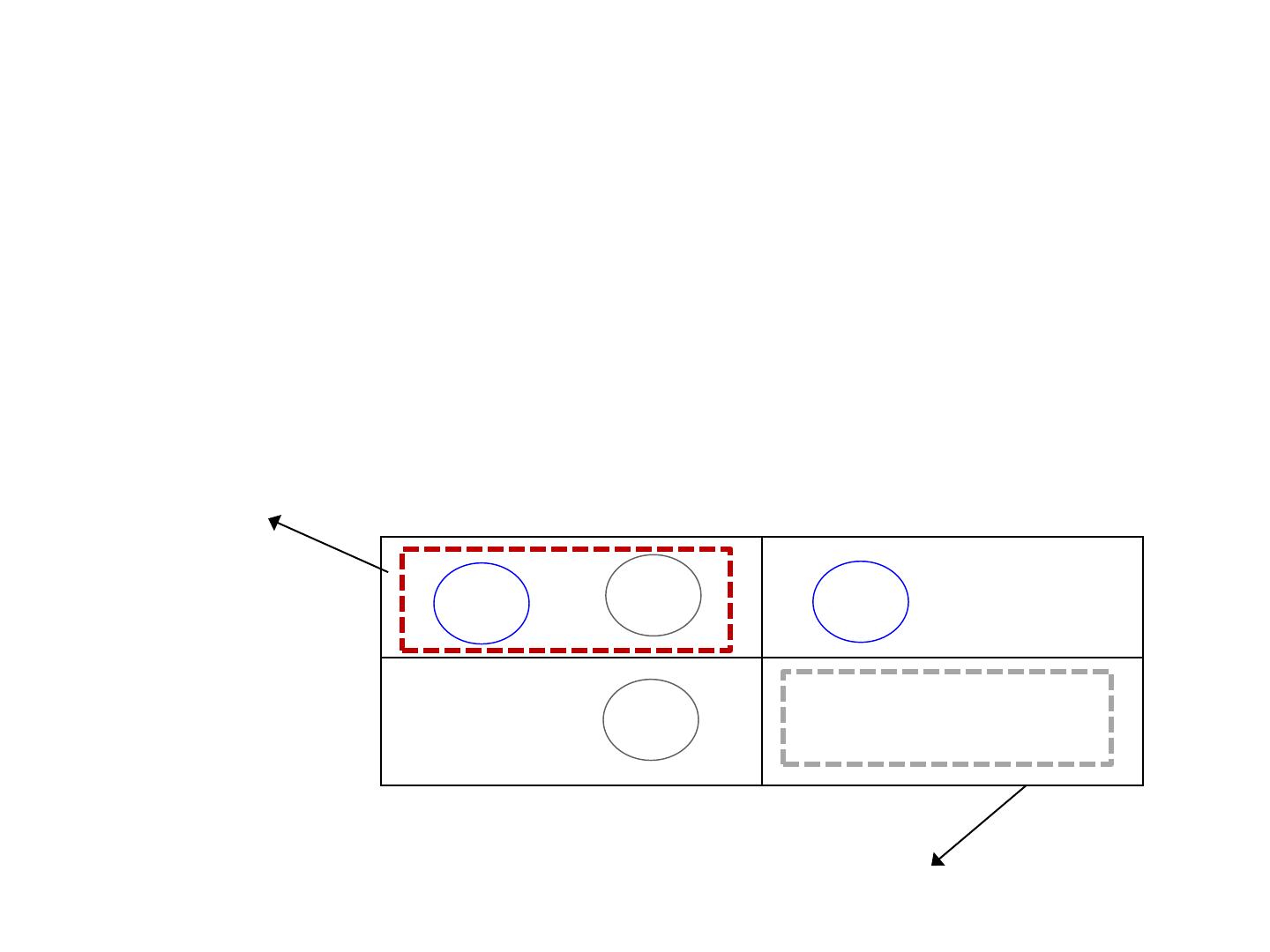
1, 1 0, 0
0, 0 1, 1
Top
Bottom
Player 2
Player 1
Left Right
• Here we have two Nash Equilibria, (Top, Left) and
(Bottom, Right).
– There is no clear prediction about the outcome of this
game.

21
Find Nash Equilibrium in the following game.
• Consider a married couple with the following preferences
for Saturday afternoon.
– Husband prefers baseball to opera and wife prefers opera
to baseball.
– They prefer to be together regardless of the choice of
outing.
– Assume the two players take their actions simultaneously.
Exercise 3 (Battle of the Sexes)
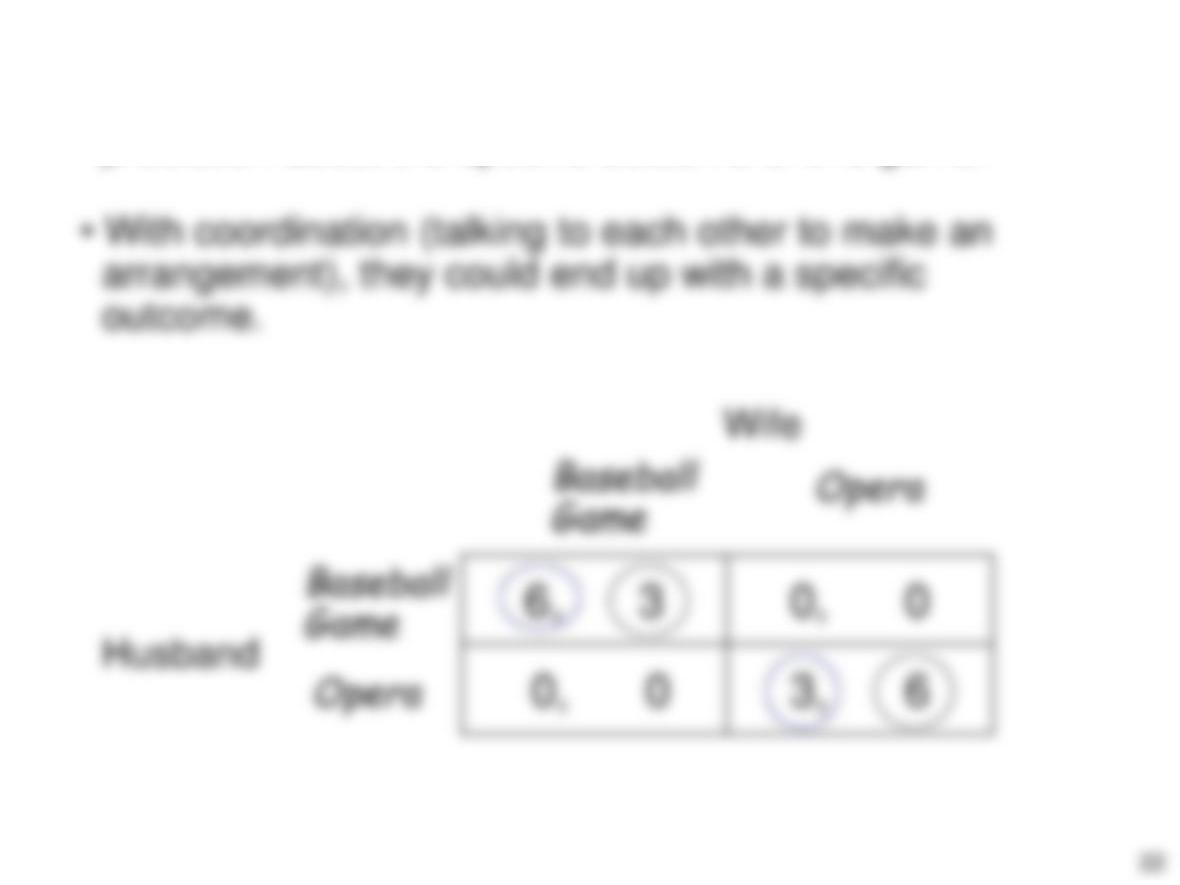
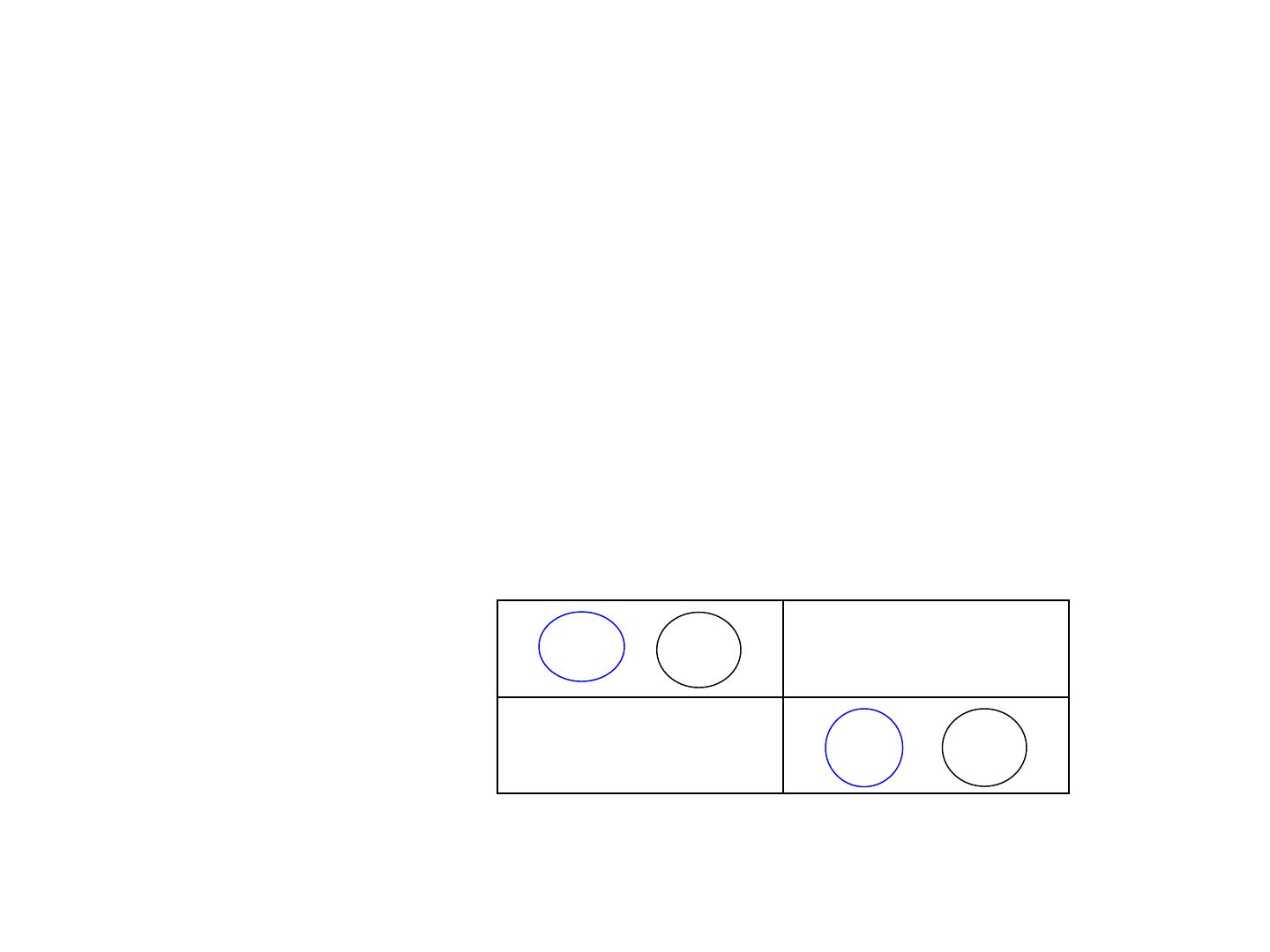
• Here we have two Nash Equilibria and there is no clear
prediction about the specific outcome of this game.