PERU
Historical Trends
According to (The World Bank 2017), over the last decade, poverty and inequality dropped
significantly in Peru, thanks to economic growth and expanding labor incomes, especially at the
bottom of the income distribution. Human development and access to services also improved.
Rural areas, however, still have high poverty rates, and their populations have lower access to
services and lower human capital than their urban counterparts. Women face incongruities in the
labor market, and they are profoundly exposed to violence in the domestic realm. And, Indigenous
and Afro-Peruvians face further disadvantages in living conditions. However, location plays a
much larger role than ethnicity in explaining poverty. Peru’s large spatial disparities in
development are thus a key impediment hindering many Peruvians from procuring the human
capital necessary to access better job opportunities.
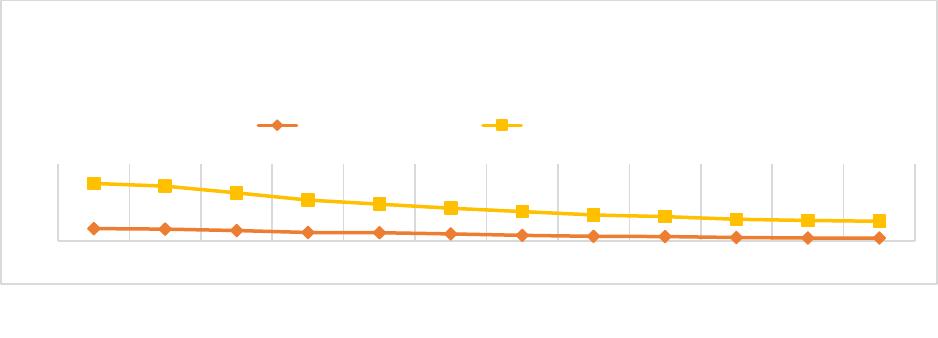
The World Bank Group (2017) said that over the last ten years, moderate poverty fell by
more than half, and extreme poverty by more than two-thirds. Shared prosperity was strong, as
incomes of households in the Bottom 40 increased by an average of 6.8 percent per year, against
2.5 percent per year for the Top 60. The share of the population living in poverty fell from 58.7
percent in 2004 to 21.8 in 2015, a 63 percent fall in the poverty rate. Similarly, extreme poverty
16.4 15.8 13.8 11.2 10.9 9.5 7.6 6.3 64.7 4.3 4.1
58.7 55.6 49.1 42.4 37.3 33.5 30.8 27.8 25.8 23.9 22.7 21.8
0
50
100
2004 2005 2006 2007 2008 2009 2010 2011 2012 2013 2014 2015
EXTREME AND MODERATE POVERTY RATES
2004–2015
Extreme Poverty (%) Moderate Poverty (%)
Figure 1. Extreme and Moderate Poverty Rates 2004-2015
fell by three-fourths, reaching 4.1 percent in 2015 (Figure 1). In absolute numbers, these changes
signify that 9.3 million people exited poverty, and 3.2 million people exited extreme poverty over
these ten years. Moreover, at the national level, for each percentage point increase in Peru’s GDP
growth, poverty fell by 1.4 percentage points. On average, the poverty-growth elasticity was higher
in Peru’s urban areas in the first half of the period (until 2010), after which rural poverty became
substantially more responsive to growth. This trend is apparent especially in the Sierra and Selva
regions of the country (The World Bank Group, 2017).
In addition, The World Bank Group (2017) stated that poverty is unevenly distributed across
the country and is concentrated in rural areas. Some Regions, such as Ica and Madre de Dios, have
very low poverty rates (5 and 7 percent, respectively), while Cajamarca, Amazonas, Huancavelica,
and Ayacucho have poverty rates above 40 percent. While less than a quarter of Peru’s population
is rural, about half of the poor and 80 percent of the extreme poor reside in rural areas – including
indigenous and Afro-Peruvians. Finally, in 2015, the poverty headcount in rural areas was more