Green Technology
Economic Considerations of
Green Buildings
by:
Rakan Muawad
201178370- 214-01
Major: Actuarial Science and Financial
Mathematics
for:
Mr. Joshua Billam
Academic and Professional Communication
ENGLISH 214
ABSTRACT:
The report starts by introducing the global energy and water shortage problems in addition
to the discussion of the consequences of the increasing population. Furthermore, it explains
the inefficiencies in conventional buildings such as the waste of energy and the water how
this affect our economy. In addition, a discussion about Green Houses is reported and how
they can save the environment and improve the economy. At last, recommendations about
reducing our energy and water situations will be given.
August 1 2014
Table of Contents
INTRODUCTION 3
I. BACKGROUND 3
Energy Crisis 3
Water Shortage 3
Increasing Population 4
II. ACCOMODATION AND BUILDINGS 4
Statistics 4
Materials 5
Inefficiencies 5
Design 5
Water 6
Energy 6
III. GREEN HOUSES 6
Materials 6
Design 7
Water7
Energy 8
IV. Recommendation & Discussion 9
Cost 9
My Opinion 9
Future Predictions 9
CONCLUSION 9
REFERECES 11
2

Introduction
Nowadays, the world is facing a variety of problems and the environmental problem is
one of the largest dilemmas. The environment has been abused with unhealthy activities
because of the emissions that are created by oil usages such as factories and transportation.
The population is increasing dramatically and so the size of the industries, so oil is needed
more to run the industry people’s lives by producing water and electricity. Households must
start with themselves to control the environmental problem and green houses are the solution
that they can start with. This report discussed the current situation in the world regarding
energy and water, facts about current households’ violations, green houses and how effective
are they, and ending with a discussion about the cost of a green house and how it can save
households’ money in addition to future predictions.
I. BACKGROUND
A. Energy Crisis
The demand for oil has increased dramatically since the industrial revolution, in the last
ten years especially. Oil is used as a source of energy in many industrial needs such as water
desalination, cement factories, and generating electric power to run cities. Also, oil is used in
public transportation such as cars, buses, and airplanes, which represent a large fraction of oil
usage these days. All of the above processes burn oil in huge amounts, which leads to
extensive CO2 emissions so the environment will be polluted. A nation’s economy will be
harmed since a lot of money is needed to purify the environment to create a suitable
environment for its labor force. Since oil is a non-renewable source of energy, its price per
barrel will increase as oil tends to be depleted. As consequence, many industrial nations that
are not considered as oil producers will face huge economic difficulty to import oil to run their
industry.
B. Water Shortages
In recent years, water has been used excessively in many different applications such as
agriculture, industry, and for drinking. In addition, some countries do not have fresh surface
water sources such as Saudi Arabia so the water supply must be from either ground water or
desalinated water. As a consequence, Saudi will face a water shortage problem and must fund
huge projects to extract ground water or desalinate seawater. As stated by the Ministry of
Water and Electricity (SA) (2012, p.15), half of Saudi domestic uses and industrial companies
use fresh water from water desalination. In addition, some of the ground water aquifers are
non-renewable, so this situation will worsen the problem. Therefore, Saudi Arabia spends a lot
of money to produce fresh water and water bills do not cover the cost of producing the water.
Also, 35% of water in the kingdom is wasted due to pipe leakage problems (Al-Zahrany,
2010,p.3).
C. Increasing Population
3
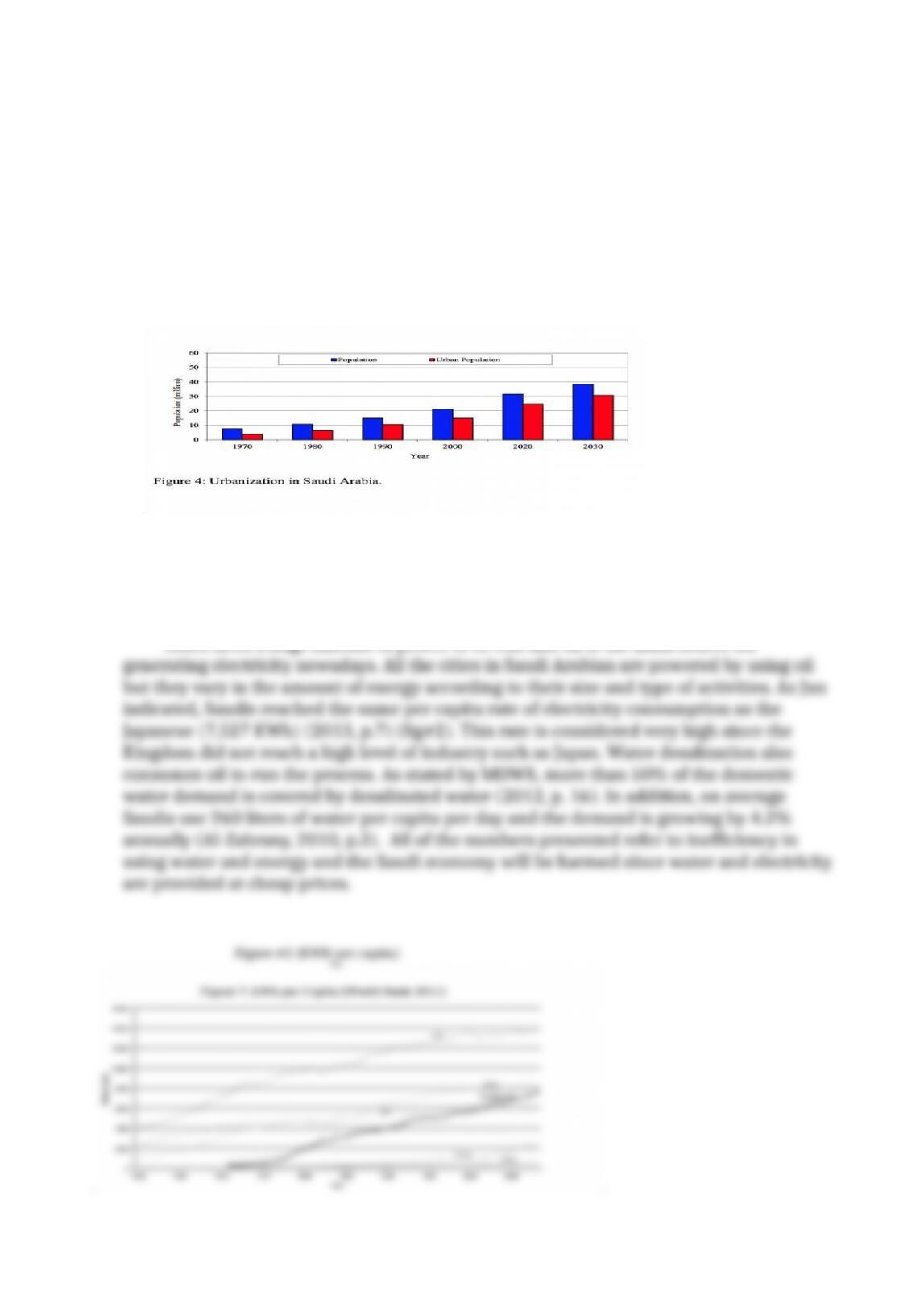
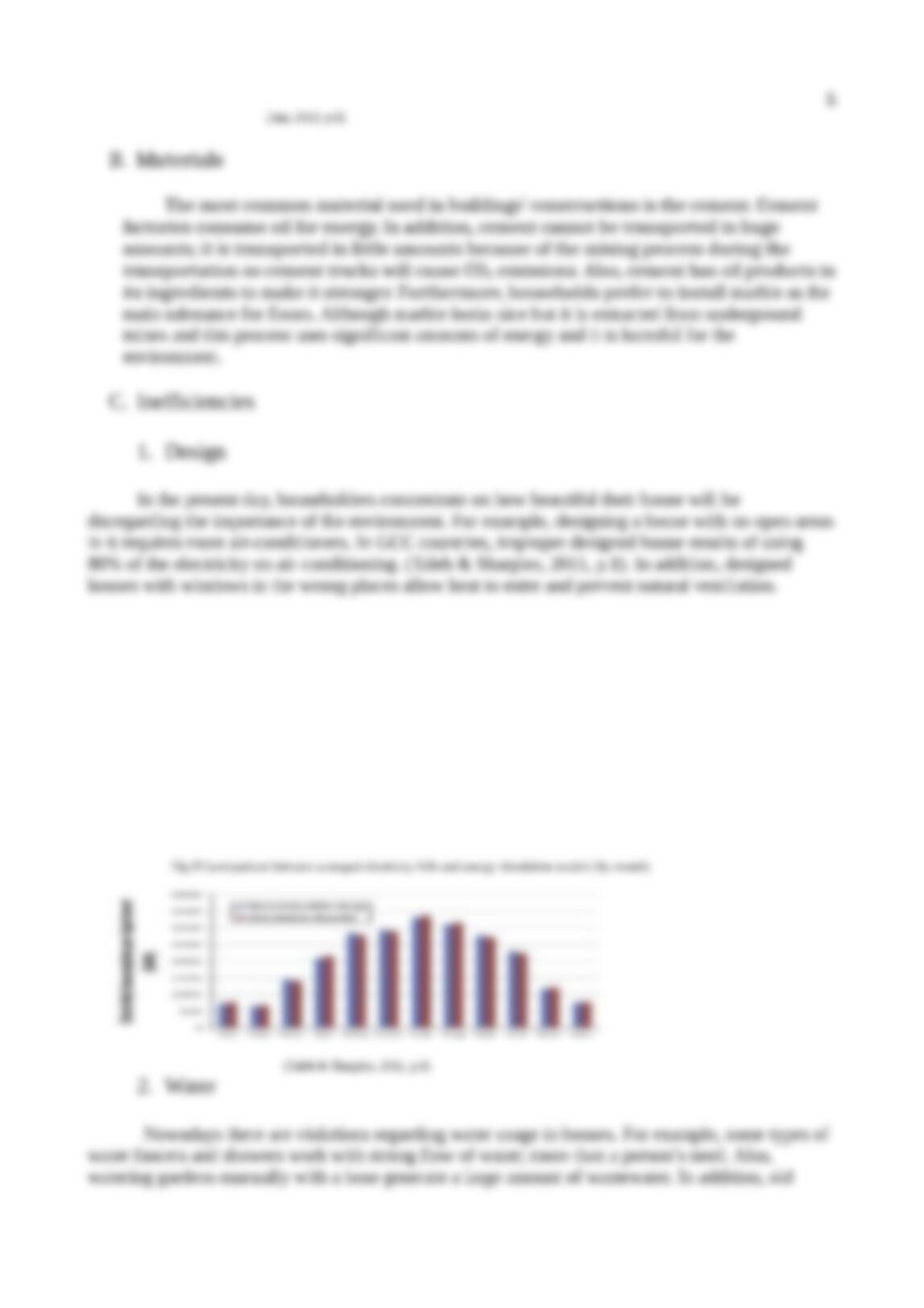
Another factor that affect the environment in our current situation is the increasing of
the population. As the MOWE indicated (2012, p.8), the population was slightly over 20
millions by the year 2000 and expected to reach 30 millions by 2020 (Fig# 1). Therefore, it is
increasing dramatically by 2.8% per annum (mowe, 2012, p.6). Those people need houses,
facilities, and they need to transport so more energy consumption will occur. Some countries
are not giving this crisis any attention such as Saudi Arabia, so in short period of ignorance the
problem will be worse and the oil will not cover demand.
Figure #1 (Urbanization in Saudi Arabia)
(MOWE, 2012, p.8)
II. ACCOMODATION & BUILDINGS
A. Statistics
4