1
Copyright © 2016 Pearson Education, Inc.
Economic Analysis of Social Issues (Grant)
Chapter 4 Game Theory: Games Between Three or More Players
4.1 Introduction to Three-Player Games
1) In a three-player game, which of the following is not one of the player designations for a
payoff matrix?
A) row
B) column
C) chapter
D) page
Answer: C
Diff: 1 Page Ref: 82
Topic: Introduction to Three-Player Games
Learning Outcome: Micro-16: Discuss the functions of cooperation, competition, and public
policies in oligopolies.
AACSB : Application of knowledge
2
Copyright © 2016 Pearson Education, Inc.
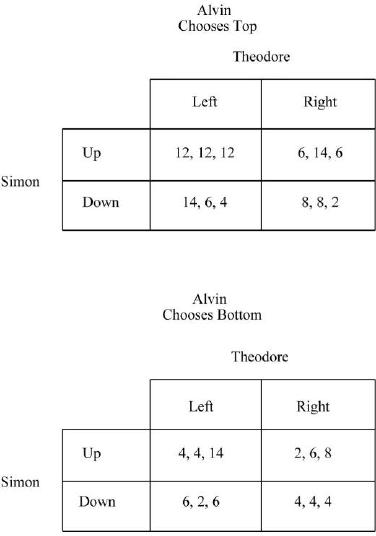
Figure 4.1
2) Refer to Figure 4.1. Alvin is the ________ player.
A) row
B) column
C) chapter
D) page
Answer: D
Diff: 1 Page Ref: 80-82
Topic: Introduction to Three-Player Games
Learning Outcome: Micro-16: Discuss the functions of cooperation, competition, and public
policies in oligopolies.
AACSB : Application of knowledge
3) Refer to Figure 4.1. Simon is the ________ player.
A) row
B) column
C) chapter
D) page
Answer: A
Diff: 1 Page Ref: 80-82
Topic: Introduction to Three-Player Games
Learning Outcome: Micro-16: Discuss the functions of cooperation, competition, and public
policies in oligopolies.
AACSB : Application of knowledge
3
Copyright © 2016 Pearson Education, Inc.
4) Refer to Figure 4.1. Theodore is the ________ player.
A) row
B) column
C) chapter
D) page
Answer: B
Diff: 1 Page Ref: 80-82
Topic: Introduction to Three-Player Games
Learning Outcome: Micro-16: Discuss the functions of cooperation, competition, and public
policies in oligopolies.
AACSB : Application of knowledge
5) Refer to Figure 4.1. Alvin’s available strategies include
A) top and bottom.
B) up and down.
C) left and right.
D) all of the above
Answer: A
Diff: 2 Page Ref: 80-82
Topic: Introduction to Three-Player Games
Learning Outcome: Micro-16: Discuss the functions of cooperation, competition, and public
policies in oligopolies.
AACSB : Application of knowledge
6) Refer to Figure 4.1. Simon’s available strategies include
A) top and bottom.
B) up and down.
C) left and right.
D) all of the above
Answer: B
Diff: 2 Page Ref: 80-82
Topic: Introduction to Three-Player Games
Learning Outcome: Micro-16: Discuss the functions of cooperation, competition, and public
policies in oligopolies.
AACSB : Application of knowledge
7) Refer to Figure 4.1. Theodore’s available strategies include
A) top and bottom.
B) up and down.
C) left and right.
D) all of the above
Answer: C
Diff: 2 Page Ref: 80-82
Topic: Introduction to Three-Player Games
Learning Outcome: Micro-16: Discuss the functions of cooperation, competition, and public
policies in oligopolies.
AACSB : Application of knowledge
4
Copyright © 2016 Pearson Education, Inc.
8) Refer to Figure 4.1. Suppose Alvin chooses Bottom, while Simon chooses Up, and Theodore
chooses Right. Alvin’s payoff will be
A) 2.
B) 6.
C) 8.
D) 16.
Answer: C
Diff: 2 Page Ref: 80-82
Topic: Introduction to Three-Player Games
Learning Outcome: Micro-16: Discuss the functions of cooperation, competition, and public
policies in oligopolies.
AACSB : Analytic thinking
9) Refer to Figure 4.1. Suppose Alvin chooses Top, while Simon chooses Down, and Theodore
chooses Right. Simon’s payoff will be
A) 2.
B) 8.
C) 10.
D) 18.
Answer: B
Diff: 2 Page Ref: 80-82
Topic: Introduction to Three-Player Games
Learning Outcome: Micro-16: Discuss the functions of cooperation, competition, and public
policies in oligopolies.
AACSB : Analytic thinking
10) Refer to Figure 4.1. Suppose Alvin chooses Top, while Simon chooses Down, and Theodore
chooses Left. Theodore’s payoff will be
A) 4.
B) 6.
C) 14.
D) 24.
Answer: B
Diff: 2 Page Ref: 80-82
Topic: Introduction to Three-Player Games
Learning Outcome: Micro-16: Discuss the functions of cooperation, competition, and public
policies in oligopolies.
AACSB : Analytic thinking
11) In a payoff matrix for a three-player game, there are three payoffs in each cell. The third
payoff goes to the column player.
Answer: FALSE
Diff: 1 Page Ref: 80-82
Topic: Introduction to Three-Player Games
Learning Outcome: Micro-16: Discuss the functions of cooperation, competition, and public
policies in oligopolies.
AACSB : Application of knowledge
5
Copyright © 2016 Pearson Education, Inc.
12) In a payoff matrix for a three-player game, one player picks the row, another picks the
column, and the third picks the page.
Answer: TRUE
Diff: 1 Page Ref: 80-82
Topic: Introduction to Three-Player Games
Learning Outcome: Micro-16: Discuss the functions of cooperation, competition, and public
policies in oligopolies.
AACSB : Application of knowledge
13) In a three-player game, each player must have three choices.
Answer: FALSE
Diff: 2 Page Ref: 80-82
Topic: Introduction to Three-Player Games
Learning Outcome: Micro-16: Discuss the functions of cooperation, competition, and public
policies in oligopolies.
AACSB : Application of knowledge
14) When economists model a game with three players instead of two, what is different about the
payoff matrix and the payoffs listed in each cell of the matrix?
Answer: The payoff matrix contains a separate page for each possible strategy available to one
player. On each page, an ordinary payoff matrix summarizes the choices available to the
remaining two players, given the strategy chosen by the first player. Each cell shows three
payoffs, with the first going to the row player, the second to the column player, and the third to
the page player.
Diff: 2 Page Ref: 80-82
Topic: Introduction to Three-Player Games
Learning Outcome: Micro-16: Discuss the functions of cooperation, competition, and public
policies in oligopolies.
AACSB : Analytic thinking
15) In a three-player game where each player has to make one of two choices, either North or
South, how many possible choices are there, and what specifically are those choices? Identify the
players as player A, player B, and player C.
Answer: There are 8 possible choices:
1. Player A chooses North, Player B chooses North, Player C chooses North
2. Player A chooses North, Player B chooses North, Player C chooses South
3. Player A chooses North, Player B chooses South, Player C chooses North
4. Player A chooses North, Player B chooses South, Player C chooses South
5. Player A chooses South, Player B chooses North, Player C chooses North
6. Player A chooses South, Player B chooses North, Player C chooses South
7. Player A chooses South, Player B chooses South, Player C chooses North
8. Player A chooses South, Player B chooses South, Player C chooses South
Diff: 3 Page Ref: 80-82
Topic: Introduction to Three-Player Games
Learning Outcome: Micro-16: Discuss the functions of cooperation, competition, and public
policies in oligopolies.
AACSB : Analytic thinking
6
Copyright © 2016 Pearson Education, Inc.
4.2 Finding Nash Equilibria in Three-Player Games
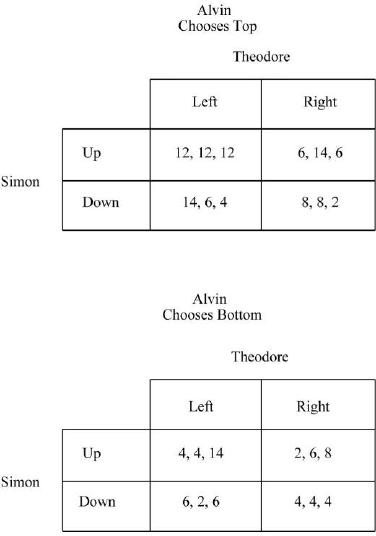
Figure 4.1
1) Refer to Figure 4.1. The dominant strategy for Alvin is
A) Top.
B) Bottom.
C) both Top and Bottom.
D) Alvin does not have a dominant strategy.
Answer: B
Diff: 2 Page Ref: 82-83
Topic: Dominance in Three-Player Games
Learning Outcome: Micro-16: Discuss the functions of cooperation, competition, and public
policies in oligopolies.
AACSB : Analytic thinking
2) Refer to Figure 4.1. The dominant strategy for Simon is
A) Up.
B) Down.
C) both Up and Down.
D) Simon does not have a dominant strategy.
Answer: B
Diff: 2 Page Ref: 82-83
Topic: Dominance in Three-Player Games
Learning Outcome: Micro-16: Discuss the functions of cooperation, competition, and public
policies in oligopolies.
AACSB : Analytic thinking
3) Refer to Figure 4.1. The dominant strategy for Theodore is
A) Left.
B) Right.
C) both Left and Right.
D) Theodore does not have a dominant strategy.
Answer: B
Diff: 2 Page Ref: 82-83
Topic: Dominance in Three-Player Games
Learning Outcome: Micro-16: Discuss the functions of cooperation, competition, and public
policies in oligopolies.
AACSB : Analytic thinking
4) Refer to Figure 4.1. A Nash equilibrium can be found at
A) (Up; Top; Left).
B) (Up; Top; Right).
C) (Down; Bottom; Right).
D) There is no Nash equilibrium.
Answer: C
Diff: 2 Page Ref: 82-83