1
Copyright © 2016 Pearson Education, Inc.
Economic Analysis of Social Issues (Grant)
Chapter 3 Basic Game Theory: Games Between Two Players
3.1 What is Game Theory?
1) A method of analyzing the strategic interaction that occurs between small numbers of people,
firms, organizations, or countries is called
A) clinical observation.
B) microdemographics.
C) forensic economics.
D) game theory.
Answer: D
Diff: 1 Page Ref: 57
Topic: What Is Game Theory?
Learning Outcome: Micro-20: Apply the concepts of opportunity cost, marginal analysis, and
present value to make decisions.
AACSB : Application of knowledge
2) Anticipating the decisions others will make in response to your decision while knowing the
others are anticipating your response is known as
A) strategic interaction.
B) the wait-and-see game.
C) psychic intuition.
D) best-response analysis.
Answer: A
Diff: 1 Page Ref: 57
Topic: What Is Game Theory?
Learning Outcome: Micro-20: Apply the concepts of opportunity cost, marginal analysis, and
present value to make decisions.
AACSB : Application of knowledge
3) The characteristic of games whereby the outcome of the game depends not only on what you
do but on what the other players do in response is called
A) strategic interaction.
B) mutual interdependence.
C) optimal choice analysis.
D) decision theory.
Answer: B
Diff: 1 Page Ref: 57
Topic: What Is Game Theory?
Learning Outcome: Micro-20: Apply the concepts of opportunity cost, marginal analysis, and
present value to make decisions.
AACSB : Application of knowledge
2
Copyright © 2016 Pearson Education, Inc.
4) Game theory is a method of analyzing the strategic interaction that occurs between small
numbers of
A) people.
B) firms.
C) countries.
D) All of the above are correct.
Answer: D
Diff: 1 Page Ref: 57
Topic: What Is Game Theory?
Learning Outcome: Micro-20: Apply the concepts of opportunity cost, marginal analysis, and
present value to make decisions.
AACSB : Application of knowledge
5) Which of the following situations is least likely to involve strategic interaction?
A) two countries deciding whether to impose trade restrictions on each other
B) competing convenience stores deciding how much to charge for coffee
C) two customers deciding which toaster to buy from Target
D) a state legislature deciding whether to legalize casino gambling
Answer: C
Diff: 2 Page Ref: 57
Topic: What Is Game Theory?
Learning Outcome: Micro-20: Apply the concepts of opportunity cost, marginal analysis, and
present value to make decisions.
AACSB : Analytic thinking
6) Which of the following situations is least likely to involve mutual interdependence?
A) Canada is thinking about banning all imported beef from the United States.
B) Octavia is thinking about trading in her Toyota Prius for a BMW 220i.
C) Walmart is considering moving up the start-time for its Black Friday sales to 12:01 AM on
Thanksgiving day.
D) McDonald’s is thinking about lowering all its menu prices by 50 percent.
Answer: B
Diff: 2 Page Ref: 57-58
Topic: What Is Game Theory?
Learning Outcome: Micro-20: Apply the concepts of opportunity cost, marginal analysis, and
present value to make decisions.
AACSB : Analytic thinking
3
Copyright © 2016 Pearson Education, Inc.
7) When playing a game, you need to
A) anticipate the moves others might be making.
B) choose a strategy based on the move you anticipate from your rival.
C) both A and B
D) neither A nor B
Answer: C
Diff: 2 Page Ref: 58
Topic: What Is Game Theory?
Learning Outcome: Micro-20: Apply the concepts of opportunity cost, marginal analysis, and
present value to make decisions.
AACSB : Analytic thinking
8) When the payoff you receive depends only on what you choose, but not on what your
opponent chooses, mutual interdependence is said to exist.
Answer: FALSE
Diff: 1 Page Ref: 57
Topic: What Is Game Theory?
Learning Outcome: Micro-20: Apply the concepts of opportunity cost, marginal analysis, and
present value to make decisions.
AACSB : Application of knowledge
9) Choosing a pair of shoes that fit your feet most comfortably describes both a decision and a
game.
Answer: FALSE
Diff: 1 Page Ref: 58
Topic: What Is Game Theory?
Learning Outcome: Micro-20: Apply the concepts of opportunity cost, marginal analysis, and
present value to make decisions.
AACSB : Application of knowledge
10) When you are playing a game, you must anticipate the move that other players might be
making.
Answer: TRUE
Diff: 1 Page Ref: 58
Topic: What Is Game Theory?
Learning Outcome: Micro-20: Apply the concepts of opportunity cost, marginal analysis, and
present value to make decisions.
AACSB : Analytic thinking
4
Copyright © 2016 Pearson Education, Inc.
11) Of the following situations, explain which are best described as games and which are best
described as just decisions:
a. Starbucks is deciding whether to offer a new, 40 oz. option called the Uberventi.
b. Sasha is deciding whether to order a grande latte or venti latte from Starbucks.
c. The people of Catalonia are deciding whether to vote for independence from Spain.
d. MGM Resorts International is preparing to bid to obtain the last available casino license in
Macao.
e. The Hollywood Hills Homeowner Association is debating the landscape design for the
renovation of the main entrance to their neighborhood.
Answer: Situations a, c, and d are best described as games because they involve strategic
interaction and mutual interdependence. Situations b and e are best described as just decisions
because they do not involve any significant degree of strategic interaction or mutual
interdependence.
Diff: 3 Page Ref: 57-58
Topic: What Is Game Theory?
Learning Outcome: Micro-20: Apply the concepts of opportunity cost, marginal analysis, and
present value to make decisions.
AACSB : Analytic thinking
12) Explain why choosing which job to apply for constitutes a game, while choosing where to
order pizza for dinner is more likely just a decision.
Answer: Choosing which job to apply for is a game because it involves mutual interdependence.
Each job opening is only available to one person, so being hired not only depends on what you
do in an attempt to be hired and what qualities you can bring to the job, such as preparing for
your interview, making sure you have great references, your previous job experience, etc., but
also what qualities other applicants (the other players) have or how hard they work to get the job.
Choosing where to order a pizza is just a decision because there is no mutual interdependence
involved.
Diff: 2 Page Ref: 57-58
Topic: What Is Game Theory?
Learning Outcome: Micro-20: Apply the concepts of opportunity cost, marginal analysis, and
present value to make decisions.
AACSB : Analytic thinking
5
Copyright © 2016 Pearson Education, Inc.
3.2 The Basic Structure of Games
1) A structured and simplified version of reality that can be used to explain real-world behavior
is called
A) an economic model.
B) a rationality assumption.
C) a postulate.
D) a normative alternate reality.
Answer: A
Diff: 1 Page Ref: 58
Topic: The Basic Structure of Games
Learning Outcome: Micro-1: Identify the basic principles of economics and explain how to
think like an economist.
AACSB : Application of knowledge
2) A payoff matrix summarizes all of the following except
A) who the players are.
B) the reason each player is playing the game.
C) the actions available to each player.
D) the payoffs available to each player.
Answer: B
Diff: 1 Page Ref: 58
Topic: Setting Up a Game
Learning Outcome: Micro-1: Identify the basic principles of economics and explain how to
think like an economist.
AACSB : Application of knowledge
3) A Nash equilibrium is an outcome where
A) both players are playing their best strategy, given the strategy chosen by the opponent.
B) both players are playing their best strategy, regardless of the strategy chosen by the opponent.
C) only one player can play his or her best strategy due to the strategy chosen by the opponent.
D) neither player has a best strategy to play.
Answer: A
Diff: 1 Page Ref: 60
Topic: Nash Equilibrium
Learning Outcome: Micro-16: Discuss the functions of cooperation, competition, and public
policies in oligopolies.
AACSB : Application of knowledge
6
Copyright © 2016 Pearson Education, Inc.
4) The person often credited with inventing modern game theory is
A) John Nash.
B) Albert Einstein.
C) John von Neumann.
D) Isaac Newton.
Answer: C
Diff: 1 Page Ref: 61
Topic: Nash Equilibrium
Learning Outcome: Micro-16: Discuss the functions of cooperation, competition, and public
policies in oligopolies.
AACSB : Application of knowledge
Special Feature: The People Behind the Theory: John Nash
5) A strategy which is universally best, regardless of the strategy chosen by others, is called a
A) Nash strategy.
B) dominant strategy.
C) mutually interdependent strategy.
D) zero-sum strategy.
Answer: B
Diff: 1 Page Ref: 62
Topic: Strategies for Finding Equilibria
Learning Outcome: Micro-16: Discuss the functions of cooperation, competition, and public
policies in oligopolies.
AACSB : Application of knowledge
6) Leona and Bernie have committed a crime. If Leona denies committing the crime, Bernie can
lower his penalty from 5 years to 2 years by confessing to the crime. If Leona confesses to the
crime, Bernie can lower his penalty from 18 years to 7 years by confessing to the crime. Based
on this information, we know with certainty that
A) Bernie’s dominant strategy is to deny the crime.
B) Bernie has no dominant strategy.
C) Bernie’s dominant strategy is to confess to the crime.
D) Bernie’s dominant strategy is to confess to the crime only if Leona denies committing the
crime.
Answer: C
Diff: 2 Page Ref: 62
Topic: Strategies for Finding Equilibria
Learning Outcome: Micro-16: Discuss the functions of cooperation, competition, and public
policies in oligopolies.
AACSB : Analytic thinking
7) If both players in a game have a dominant strategy, then the game they are playing
A) has no Nash equilibrium.
B) must have one Nash equilibrium.
C) must have two Nash equilibria — one for each player.
D) More information is needed to determine the number of Nash equilibria in the game.
Answer: B
Diff: 2 Page Ref: 62
Topic: Strategies for Finding Equilibria
Learning Outcome: Micro-16: Discuss the functions of cooperation, competition, and public
policies in oligopolies.
AACSB : Analytic thinking
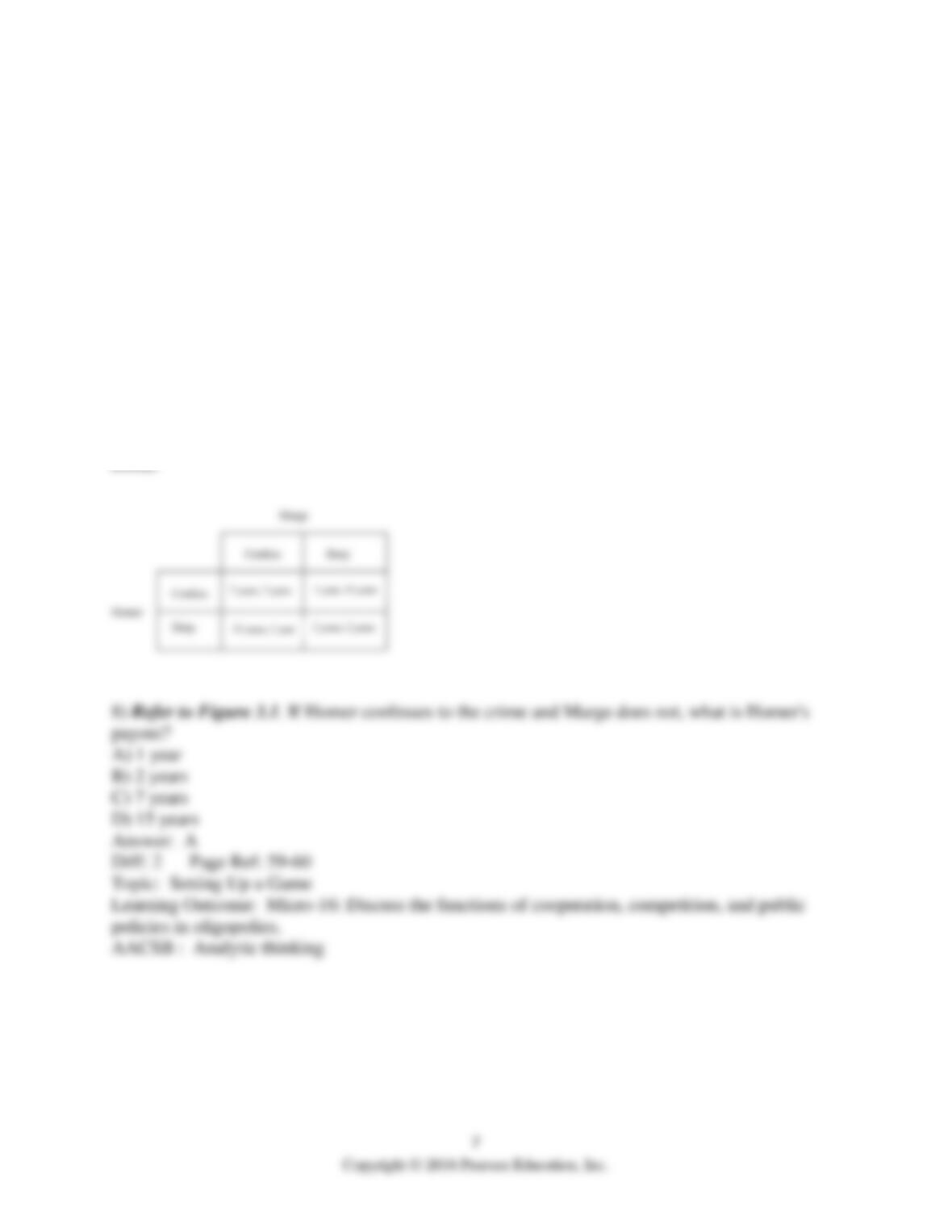
Figure 3.1
Homer and Marge have been accused of committing a crime, and the payoff matrix below
represents the payoffs associated with confessing to the crime and denying having committed the