Professor Ricardo Perez–Truglia Fall 2018
Management 405 Managerial Economics
1
Practice Exercises
Module 7: Advanced Pricing and Auctions
1. Consumer Surplus Parity
There is currently only a single firm, PharmaSolutions, that specializes in software and associated
support to assist pharmaceutical firms in the management of its clinical trials. The typical client
values the PharmaSolutions program at $400,000. They would be willing to pay, at most, that
amount for the product rather than to do without it. The price that PharmaSolutions is charging is
$250,000. (No need to consider why that price is selected.)
A potential entrant called DrugSoft is considering entering the market with its own proprietary
software product. DrugSoft’s program would be superior to that of PharmaSolutions and the
company is weighing the product’s superiority in its pricing strategy should it enter the market.
Most experts in the industry consider DrugSoft’s program, with its projected features, to be worth
$500,000 each to the pharmaceutical firms that might deploy it.
a. What is the maximum price that DrugSoft could charge for its version of its software assuming
PharmaSolutions maintains its price? Why?
b. If PharmaSolutions were to drop its price to $200,000 should DrugSoft enter the market, what is
then the maximum price that DrugSoft could charge?
c. Suppose that a switching cost would be incurred by the existing clients of PharmaSolutions
should they switch to the new entrant. Imagine the switching cost is $100,000. What is now the
maximum price that DrugSoft could charge existing clients – assuming that PharmaSolutions would
charge a price of $200,000 – and have a chance of selling to them?
d. Suppose DrugSoft does not anticipate having its ATC dip beneath $225,000 at foreseeable
volumes, should it enter the market – assuming that PharmaSolutions charges a price of $200,000
and that switching costs are $100,000?
2. Two–Part Pricing (from Pindyck and Rubinfeld)
You are an executive for Super Computer, Inc. (SC), which rents out supercomputers. SC receives a
fixed rental payment per time period in exchange for the right to unlimited computing at a rate of
P cents per second. SC has two types of potential customers in equal number – 10 businesses and
10 academic customers.
Each business customer has the demand function Q = 10 – P, where Q is in millions of seconds per
month. Each academic institution has the demand Q = 8 – P. The marginal cost to SC of additional
computing is 2 cents per second, regardless of volume.
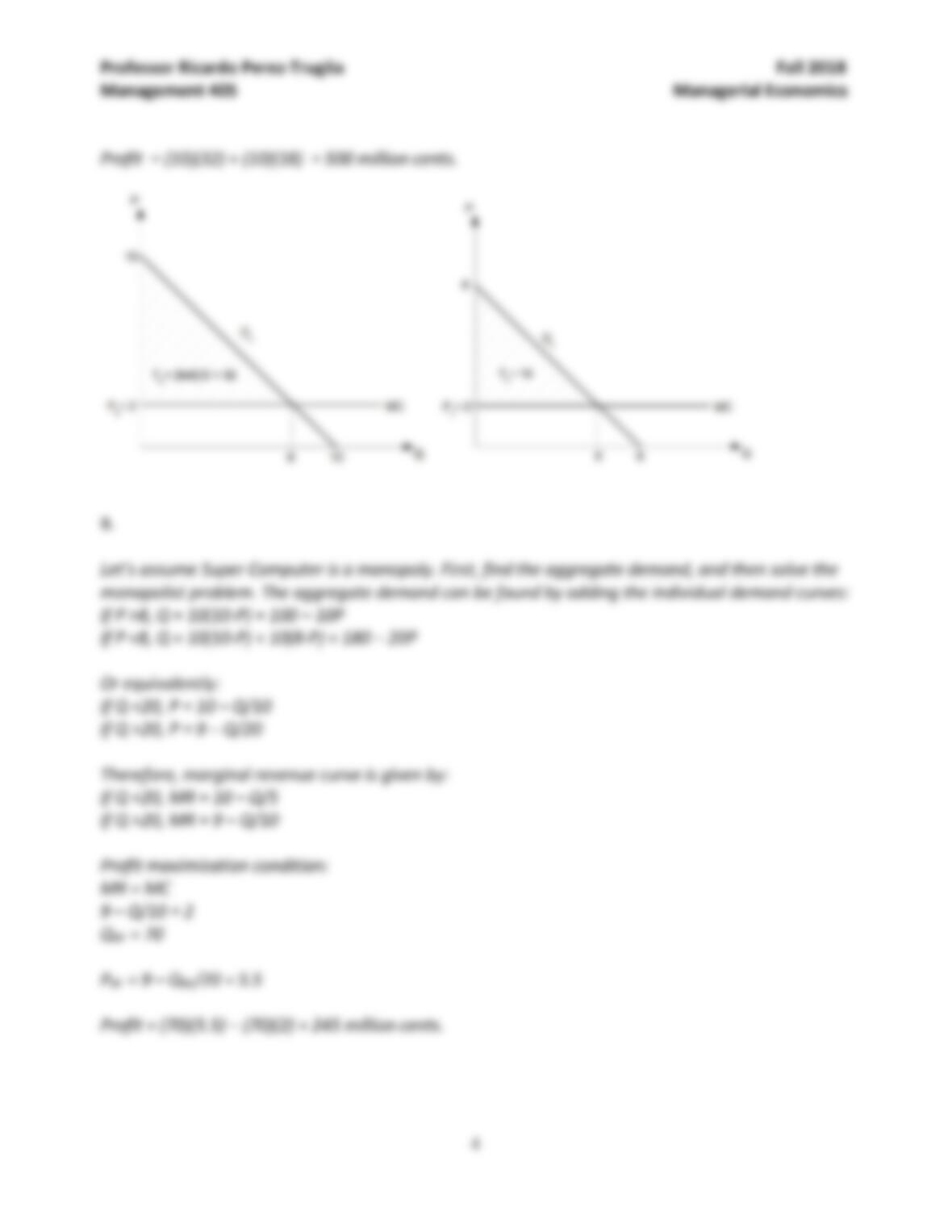
A. Suppose you want to separate business and academic customers. What rental fee and
usage fee would you charge each group? What would your profits be?
Professor Ricardo Perez–Truglia Fall 2018
Management 405 Managerial Economics
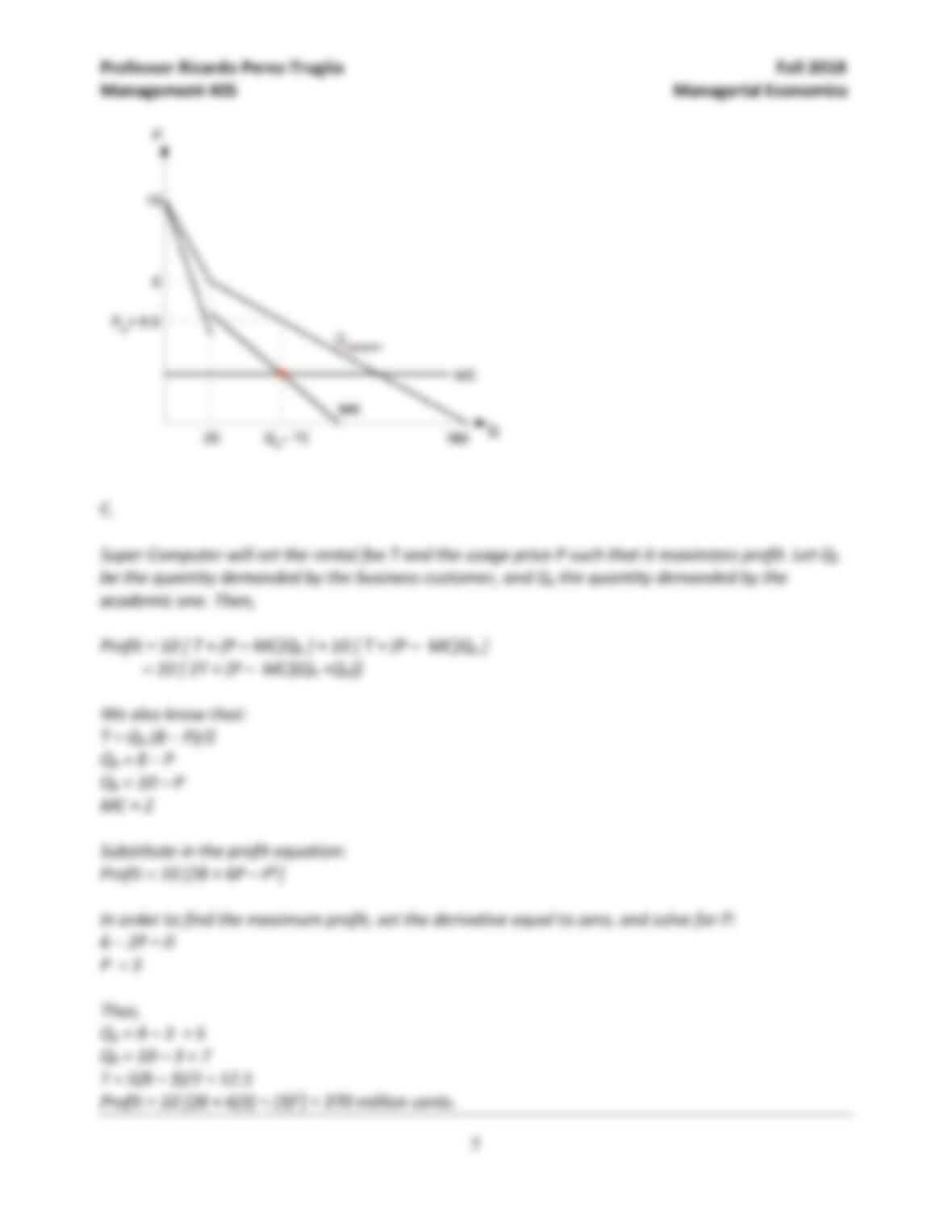
B. Suppose you were unable to keep both kinds of customers separate and charged a zero
rental fee. What usage fee would maximize your profits? What would be your profits?
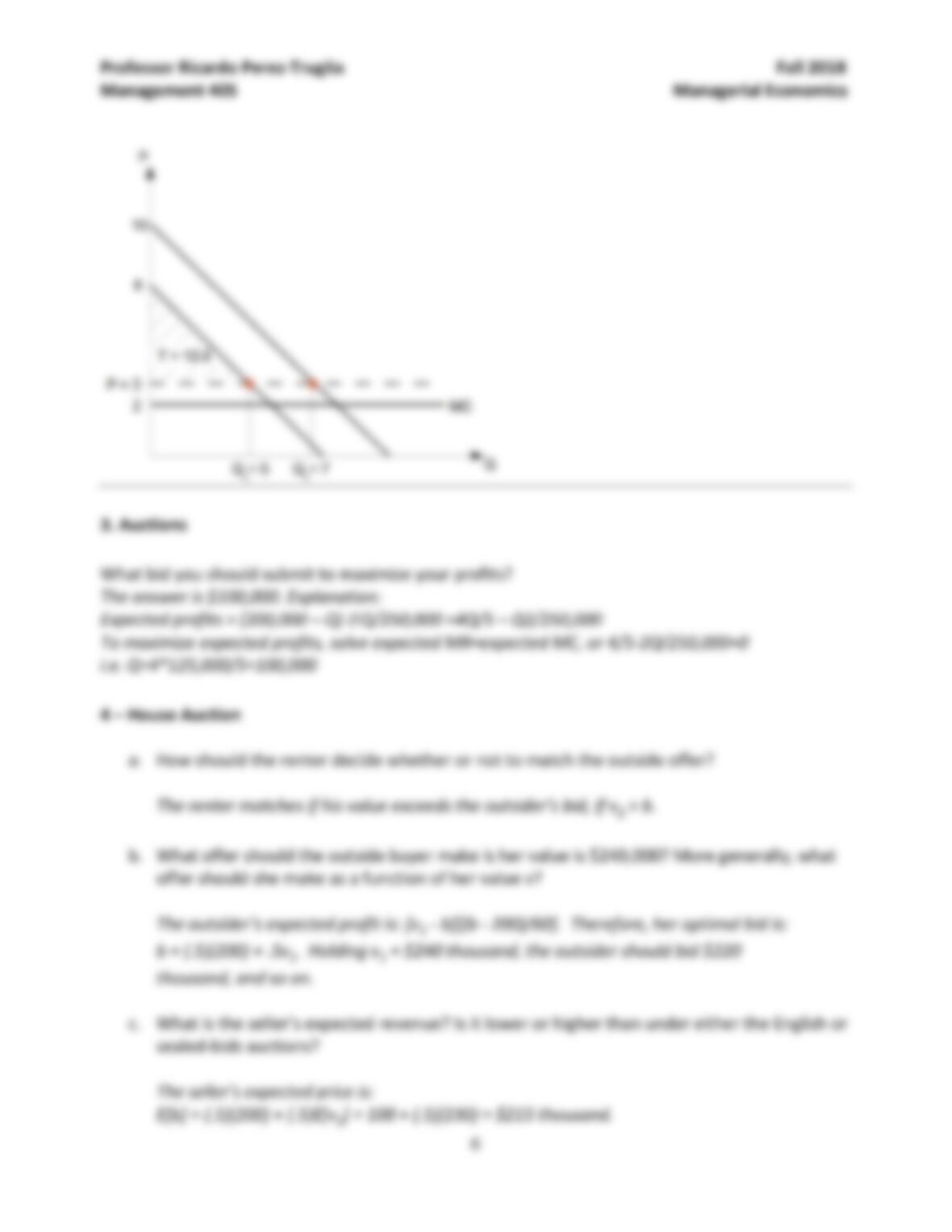
C. Suppose you were to set up a single two–part tariff – that is, you set one rental and one
usage fee that both academic and business customers pay. What rental and usage fees
would you set? What would be your profits? Explain why price would not be equal to
marginal cost.
3. Auctions
(Adapted from Besanko and Braeutigam, 3rd ed). You are bidding for an architectural remodel job
against one other contractor in a first–price sealed bid auction with private values. You believe that
the other bidder’s valuation is equally likely to lie anywhere in the interval from $0 to $500,000.
Your own valuation is $200,000. Suppose that you expect the other contractor to submit a bid
equal to exactly one half of her valuation. Thus, you believe that your rival’s bids are equally likely
to fall anywhere between $0 and $250,000. Given this, if you submit a bid of Q, the probability
that you win the auction is the probability that your bid Q exceeds your rival’s bid. It turns out that