1. If the real interest rate increases, what will happen to planned investment (all else being equal)? B. Planned
investment will decrease 2. What did Keynes say we should do to end a recession? D. Rely on the government to
increase spending 3. If actual unemployment is higher than the natural rate, what are automatic stabilizers doing to
aggregate demand? Answer: Automatic stabilizers are increasing aggregate demand. 6. According to Classical
theory, what should the government do if the economy goes into a recession? C. Nothing; the economy will adjust
back to potential GDP by itself 7.What is the primary function of money? Answer: Medium of exchange 10. If
aggregate purchases are higher than aggregate production, what is happening to inventories? B. Inventories are
shrinking 11. If the economy is experiencing an inflationary GDP gap, how does the unemployment rate compare to
the natural rate? Answer: Unemployment is less than the natural rate. 12. What is the most important determinant of
household consumption? A. Disposable income 14. Historically, the level of investment spending in the U.S. has
tended to be: B. Volatile 15. According to the Classical model, what happens to the wage rate during a recession?
Answer: The wage rate falls far enough to shift aggregate supply downward far enough to restore equilibrium at
potential GDP. 18. Which major school of macro-economic thought believes that the economy is inherently
unstable, and that discretionary fiscal policy should be used to manage aggregate demand? B. Keynesian 19. How
will an increase in aggregate supply (all else being equal) affect the price level? Answer: It will lower the price level
21. Which of the following are factors which may limit the effectiveness of fiscal policy? A. The crowding out
effect B. Time lags between the recognition of a macro problem and the implementation of corrective measures C.
Political considerations which could alter the content and timing of fiscal policy D. All of the above
22. Private investment gets “crowded out” when the government runs a deficit, because: B. Government borrowing
raises the real interest rate 23. Which of the following government expenditures is not an investment. That is, which
is not likely to expand future production possibilities? B. Social Security payments 24. If aggregate purchases
exceed aggregate production, what happens to inventories? Answer: Inventories are drawn down 26. A sustained
increase in total output is possible only if: B. The aggregate supply curve shifts to the right 27. Economic growth, in
the long run: A. Shifts the production possibilities curve outward 28. Which of the following Federal Reserve
actions indicates a contractionary monetary policy? D. Selling government securities on the open market 29. Which
of the following measures the growth rate of an economy? A. The percentage change in real GDP from one period to
another 30. Because of this economist’s theories about the inevitable consequences of population growth, economics
came to be called the Dismal Science. B. Thomas Malthus 31. Which of the following statements about the Federal
debt is not true? B. The Federal debt gets larger any year that tax receipts exceed government spending 33. Which of
the following is not a leakage from the circular flow diagram? B. Investment 34. If disposable income increases,
what will happen to net exports? Answer: An increase in disposable income will lead to an increase in imports, with
no change in exports. Thus, net exports will decline. 35. The equation of exchange is MV = PQ. What do each of
the 4 terms stand for? Answer: M = Money supply, V = Velocity of money, P = Price level, Q = Read GDP 36. “At
current rates of consumption, the world will run out of oil in 50 years.” Even if this statement is true, why is there
likely to still be plenty of oil 50 years from now? C. As oil supplies dwindle, the price of oil will rise and the rate of
consumption will fall 37. Which of the following events would cause aggregate supply to decline? D. A war in the
Middle East that shuts down the Saudi Arabian oil fields 38. If inventories are falling, how does planned investment
compare to actual investment? Answer: Planned investment is greater than actual investment (because of the
unintended decrease in inventories) 41. Compared to business cycles before World War I, contractions since the end
of World War II have generally been: A. Shorter and milder 42. What effect will the purchase of government
securities by the Fed have on the monetary base? Answer: It will cause the monetary base to increase. 44. Who
founded the monetarist school of economic thought? C. Milton Friedman
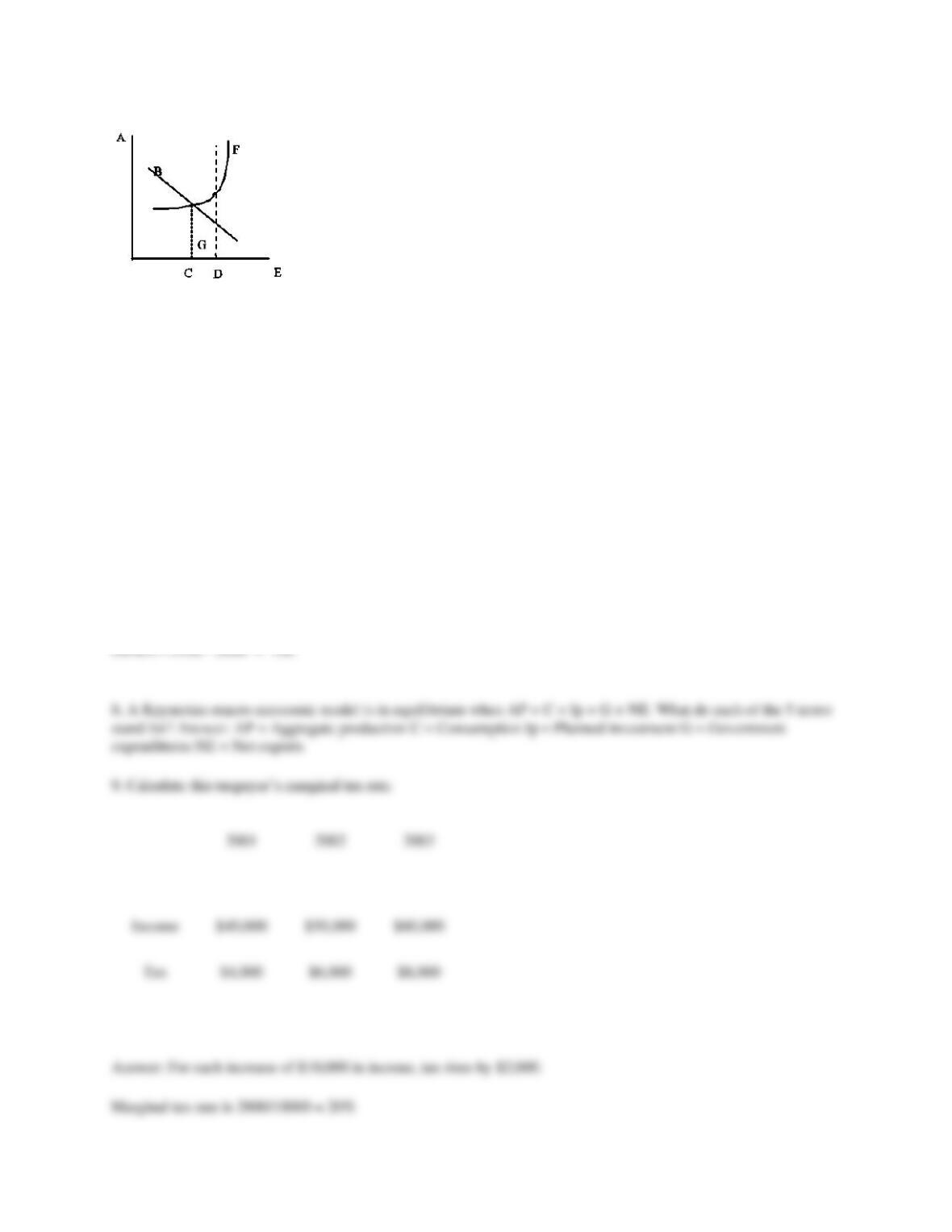
4. Label the 7 parts of this graph.
A = 9. Price level B = 4. Aggregate demand C = 7. Equilibrium GDP D = 8. Potential GDP E = 6. Real
GDP F = 5. Aggregate supply G = 1. Recessionary GDP gap
5. Using the figures below, calculate the federal budget deficit.
Discretionary spending = 600 Tax receipts = 2,000
Spending on entitlements = 1,250 Interest on the debt = 250
Answer: Deficit = Total spending – Tax receipts
Total spending = Discretionary + Entitlements + Interest on debt
= 600 + 1250 + 250
= 2100