Jennah Hapatsha
ECON 2020
EXAM 2
July 8, 2017
1. Assume that Anthi has $14 to spend on Pizza and Pepsi and both goods must be purchased
whole (no fractional units). Pizzas cost $6 each and Pepsi cost $2 each. Anthi’s preferences are
summarized by the following information:
(a) Fill in the figures for marginal utility and marginal utility per dollar for both Pizza and
Pepsi.
(b) Given the budget of $14 what quantity of Pizzas and what quantity of Pepsi will maxi-
mize Anthi’s utility? Explain.
2 pizzas and 1 pepsi. To maximize utility, the individual should allocate income toward
those goods with the highest marginal utility per dollar. The first and second pizza have a
Number of Pizzas
TU
MU
MU/$
1
30
30-0=30
30/6=5
2
52
52-30=22
22/6=3.67
3
67
67-52= 15
15/6=2.50
4
76
76-67=9
9/6=1.50
5
80
80-76=4
4/6=0.67
Number of
Pepsis
TU
MU
MU/$
1
20
20-0=20
20/2=10
2
35
35-20=15
15/2= 7.50
3
47
47-35=12
12/2=6.00
4
57
57-47=10
10/2= 5.00
5
64
64-57=7
7/2=3.50
high marginal utility than the pepsi, which is how we decide that 2 pizzas maximizes his
utility, costing a subtotal of $12. Next the 1 bottle of pepsi comes in third as far as for mar–
gial utility. With that 1 bottle, it allows Anthony to reach his spending which comes to
$14.00.
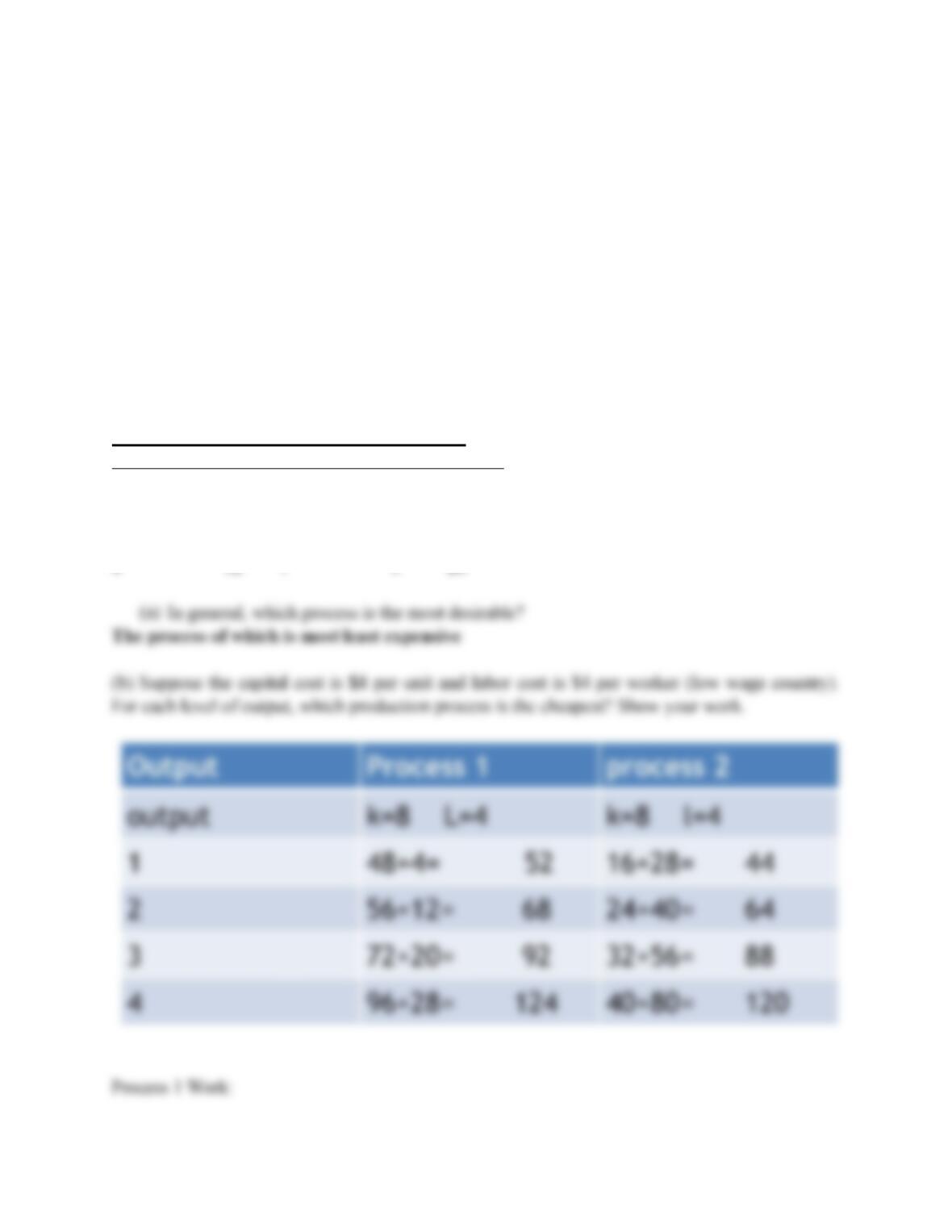
2. Consider a firm which it can use two different production processes to produce different levels
of output as follows:
Process 1 Process 2
Output K L K L
1 6 1 2 7
2 7 3 3 10
3 9 5 4 14