(Introduction to Macroeconomics ECON 202 C)
Assignment 1 (Solution)
Due Date: January 24
1. Which of the following goods are usually intermediate goods and which are usually final goods:
running shoes; cotton fibers; watches; textbooks; coal; sunscreen lotion; lumber?
Answer: Running shoes are usually a final good. The person purchasing the running shoes is
typically the individual who will use the shoes.
Cotton fibers are usually an intermediate good. The cotton fibers are used to produce other goods
that will be sold in the market.
Watches are usually a final good. The person purchasing the watch is typically the individual who
will use the watch.
Textbooks are usually a final good. The person purchasing the textbook is typically the individual
who will use the textbook.
Coal is usually an intermediate good. The coal is used to produce other goods, primarily electricity,
that will be sold in the market.
Sunscreen lotion is usually a final good. The person purchasing the sunscreen lotion is typically the
individual who will use the sunscreen lotion.
Lumber is usually an intermediate good. The lumber is used to produce other goods, that will be sold
in the market.
2. Which of the following are included or excluded in deriving this year’s GDP? Explain your answer in
each case.
a. Interest received on a Rogers Communications corporate bond.
b. Canada Pension Plan payments received by a retired factory worker.
c. The unpaid services of a family member in painting the family home.
d. The Income of a dentist from the dental services provided.
e. The monthly allowance a college/university student receives from home.
f. The money received by Josh when he resells his nearly brand-new Honda automobile to Kim.
g. The publication and sale of a new college/university textbook.
h. An increase in leisure resulting from a two-hour decrease in the length of the workweek, with no
reduction in pay.
i. A $2 billion increase in business inventories.
j. The purchase of 100 shares of Research in Motion common stock.
Answer:
(a) Included. Income received by the bondholder for the services derived by the corporation for the
loan of money.
(b) Excluded. A transfer payment from taxpayers for which no service is rendered (in this year).
(c) Excluded. Nonmarket production.
(d) Included. Payment for a final service. You cannot pass on a tooth extraction!
(e) Excluded. A private transfer payment; simply a transfer of income from one private individual to
another for which no transaction in the market occurs.
(f) Excluded. The production of the car had already been counted at the time of the initial sale.
(g) Included. It is a new good produced for final consumption.
(h) Excluded. The effect of the decline will be counted, but the change in the workweek itself is not
the production of a final good or service or a payment for work done.
(i) Included. The increase in inventories could only occur as a result of increased production.
(j) Excluded. Merely the transfer of ownership of existing financial assets.
3. The following table shows nominal GDP and an appropriate price index for a group of selected years.
Compute real GDP. Indicate in each calculation whether you are inflating or deflating the nominal GDP
data.
Year
Nominal GDP(billions)
GDP deflator(2002 = 100)
Real GDP(billions)
1962
44.8
15.8
$
1974
173.9
30.1
$
1984
449.6
65.8
$
1994
770.9
88.2
$
2004
1290.9
106.6
$
2010
1,624.6
122.6
$
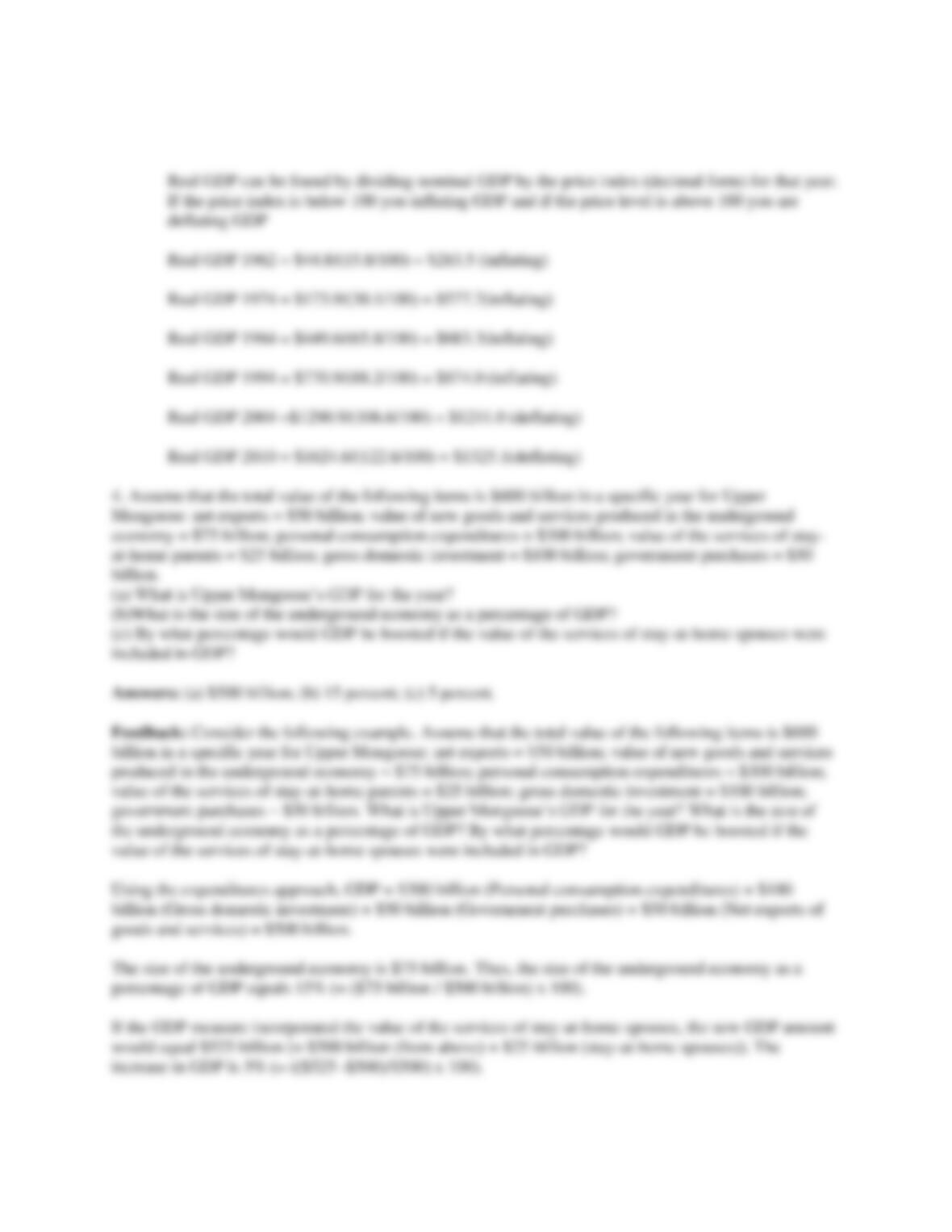
Answer: The table should be updated with the following values for Real GDP:
Real GDP 1962 = $283.5 (inflating)
Real GDP 1974 = $577.7 (inflating)
1962
44.8
15.8
$
1974
173.9
30.1
$
1984
449.6
65.8
$
1994
770.9
88.2
$
2004
1290.9
106.6
$
2010
1,624.6
122.6