1
NOTES ON PRODUCTION AND COST
1. DEFINITION OF COST:
There are two kinds of cost in economics:
A. Explicit Costs
An explicit cost is a cost paid in money. This cost includes the cost of labor, raw materials or
other out-of-pocket expenses.
B. Implicit Costs
An implicit cost is an opportunity cost incurred by a firm when it uses a factor of production
for which it does not make a direct money payment. There are two major components of
this cost:
a. Depreciation Costs: Economic depreciation is an opportunity cost of a firm using capital
that it owns—measured as the change in the market value of capital over a given
period.
b. Normal Profit: Normal profit is the return to entrepreneurship. Normal profit is part of a
firm’s opportunity cost because it is the cost of the entrepreneur not running another
firm.
2. DEFINITION OF PROFIT:
In general, Profit = Total Revenue – Total Cost.
Total Revenue = Price x Production
However, in terms of cost, there are two concepts that we encounter in business:
A. Accounting Profit
Accounting Profit = Total Revenue – Explicit Cost
B. Economic Profit
Economic Profit = Total Revenue – Explicit Cost – Implicit Cost
It should be noted that, Opportunity Cost = Explicit Cost + Implicit Cost
Therefore, Economic Profit = Total Revenue – Opportunity Cost
It should be noted that Accounting Profit >= Economic Profit
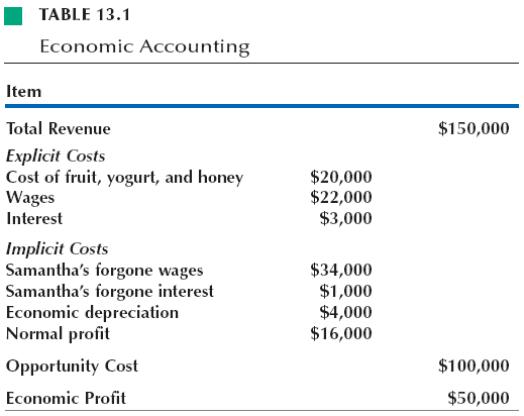
Example: In the example below, we see
2
Explicit Cost = 20,000+22,000+3,000 = 45,000; Implicit Cost = 34,000 + 1,000 + 4,000 + 16,000 = 55,000
Opportunity Cost = Explicit Cost + Implicit Cost = 45,000 + 55,000 = 100,000
So, Accounting Profit = TR – Explicit Cost = 150,000 – 45,000 = 105,000
Economic Profit = TR – Opportunity Cost = 150,000 – 100,000 = 50,000
3. COST IN THE SHORT RUN AND LONG RUN:
The nature of cost can vary depending on the length of time at which we are measuring it. We will
explain it as follows:
A. Variable Cost
Variable cost of production includes costs that vary with the level of production. Examples of
variable cost include, but not limited to, labor cost and the cost of raw materials. Variable costs are
easy to change, according to economic theory.
B. Fixed Cost
Fixed costs of production include costs that do not change with the level of production. Examples of
fixed costs include, but not limited to, cost of replacing machines, buying new machines, cost of land
and other infrastructure. Compared to variable costs, Fixed costs are usually larger. They are also
more difficult or time consuming to change, according to economic theory.
C. Short Run and Costs
Short run refers to the planning or production horizon when the firm cannot adjust some costs such
as buy a new machine. Therefore, in the short run, there are both variable cost and fixed costs.
D. Long Run and Costs
Long run refers to the planning or production horizon when the firm adjust any costs which includes
buying a new machine. Therefore, in the long run, all costs are variable costs.
4. DEFINITION OF PRODUCTION:
Production is a process of combining inputs and produce an output. In production, three are
mainly three types of inputs used:
A. Labor
Labor refers to the human time used in the production process. Labor might also use skill and
experience as part of its input in the production. However, in recent times, skill and experience
are considered as a different input called the ‘Human Capital’.
B. Capital
In simple terms, capital refers to the machines used the production process. Capital allows labor
to work on it and produce output. However, human capital could be considered as part of the
capital stock as well.
C. Natural Resources (Land)
Natural Resources combine any natural elements used in the production process. This could
include raw materials and other natural resources such as land, sun, air and so on.
3
D. The Importance of Technology in Production
Although not considered as an input, technology could be equally, if not more important for
production. Technology is the processes a firm uses to turn inputs into outputs of goods and
services. A change in the ability of a firm to produce a given level of output with a given quantity
of inputs is called a Technological Change.
5. VARIOUS TYPES OF COST AND PRODUCTION CONCEPTS IN THE SHORT RUN:
In the short run, capital is fixed. Therefore, production in the short changes only when variable
inputs such as labor changes. On the other hand, in the short run, we will have both fixed and
variable cost of production.
A. Production in the Short Run
Production can be described by Production Function. Production function shows the
relationship between the inputs employed and the maximum output of the firm. A typical
production function might look like the following:
( )
,Q f K L=
Where Q is the quantity of output, K is the quantity of capital used, and L is quantity of labor
used.
A common functional form used in economics is referred to as the Cobb–Douglas production
function,
Q K L
=
Where the quantity of each input, each raised to a power (usually less than one), are multiplied
together.
The short run refers to the case in which the level of capital is fixed, typically expressed as:
( )
,Q f K L=
In order to understand production, we will develop the following concepts:
a. Total Product
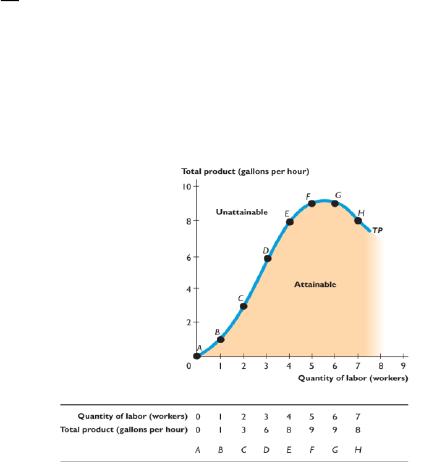
Total product (TP) is the total quantity of a good produced in a given period.
Figure on the right shows the total product and the
total product curve. Points A through H on the curve
correspond to the columns of the table. The TP curve is
like the PPF: It separates attainable points and
unattainable points.
Notice: TP initially increases quite sharply when input
increases. Later, it starts going down.
b. Marginal Product
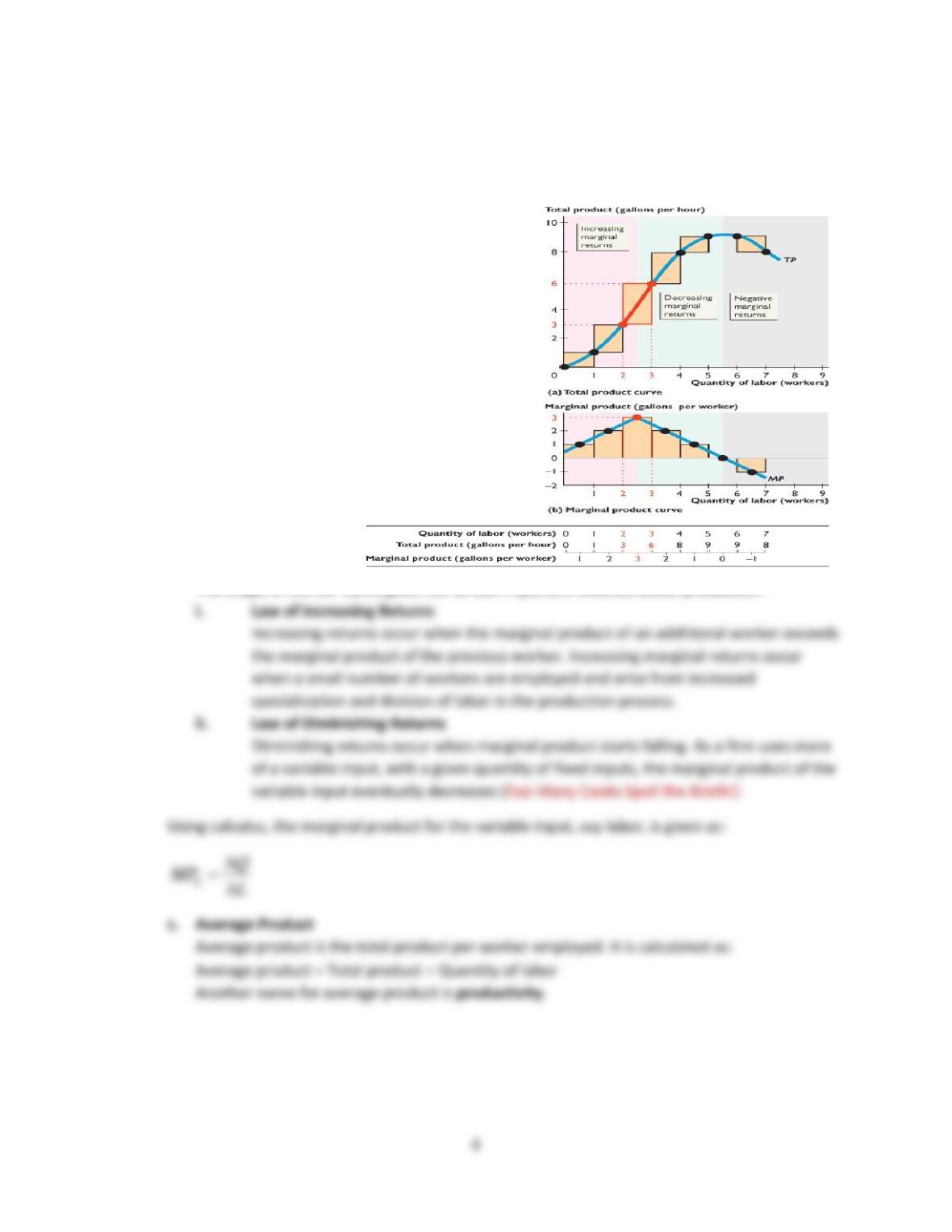
Marginal product is the change in total product that results from a one-unit increase in the
quantity of labor employed. Marginal product tells us the contribution to total product of
adding one more worker.
The best way to understand marginal product is
to see it in relation to total product. The table
calculates marginal product and the orange bars
in part (b) illustrate it. The total product and
marginal product curves in this figure
incorporate a feature of all production
processes:
• Increasing marginal returns initially
when TP rises sharply
• Decreasing marginal returns eventually
when TP starts to flatten out.
• Negative marginal returns when TP
starts falling