Copying or posting is an infringement of copyright. Permissions@hbsp.harvard.edu or 617–783–7860.
9-504-016
REV: FEBRUARY 3, 2004
________________________________________________________________________________________________________________
Professors Youngme Moon and John Quelch prepared this case. HBS cases are developed solely as the basis for class discussion. Cases are not
intended to serve as endorsements, sources of primary data, or illustrations of effective or ineffective management.
Copyright © 2003 President and Fellows of Harvard College. To order copies or request permission to reproduce materials, call 1-800-545-7685,
write Harvard Business School Publishing, Boston, MA 02163, or go to http://www.hbsp.harvard.edu. No part of this publication may be
reproduced, stored in a retrieval system, used in a spreadsheet, or transmitted in any form or by any means—electronic, mechanical,
photocopying, recording, or otherwise—without the permission of Harvard Business School.
YOUNGME MOON
JOHN QUELCH
Starbucks: Delivering Customer Service
In mid-2002, Christine Day, Starbucks’ senior vice president of administration in North America,
sat in the seventh-floor conference room of Starbucks’ Seattle headquarters and reached for her
second cup of toffee nut latte. The handcrafted beverage—a buttery, toffee-nut flavored espresso
concoction topped with whipped cream and toffee sprinkles—had become a regular afternoon
indulgence for Day ever since its introduction earlier that year.
As she waited for her colleagues to join her, Day reflected on the company’s recent performance.
While other retailers were still reeling from the post-9/11 recession, Starbucks was enjoying its 11th
consecutive year of 5% or higher comparable store sales growth, prompting its founder and
chairman, Howard Schultz, to declare: “I think we’ve demonstrated that we are close to a recession-
proof product.”1
Day, however, was not feeling nearly as sanguine, in part because Starbucks’ most recent market
research had revealed some unexpected findings. “We’ve always taken great pride in our retail
service,” said Day, “but according to the data, we’re not always meeting our customers’ expectations
in the area of customer satisfaction.”
As a result of these concerns, Day and her associates had come up with a plan to invest an
additional $40 million annually in the company’s 4,500 stores, which would allow each store to add
the equivalent of 20 hours of labor a week. “The idea is to improve speed-of-service and thereby
increase customer satisfaction,” said Day.
In two days, Day was due to make a final recommendation to both Schultz and Orin Smith,
Starbucks’ CEO, about whether the company should move forward with the plan. “The investment
is the EPS [earnings per share] equivalent of almost seven cents a share,” said Day. In preparation for
her meeting with Schultz and Smith, Day had asked one of her associates to help her think through
the implications of the plan. Day noted, “The real question is, do we believe what our customers are
telling us about what constitutes ‘excellent’ customer service? And if we deliver it, what will the
impact be on our sales and profitability?”
1 Jake Batsell, “A Grande Decade for Starbucks,” The Seattle Times, June 26, 2002.

Copying or posting is an infringement of copyright. Permissions@hbsp.harvard.edu or 617–783–7860.
504-016 Starbucks: Delivering Customer Service
2
Company Background
The story of how Howard Schultz managed to transform a commodity into an upscale cultural
phenomenon has become the stuff of legends. In 1971, three coffee fanatics—Gerald Baldwin,
Gordon Bowker, and Ziev Siegl—opened a small coffee shop in Seattle’s Pike Place Market. The shop
specialized in selling whole arabica beans to a niche market of coffee purists.
In 1982, Schultz joined the Starbucks marketing team; shortly thereafter, he traveled to Italy,
where he became fascinated with Milan’s coffee culture, in particular, the role the neighborhood
espresso bars played in Italians’ everyday social lives. Upon his return, the inspired Schultz
convinced the company to set up an espresso bar in the corner of its only downtown Seattle shop. As
Schultz explained, the bar became the prototype for his long-term vision:
The idea was to create a chain of coffeehouses that would become America’s “third place.”
At the time, most Americans had two places in their lives—home and work. But I believed
that people needed another place, a place where they could go to relax and enjoy others, or just
be by themselves. I envisioned a place that would be separate from home or work, a place that
would mean different things to different people.
A few years later, Schultz got his chance when Starbucks’ founders agreed to sell him the
company. As soon as Schultz took over, he immediately began opening new stores. The stores sold
whole beans and premium-priced coffee beverages by the cup and catered primarily to affluent, well-
educated, white-collar patrons (skewed female) between the ages of 25 and 44. By 1992, the company
had 140 such stores in the Northwest and Chicago and was successfully competing against other
small-scale coffee chains such as Gloria Jean’s Coffee Bean and Barnie’s Coffee & Tea.
That same year, Schultz decided to take the company public. As he recalled, many Wall Street
types were dubious about the idea: “They’d say, ‘You mean, you’re going to sell coffee for a dollar in
a paper cup, with Italian names that no one in America can say? At a time in America when no one’s
drinking coffee? And I can get coffee at the local coffee shop or doughnut shop for 50 cents? Are you
kidding me?’”2
Ignoring the skeptics, Schultz forged ahead with the public offering, raising $25 million in the
process. The proceeds allowed Starbucks to open more stores across the nation.
By mid-2002, Schultz had unequivocally established Starbucks as the dominant specialty-coffee
brand in North America. Sales had climbed at a compound annual growth rate (CAGR) of 40% since
the company had gone public, and net earnings had risen at a CAGR of 50%. The company was now
serving 20 million unique customers in well over 5,000 stores around the globe and was opening on
average three new stores a day. (See Exhibits 1–3 for company financials and store growth over
time.)
What made Starbucks’ success even more impressive was that the company had spent almost
nothing on advertising to achieve it. North American marketing primarily consisted of point-of-sale
materials and local-store marketing and was far less than the industry average. (Most fast-food
chains had marketing budgets in the 3%–6% range.)
For his part, Schultz remained as chairman and chief global strategist in control of the company,
handing over day-to-day operations in 2002 to CEO Orin Smith, a Harvard MBA (1967) who had
joined the company in 1990.
2 Batsell.

Copying or posting is an infringement of copyright. Permissions@hbsp.harvard.edu or 617–783–7860.
Starbucks: Delivering Customer Service 504-016
3
The Starbucks Value Proposition
Starbucks’ brand strategy was best captured by its “live coffee” mantra, a phrase that reflected the
importance the company attached to keeping the national coffee culture alive. From a retail
perspective, this meant creating an “experience” around the consumption of coffee, an experience
that people could weave into the fabric of their everyday lives.
There were three components to this experiential branding strategy. The first component was the
coffee itself. Starbucks prided itself on offering what it believed to be the highest-quality coffee in the
world, sourced from the Africa, Central and South America, and Asia-Pacific regions. To enforce its
exacting coffee standards, Starbucks controlled as much of the supply chain as possible—it worked
directly with growers in various countries of origin to purchase green coffee beans, it oversaw the
custom-roasting process for the company’s various blends and single-origin coffees, and it controlled
distribution to retail stores around the world.
The second brand component was service, or what the company sometimes referred to as
“customer intimacy.” “Our goal is to create an uplifting experience every time you walk through our
door,” explained Jim Alling, Starbucks’ senior vice president of North American retail. “Our most
loyal customers visit us as often as 18 times a month, so it could be something as simple as
recognizing you and knowing your drink or customizing your drink just the way you like it.”
The third brand component was atmosphere. “People come for the coffee,” explained Day, “but
the ambience is what makes them want to stay.” For that reason, most Starbucks had seating areas to
encourage lounging and layouts that were designed to provide an upscale yet inviting environment
for those who wanted to linger. “What we have built has universal appeal,” remarked Schultz. “It’s
based on the human spirit, it’s based on a sense of community, the need for people to come
together.”3
Channels of Distribution
Almost all of Starbucks’ locations in North America were company-operated stores located in
high-traffic, high-visibility settings such as retail centers, office buildings, and university campuses.4
In addition to selling whole-bean coffees, these stores sold rich-brewed coffees, Italian-style espresso
drinks, cold-blended beverages, and premium teas. Product mixes tended to vary depending on a
store’s size and location, but most stores offered a variety of pastries, sodas, and juices, along with
coffee-related accessories and equipment, music CDs, games, and seasonal novelty items. (About 500
stores even carried a selection of sandwiches and salads.)
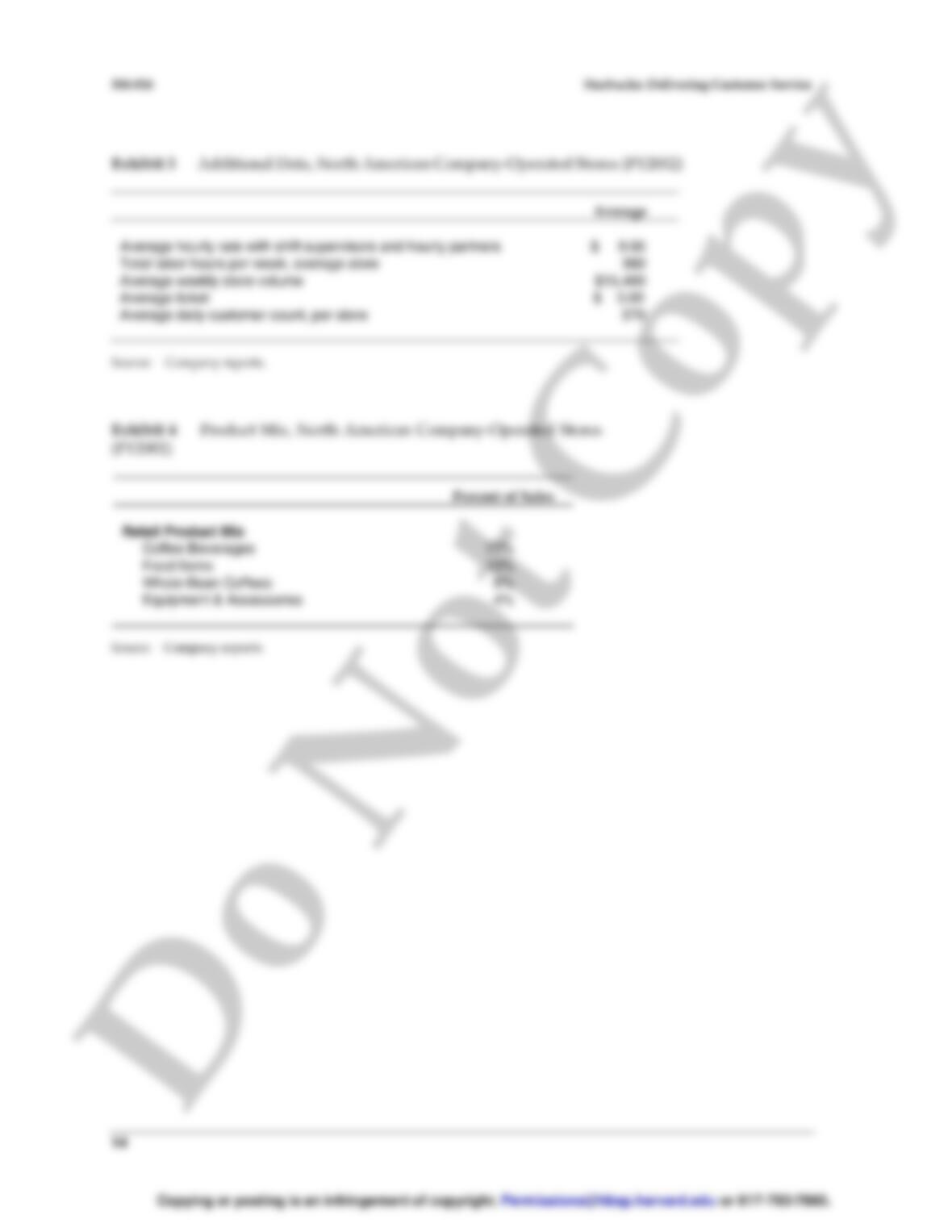
Beverages accounted for the largest percentage of sales in these stores (77%); this represented a
change from 10 years earlier, when about half of store revenues had come from sales of whole-bean
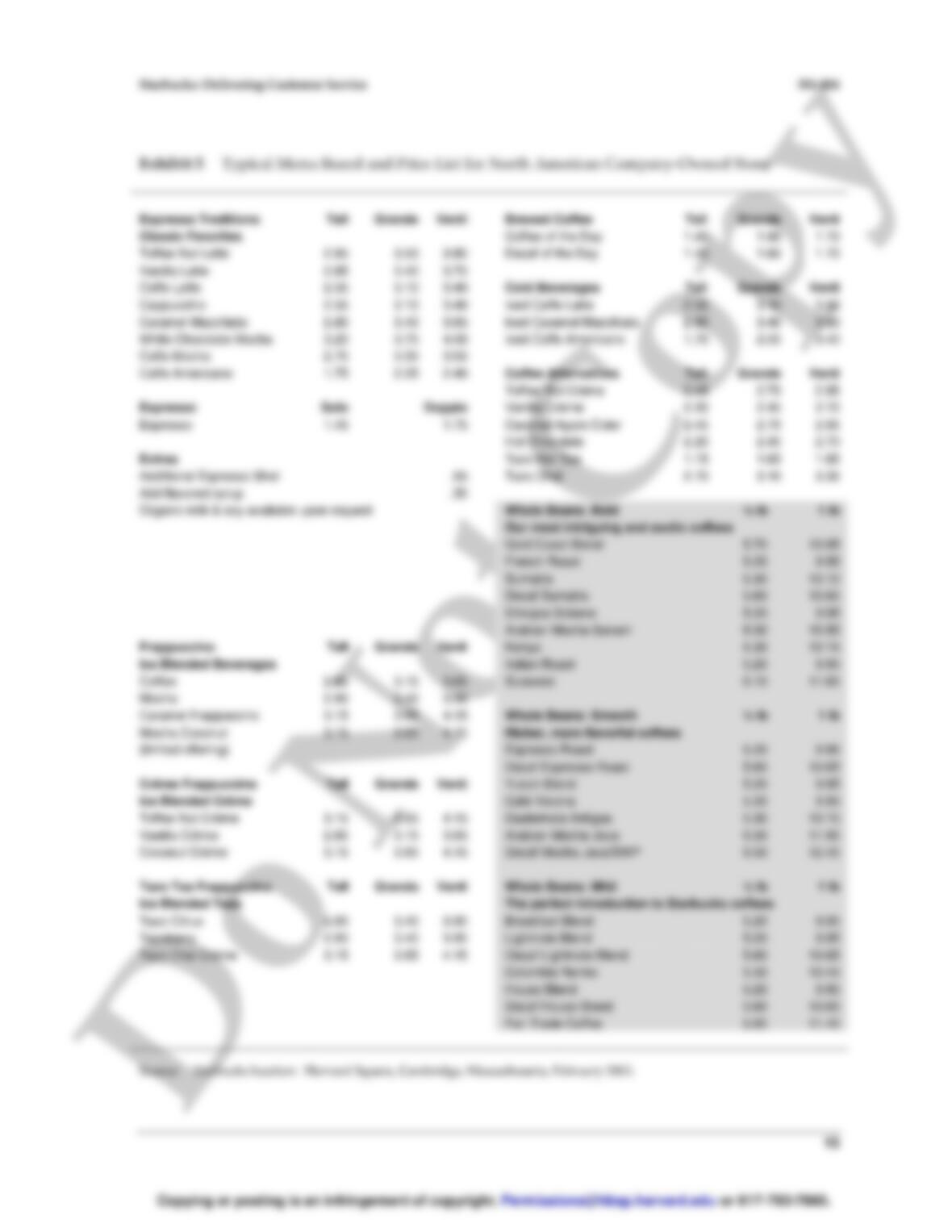
coffees. (See Exhibit 4 for retail sales mix by product type; see Exhibit 5 for a typical menu board and
price list.)
Starbucks also sold coffee products through non-company-operated retail channels; these so-
called “Specialty Operations” accounted for 15% of net revenues. About 27% of these revenues came
from North American food-service accounts, that is, sales of whole-bean and ground coffees to hotels,
airlines, restaurants, and the like. Another 18% came from domestic retail store licenses that, in
3 Batsell.
4 Starbucks had recently begun experimenting with drive-throughs. Less than 10% of its stores had drive-throughs, but in
these stores, the drive-throughs accounted for 50% of all business.

Copying or posting is an infringement of copyright. Permissions@hbsp.harvard.edu or 617–783–7860.
504-016 Starbucks: Delivering Customer Service
4
North America, were only granted when there was no other way to achieve access to desirable retail
space (e.g., in airports).
The remaining 55% of specialty revenues came from a variety of sources, including international
licensed stores, grocery stores and warehouse clubs (Kraft Foods handled marketing and distribution
for Starbucks in this channel), and online and mail-order sales. Starbucks also had a joint venture
with Pepsi-Cola to distribute bottled Frappuccino beverages in North America, as well as a
partnership with Dreyer’s Grand Ice Cream to develop and distribute a line of premium ice creams.
Day explained the company’s broad distribution strategy:
Our philosophy is pretty straightforward—we want to reach customers where they work,
travel, shop, and dine. In order to do this, we sometimes have to establish relationships with
third parties that share our values and commitment to quality. This is a particularly effective
way to reach newcomers with our brand. It’s a lot less intimidating to buy Starbucks at a
grocery store than it is to walk into one of our coffeehouses for the first time. In fact, about
40% of our new coffeehouse customers have already tried the Starbucks brand before they
walk through our doors. Even something like ice cream has become an important trial vehicle
for us.
Starbucks Partners
All Starbucks employees were called “partners.” The company employed 60,000 partners
worldwide, about 50,000 in North America. Most were hourly-wage employees (called baristas) who
worked in Starbucks retail stores. Alling remarked, “From day one, Howard has made clear his
belief that partner satisfaction leads to customer satisfaction. This belief is part of Howard’s DNA,
and because it’s been pounded into each and every one of us, it’s become part of our DNA too.”
The company had a generous policy of giving health insurance and stock options to even the most
entry-level partners, most of whom were between the ages of 17 and 23. Partly as a result of this,
Starbucks’ partner satisfaction rate consistently hovered in the 80% to 90% range, well above the
industry norm,5 and the company had recently been ranked 47th in the Fortune magazine list of best
places to work, quite an accomplishment for a company with so many hourly-wage workers.
In addition, Starbucks had one of the lowest employee turnover rates in the industry—just 70%,
compared with fast-food industry averages as high as 300%. The rate was even lower for managers,
and as Alling noted, the company was always looking for ways to bring turnover down further:
“Whenever we have a problem store, we almost always find either an inexperienced store manager or
inexperienced baristas. Manager stability is key—it not only decreases partner turnover, but it also
enables the store to do a much better job of recognizing regular customers and providing
personalized service. So our goal is to make the position a lifetime job.”
To this end, the company encouraged promotion from within its own ranks. About 70% of the
company’s store managers were ex-baristas, and about 60% of its district managers were ex-store
managers. In fact, upon being hired, all senior executives had to train and succeed as baristas before
being allowed to assume their positions in corporate headquarters.
5 Industrywide, employee satisfaction rates tended to be in the 50% to 60% range. Source: Starbucks, 2000.

Starbucks: Delivering Customer Service 504-016
Delivering on Service
When a partner was hired to work in one of Starbucks’ North American retail stores, he or she had
to undergo two types of training. The first type focused on “hard skills” such as learning how to use
the cash register and learning how to mix drinks. Most Starbucks beverages were handcrafted, and
to ensure product quality, there was a prespecified process associated with each drink. Making an
espresso beverage, for example, required seven specific steps.
The other type of training focused on “soft skills.” Alling explained:
In our training manual, we explicitly teach partners to connect with customers—to
enthusiastically welcome them to the store, to establish eye contact, to smile, and to try to
remember their names and orders if they’re regulars. We also encourage partners to create
conversations with customers using questions that require more than a yes or no answer. So
for example, “I noticed you were looking at the menu board—what types of beverages do you
typically enjoy?” is a good question for a partner to ask.
Starbucks’ “Just Say Yes” policy empowered partners to provide the best service possible, even if
it required going beyond company rules. “This means that if a customer spills a drink and asks for a
refill, we’ll give it to him,” said Day. “Or if a customer doesn’t have cash and wants to pay with a
check (which we aren’t supposed to accept), then we’ll give her a sample drink for free. The last
thing we want to do is win the argument and lose the customer.”
Most barista turnover occurred within the first 90 days of employment; if a barista lasted beyond
that, there was a high probability that he or she would stay for three years or more. “Our training
ends up being a self-selection process,” Alling said. Indeed, the ability to balance hard and soft skills
required a particular type of person, and Alling believed the challenges had only grown over time: