CECN 603 Session 12
Topics: Fiscal and Monetary Policy
Readings: PB* Ch 29 and 30, GA Ch 17, 18, 19, SRG Ch 12, 13, 14, ABCK Ch 13, 14, 15
• * is the main reading material
Fiscal Policy
After studying this topic, you will be able to:
• Describe the federal budget process and the recent history of outlays, revenues, deficits,
and debt
• Explain the supply–side effects of fiscal policy
• Explain how fiscal stimulus is used to fight a recession
The Federal Budget
• The federal budget is the annual statement of the federal government’s outlays and
revenues.
• The federal budget has two purposes:
– To finance the activities of the federal government
– To achieve macroeconomic objectives
• Fiscal policy is the use of the federal budget to achieve macroeconomic objectives, such
as full employment, sustained economic growth, and price level stability.
Highlights of the 2013 Budget
• The projected fiscal 2013 federal budget has revenues of $262 billion, outlays of $276 billion,
and a projected deficit of $14 billion.
• Revenues come from personal income taxes, corporate income taxes, indirect taxes, and
investment income.
• Personal income taxes are the largest revenue source.
• Outlays are transfer payments, expenditure on goods and services, and debt interest.
• Transfer payments are the largest item of outlays.
Budget Balance
• The federal government’s budget balance equals revenues minus outlays.
• If revenues exceed outlays, the government has a budget surplus.
• If outlays exceed revenues, the government has a budget deficit.
• If revenues equal outlays, the government has a balanced budget.
• The projected budget deficit in 2013 is $14 billion.
Page 1 of 12
The Supply–Side Effects of Fiscal Policy
• Fiscal policy has important effects employment, potential GDP, and aggregate supply—
called supply–side effects.
• An income tax changes full employment and potential GDP.
Full Employment and Potential GDP
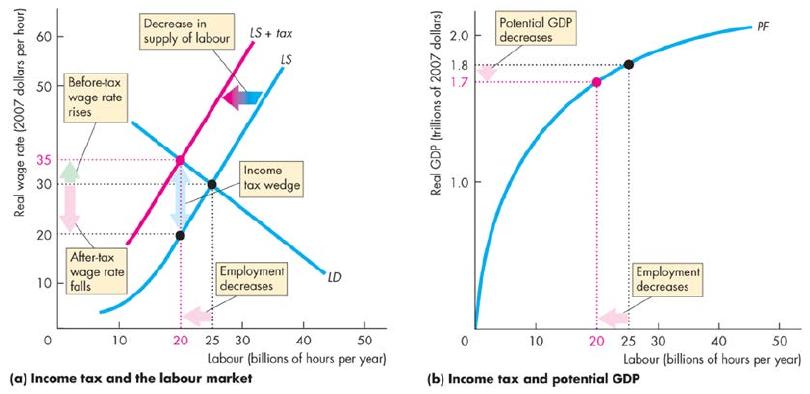
• The next figure (a) illustrates the effects of an income tax in the labour market.
• The supply of labour decreases because the tax decreases the after–tax wage rate.
• The before–tax real wage rate rises but the after–tax real wage rate falls.
• The gap created between the before–tax and after–tax wage rates is called the tax
wedge.
• The quantity of labour employed decreases.
• When the quantity of labour employed decreases, potential GDP decreases.
• The supply–side effect of a rise in the income tax decreases potential GDP and decreases
aggregate supply.
Tax Revenues and the Laffer Curve
• The relationship between the tax rate and the amount of tax revenue collected is
called the Laffer curve.
• At the tax rate T*, tax revenue is maximized.
Page 2 of 12
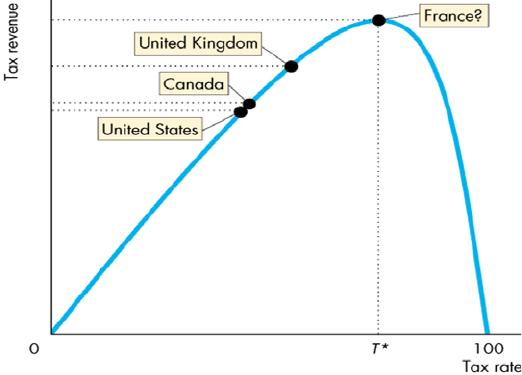
• For a tax rate below T*, a rise in the tax rate increases tax revenue.
• For a tax rate above T*, a rise in the tax rate decreases tax revenue.
Fiscal Stimulus
• A fiscal stimulus is the use of fiscal policy to increase production and employment.
• Fiscal stimulus can be either
– Automatic
– Discretionary
• Automatic fiscal policy is a fiscal policy action triggered by the state of the economy with
no government action.
• Discretionary fiscal policy is a policy action that is initiated by an act of Parliament.
Automatic Fiscal Policy and Cyclical and Structural Budget Balances
• Two items in the government budget change automatically in response to the state of the
economy.
– Tax revenues
– Transfer payments
Automatic Changes in Tax Revenues
• Parliament sets the tax rates that people must pay.
• The tax dollars people pay depend on tax rates and incomes.
• But incomes vary with real GDP, so tax revenues depend on real GDP.
• When the real GDP increases in an expansion, tax revenues increase.
• When real GDP decreases in a recession, tax revenues decrease.
Page 3 of 12
Transfer Payments
• The government creates programs that pay benefits to qualified people and businesses.
• These transfer payments depend on the economic state of the economy.
• When the economy is in an expansion, unemployment falls, so unemployment benefits
decrease.
• When the economy is in a recession, unemployment rises, so unemployment benefits
increase.
Automatic Stimulus
• In a recession, tax revenues decrease and outlays increase.
• So the budget provides an automatic stimulus that helps shrink the recessionary gap.
• In a boom, tax revenues increase and outlays decrease.
• So the budget provides automatic restraint that helps shrink the inflationary gap.
Discretionary Fiscal Stimulus
• Most discretionary fiscal stimulus focuses on its effects on aggregate demand.
• Fiscal Stimulus and Aggregate Demand
• Changes in government expenditure and taxes change aggregate demand and have