CECN 603 Session 9
Topics: The Exchange Rate and the Balance of Payments
Readings: PB Ch 25, L Ch 14, 15
Announcement:
• Note that the topic of lecture session 8 has been changed. We will cover the topics of
global economics over two lecture session periods, Session 8 and Session 9.
After studying this topic, you will be able to:
• Explain how the exchange rate is determined
• Explain the trends and fluctuations in the exchange rate
• Explain the effects of alternative exchange rate policies
• Explain what causes international deficits and surpluses
The Foreign Exchange Market
• To buy goods and services produced in another country we need money of that country.
• Foreign bank notes, coins, and bank deposits are called foreign currency.
• We get foreign currency in the foreign exchange market.
Trading Currencies
• We get foreign currency and foreigners get U.S dollars in the foreign exchange market.
• The foreign exchange market is the market in which the currency of one country is
exchanged for the currency of another.
Exchange Rates
• The price at which one currency exchanges for another is called a foreign exchange rate.
• A fall in the value of one currency in terms of another currency is called currency
depreciation.
• A rise in value of one currency in terms of another currency is called currency
appreciation.
Questions About the Canadian Dollar Exchange Rate
• How is the exchange rate determined?
• Why does the Canadian dollar sometimes appreciate and sometimes depreciate?
• How does the Bank of Canada operate in the foreign exchange market?
• How do exchange rate fluctuations influence the balance of trade and the balance of
payments? Page 1 of 14
An Exchange Rate Is a Price
• An exchange rate is the price—the price of one currency in terms of another.
• Like all prices, an exchange rate is determined in a market—the foreign exchange market.
• The Canadian dollar is demanded and supplied by thousands of traders every hour of
every day.
• With many traders and no restrictions, the foreign exchange market is a competitive
market.
The Demand for One Money Is the Supply of Another Money
• When people who are holding one money want to exchange it for Canadian dollars, they
demand Canadian dollars and they supply that other country’s money.
• So the factors that influence the demand for Canadian dollars also influence the supply of
Canadian dollars, E.U. euros, U.K. pounds, and Japanese yen.
• And the factors that influence the demand for another country’s money also influence the
supply of Canadian dollars.
Demand in the Foreign Exchange Market
• The quantity of Canadian dollars that traders plan to buy in the foreign exchange market
during a given period depends on
1. The exchange rate
2. World demand for Canadian exports
3. Interest rates in the United States and other countries
4. The expected future exchange rate
The Law of Demand for Foreign Exchange
• The demand for dollars is a derived demand.
• People buy Canadian dollars so that they can buy Canadian–produced goods and
services or Canadian assets.
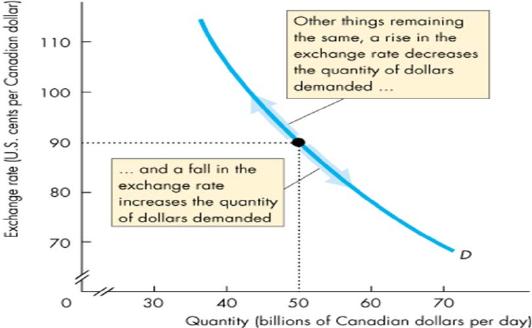
• Other things remaining the same, the higher the exchange rate, the smaller is the quantity
of Canadian dollars demanded in the foreign exchange market.
Two Effects:
• The exchange rate influences the quantity of Canadian dollars demanded for two
reasons:
Exports effect
Expected profit effect
Page 2 of 14
Exports Effect
• The larger the value of Canadian exports, the greater is the quantity of Canadian dollars
demanded on the foreign exchange market.
• The lower the exchange rate, the greater is the value of Canadian exports, so the greater
is the quantity of Canadian dollars demanded.
Expected Profit Effect
• The larger the expected profit from holding Canadian dollars, the greater is the quantity of
Canadian dollars demanded today.
• But expected profit depends on the exchange rate.
• The lower today’s exchange rate, other things remaining the same, the larger is the
expected profit from buying Canadian dollars and the greater is the quantity of Canadian
dollars demanded today.
The Demand Curve for Canadian Dollars
• The next figure illustrates the demand curve for Canadian dollars on the foreign exchange
market.
Supply in the Foreign Exchange Market
• The quantity of Canadian dollars supplied in the foreign exchange market is the amount
that traders plan to sell during a given time period at a given exchange rate.
• This quantity depends on many factors but the main ones are
1. The exchange rate
2. Canadian demand for imports
3. Interest rates in Canada and other countries
4. The expected future exchange rate
Page 3 of 14
The Law of Supply of Foreign Exchange
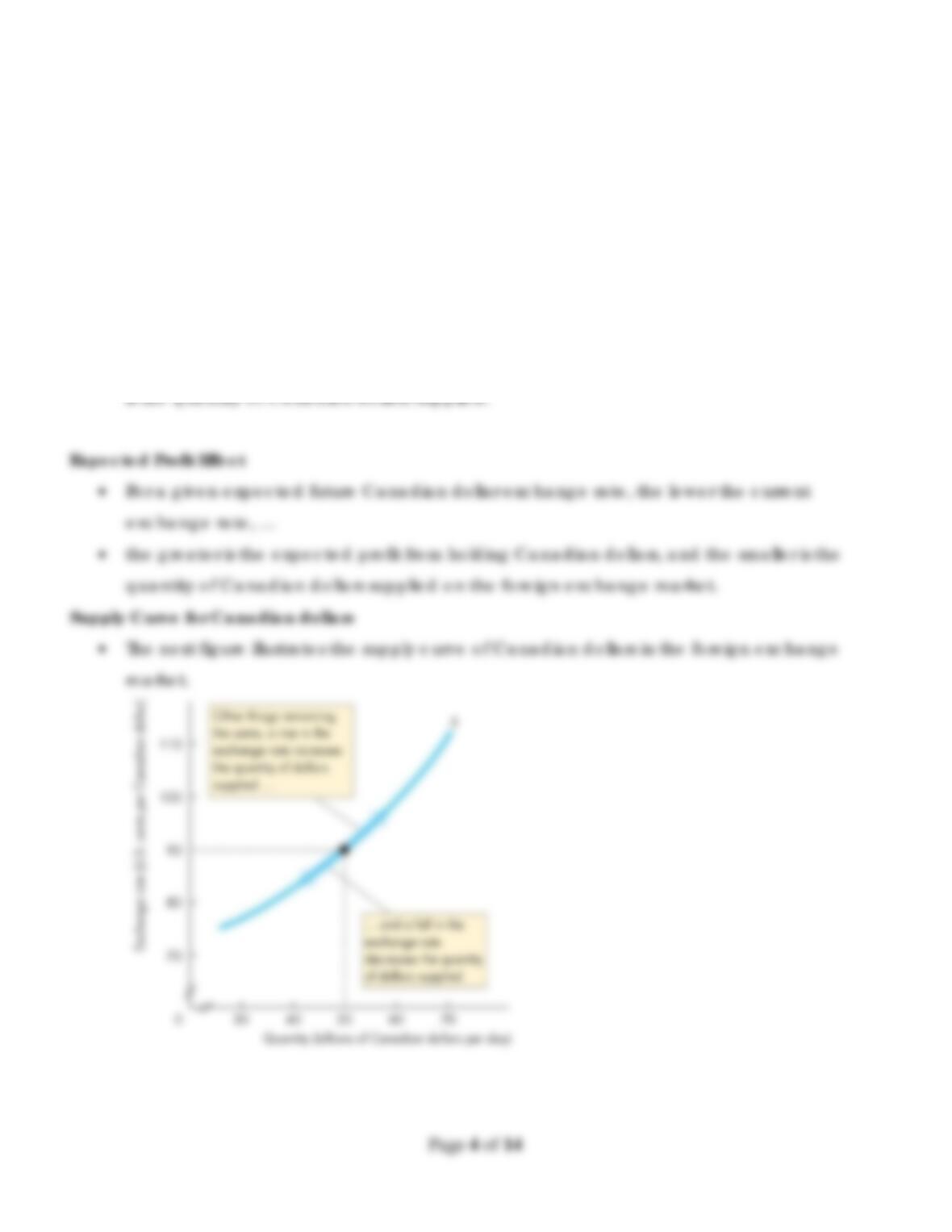
• Other things remaining the same, the higher the exchange rate, the greater is the quantity
of Canadian dollars supplied in the foreign exchange market.
• The exchange rate influences the quantity of Canadian dollars supplied for two reasons:
Imports effect
Expected profit effect
Imports Effect
• The larger the value of Canadian imports, the larger is the quantity of Canadian dollars
supplied on the foreign exchange market.
• The higher the exchange rate, the greater is the value of Canadian imports, so the greater