CECN 603 Session 8
Topics: Global Markets
Readings: PB Ch 7, L Ch 14, 15
Announcement:
• Note that the topic of lecture session 8 has been changed. We will cover the topics of
global economics over two lecture session periods, Session 8 and Session 9.
After studying this topic, you will be able to:
♦ Explain how markets work with international trade
♦ Identify the gains from international trade and its winners and losers
♦ Explain the effects of international trade barriers
♦ Explain and evaluate arguments used to justify restricting international trade
How Global Markets Work
• Because we trade with people in other countries, the goods and services that we can buy
and consume are not limited by what we can produce.
• Imports are the good and services that we buy from people in other countries.
• Exports are the goods and services we sell to people in other countries.
International Trade Today
• Global trade today is enormous.
• In 2013, global exports and imports were $23 trillion, which is a third of the value of global
production.
• In 2013, total Canadian exports were $566 billion, which is about 27 percent of the value of
Canadian production.
• In 2013, total Canadian imports were $486 billion, which is about 23 percent of the value of
Canadian production.
• Services are 15 percent of total Canadian exports and 19 percent of total Canadian
imports.
Page 1 of 11
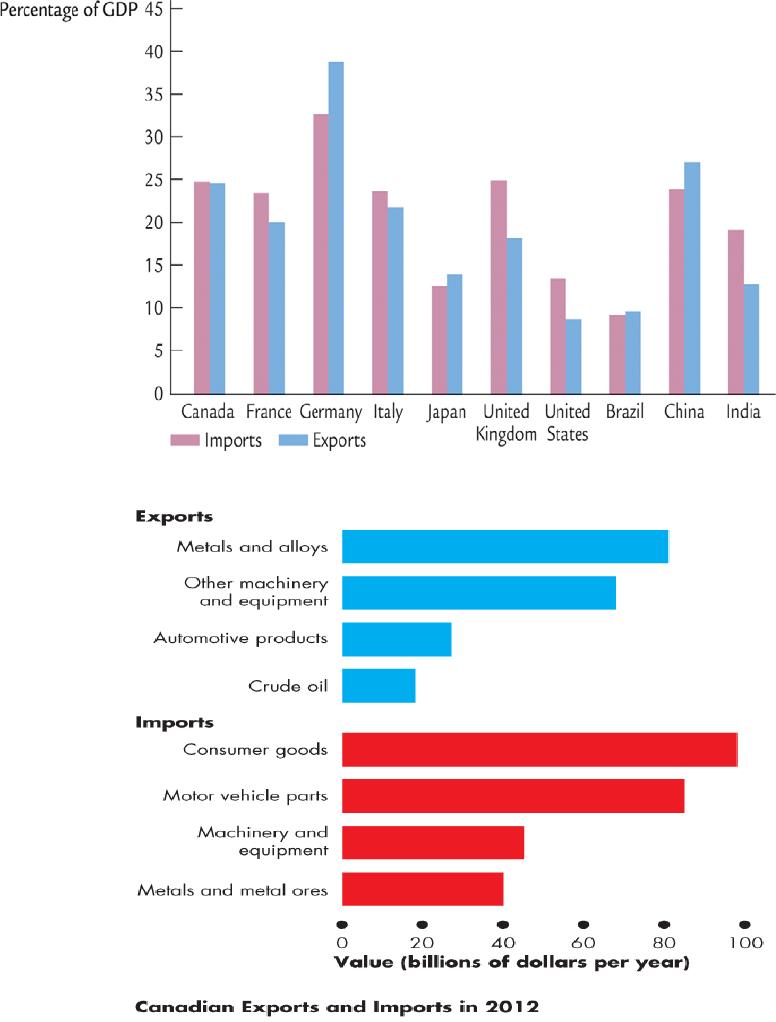
Imports and exports of selected countries, 2013
What Drives International Trade?
• The fundamental force that generates trade between nations is comparative advantage.
• The basis for comparative trade is divergent opportunity costs between countries.
• National comparative advantage as the ability of a nation to perform an activity or
produce a good or service at a lower opportunity cost than any other nation.
Page 2 of 11
• The opportunity cost of producing a T–shirt is lower in China than in Canada, so China has a
comparative advantage in producing T–shirts.
• The opportunity cost of producing a regional jet is lower in Canada than in China, so
Canada has a comparative advantage in producing regional jets.
• Both countries can reap gains from trade by specializing in the production of the good at
which they have a comparative advantage and then trading.
• Both countries are better off.
Why Canada Imports T-Shirts
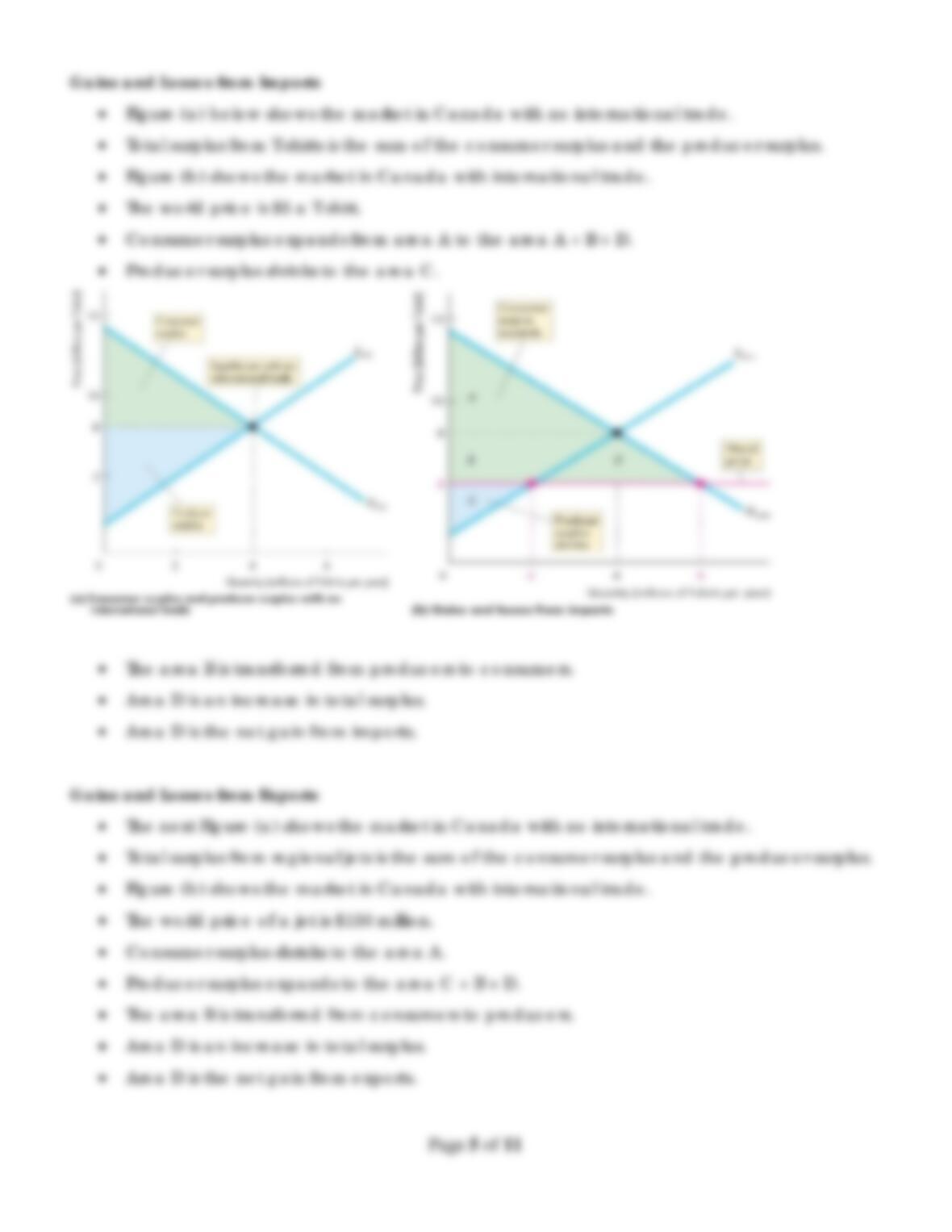
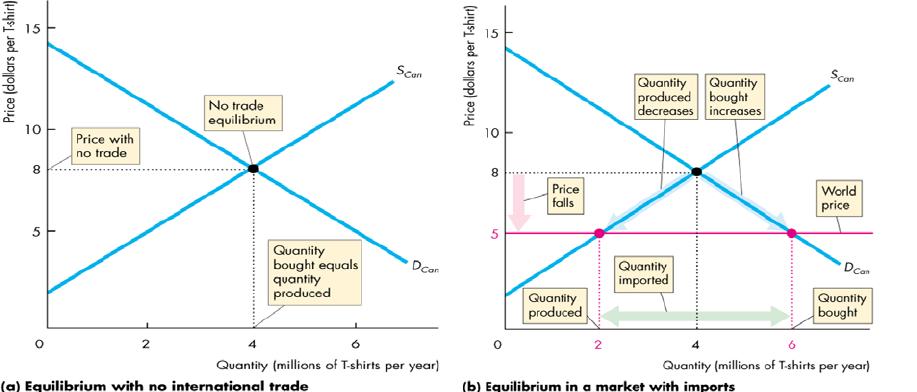
• The figure (a) below shows Canadian demand and Canadian supply with no international
trade.
• The price of a T–shirt at $8.
• Canadian firms produce 4 million T–shirts a year and Canadian consumers buy 4 million T–
shirts a year.
• The Figure (b) shows the market in Canada with international trade.
• World demand and world supply of T–shirts determine the world price of a T–shirt at $5.
• The world price is less than $8, so the rest of the world has a comparative advantage in
producing
T-shirts.
• With international trade, the price of a T–shirt in Canada falls to $5.
• At $5 a T–shirt, Canadian garment makers produce 2 million T–shirts a year.
• At $5 a T–shirt, Canadians buy 6 million T–shirts a year.
• Canada imports 4 million T-shirts a year.
Page 3 of 11
Why Canada Exports Regional Jets
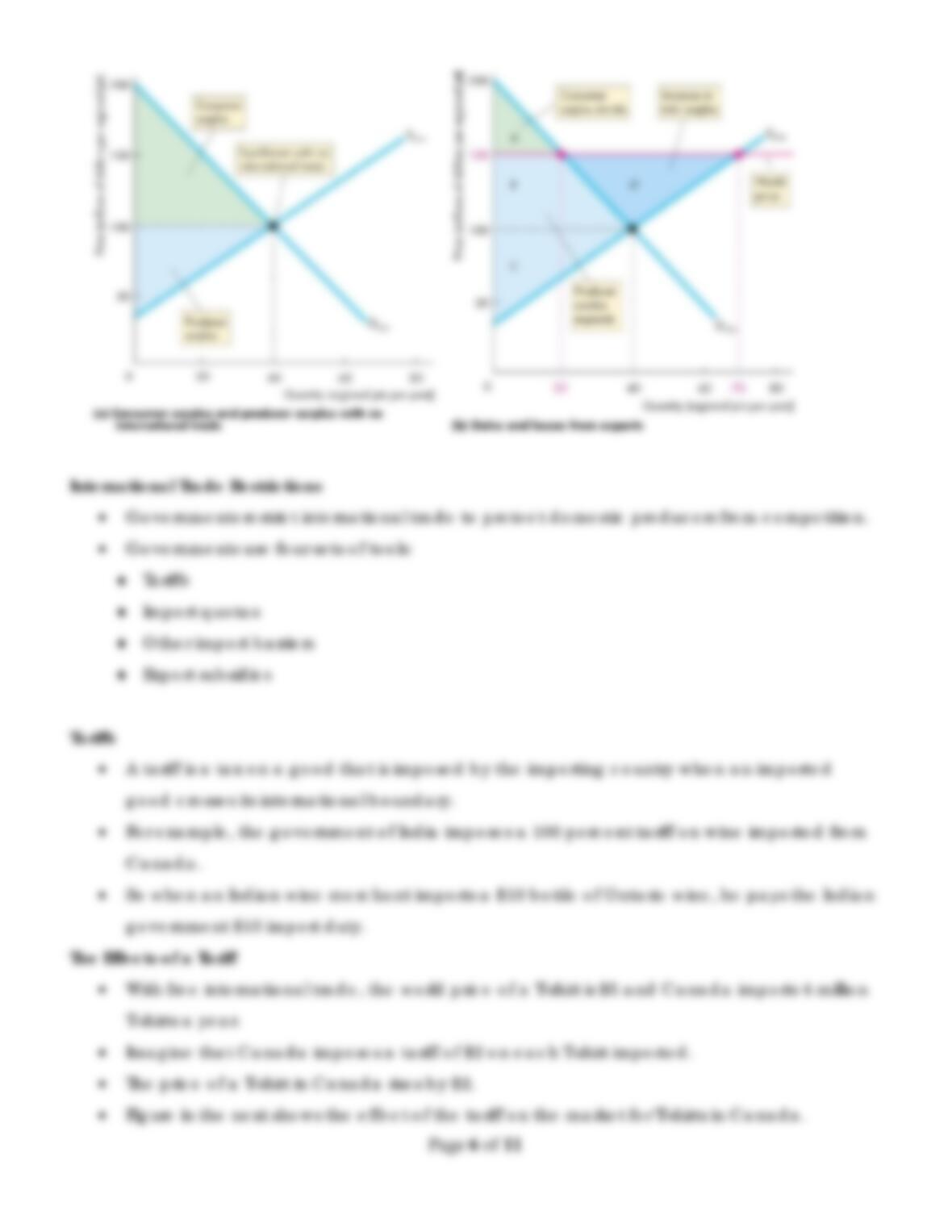
• The Figure (a) below shows Canadian demand and Canadian supply with no international
trade.
• The price of a jet at $100 million.
• Bombardier produces 40 regional jets a year and Canadian airlines buy 40 a year.
• Figure (b) below shows the market in Canada with international trade.
• World demand and world supply of jets determine the world price of a regional jet at $150
million.
• The world price exceeds $100 million, so Canada has a comparative advantage in
producing regional jets.
• With international trade, the price of a jet in Canada rises to $150 million.