CECN 603 Session 5
Topics: Public Goods
Readings: PB Ch 17, P Ch 18
Classifying Goods and Resources
• Goods, services and resources differ in the extent to which people can be excluded from
consuming them and in the extent to which one person’s consumption rival other people’s
consumption.
• Goods, services, and resources can be classified according to whether they are
excludable or nonexcludable and rival or nonrival.
Excludable
• A good is excludable if only the people who pay for it are able to enjoy its benefits.
• Brink’s security services, Aquaculture’s Farm fish, and a Coldplay concert are examples.
Nonexcludable
• A good is nonexcludable if it is impossible (or extremely costly) to prevent anyone from
benefiting from it.
• The services of the police, fish in the Pacific Ocean, and a concert on network television
are examples.
Rival
• A good is rival if one person’s use of it decreases the quantity available for someone else.
• A Brink’s truck can’t deliver cash to two banks at the same time. A fish can be consumed
only once.
Nonrival
• A good is nonrival if one person’s use of it does not decrease the quantity available for
someone else.
• The services of the police and a concert on network television are nonrival.
A Four–Fold Classification
Private Goods
• A private good is both rival and excludable.
• A can of Coke and a fish on Aquaculture’s Farm are examples of private goods.
Public goods
• A public good is both nonrival and nonexcludable. A public good can be consumed
Page 1 of 12
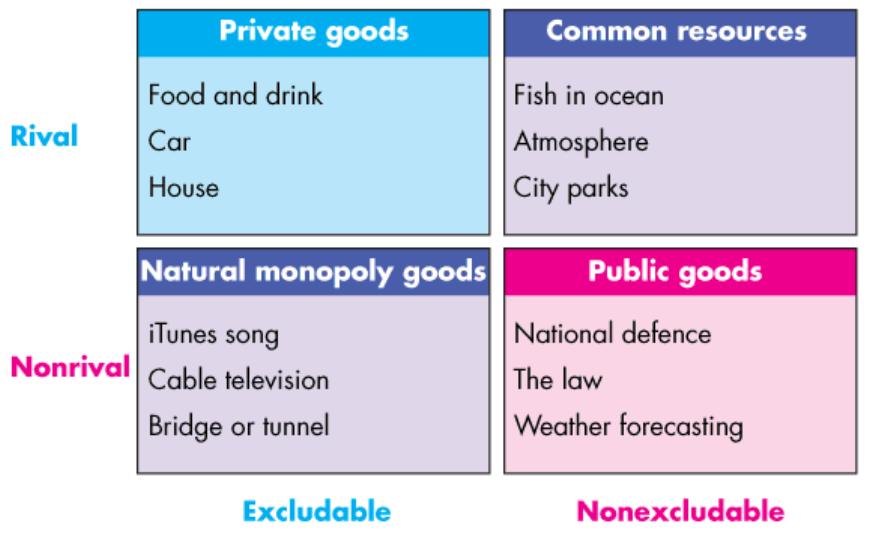
simultaneously by everyone, and no one can be excluded from its benefits.
• National defence is the best example of a public good.
Common Resources
• A common resource is rival and nonexcludable.
• A unit of a common resource can be used only once, but no one can be prevented from
using what is available. Ocean fish are a common resource.
• They are rival because a fish taken by one person isn’t available for anyone else.
• They are nonexcludable because it is difficult to prevent people from catching them.
Natural Monopoly Goods
• A natural monopoly good is nonrival and excludable.
• A special case of natural monopoly arises when the good or service can be produced at
zero marginal cost. Such a good is nonrival. If it is also excludable, it is produced by a
natural monopoly.
• The Internet and cable television are examples.
Page 2 of 12
Public Goods
• Why does the government provide weather forecasting?
• Why don’t we buy it in the marketplace, as we buy hamburgers?
• The answer is: Weather forecasting is a public good and has a free–rider problem.
The Free–Rider Problem
• A free rider enjoys the benefits of a good or service without paying for it.
• Because no one can be excluded from the benefits of a public good, everyone has an
incentive to free ride.
• Public goods create a free–rider problem—the absence of an incentive for people to pay
for what they consume.
• A free–rider problem is that the market would provide an inefficient quantity of the public
good.
• Marginal social benefit from a public good would exceed its marginal social cost and a
deadweight loss would be created.
• Liz and Max the only people is an imagined society value weather forecasts.
• The value of a private good is the maximum amount that a person is willing to pay for one
more unit of it.
• The value of a public good is the maximum amount that all the people are willing to pay
for one more unit of it.
• To calculate the value placed on a public good, we use the concepts of total benefit and
marginal benefit.
Marginal Social Benefit of a Public Good
• Total benefit is the dollar value that a person places on a given quantity of a good.
• The greater the quantity of a good, the larger is a person’s total benefit.
• Marginal benefit is the increase in total benefit that results from a one–unit increase in the
quantity of a good.
• The marginal benefit of a public good diminishes with the quantity of the good provided.
• The Figure in the next shows that the marginal social benefit of a public good is the sum of
marginal benefits of everyone at each quantity of the good provided.
• Part (a) shows Lisa’s marginal benefit.
• Part (b) shows Max’s marginal benefit.
Page 3 of 12
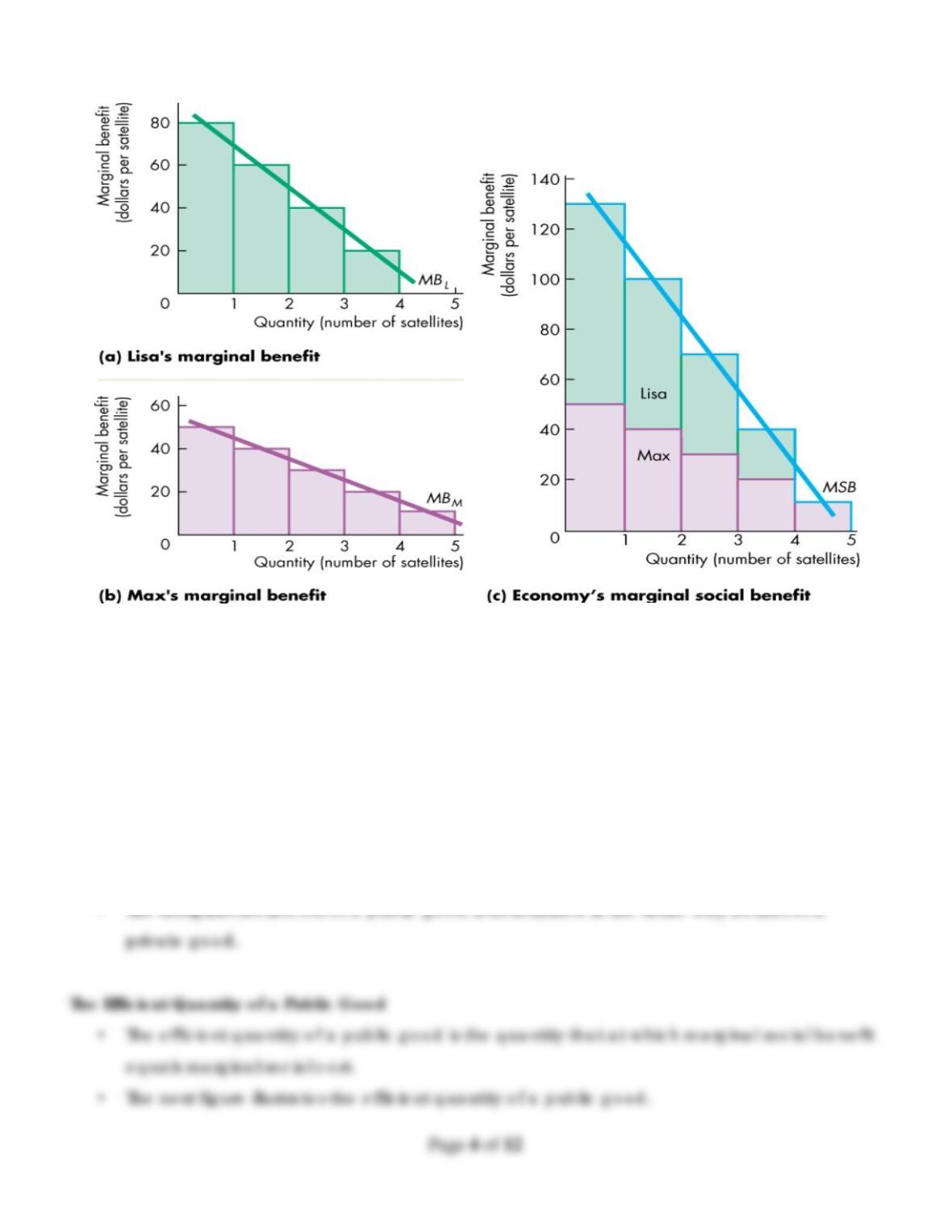
• The economy’s marginal social benefit of a public good is the sum of the marginal benefits
of all individuals at each quantity of the good provided.
• The economy’s marginal social benefit curve for a public good is the vertical sum of all
individual marginal benefit curves
• The marginal social benefit curve for a public good contrasts with the demand curve for a
private good, which is the horizontal sum of the individual demand curves at each price.
The Marginal Social Cost of a Public Good