Version 1 Page 1 of 15
EC2010
2015/6 Candidates Only
January Examinations 2016
Student Number: …..……………….
Desk Number: ……………………
DO NOT OPEN THE QUESTION PAPER UNTIL INSTRUCTED TO DO SO BY
THE CHIEF INVIGILATOR
Department Economics
Module Code EC2010
Module Title Introductory Econometrics
Exam Duration (in words) 1 hour 30 minutes
CHECK YOU HAVE THE CORRECT QUESTION PAPER
Number of Pages 15
Number of Questions 4
Instructions to Candidates
Answer ALL questions on THIS exam paper in the space
provided after each question (you do not have to use
all of the space provided).
You can use the scratch paper at the end of the exam for
notes and calculations.
FOR THIS EXAM YOU ARE ALLOWED TO USE THE FOLLOWING:
Calculators Permitted calculators are the Casio FX83 and FX85 models
Books/Statutes provided by
the University
No
Are students permitted to
bring their own
Books/Statutes/Notes?
No
Additional Stationery No

Version 1 Page 2 of 15
EC2010
2015/6 Candidates Only
Table 1. Critical Values from N(0,1) Distribution
One-sided Two-sided
10% 1.29 1.645
5% 1.645 1.96
1% 2.33 2.575
Question 1 [10 points]
Let X, Y and Z denote three random variables with:
X = 0.01 with probability one
E(Y) = 0.02 and V(Y) = 0.16
E(Z) = 0.08, V(Z) = 0.81 and cov(Y,Z) = 0.2
Define a new random variable W as a linear combination of these variables, W = 0.2X+0.5Y+0.3Z.
a) Calculate the mean value of W, E(W).
b) Calculate the variance of W, V(W).

Version 1 Page 3 of 15
EC2010
2015/6 Candidates Only
Question 2 [30 points]
Answer the following multiple choice questions. Circle only one answer. Each question is worth 2
points.
1) The consequence of imperfect multicollinearity is that:
A. the estimates of regression coefficients are inconsistent
B. OLS estimator cannot be computed
C. the variance of the coefficient estimates goes up
D. none of the above
2) You know that iii uXY 10
and 0)|(
ii XuE . The variance of Yi given that Xi is equal
to some x, )|( xXYV ii ,
A. depends on the value of i
u
B. is equal to )|(
10 xXuVx ii
C. is equal to )()(
1ii uVXV
D. is equal to )|( xXuV ii
3) Consider the following multiple regression models (a) to (d) below. DBlack = 1 if the individual is
black, and is zero otherwise; DHispanic is a binary variable which takes on the value one if the
individual is Hispanic, and is zero otherwise; DWhite is a binary variable which is unity for white
individuals and is zero otherwise, and DNonWhite is (1-DWhite). Regressing weekly earnings
(Earn) on a set of explanatory variables, in which of the following cases will you experience
perfect multicollinearity?
A. iiii uDHispanicDBlackEarn
210
B. iiii uDNonWhiteDBlackEarn
210
C. iiii uDWhiteDBlackEarn
210
D. iiii uDNonWhiteDWhiteEarn
210
4) Consider a regression model iii uXY
10
, where Y is a binary variable equal to one
or zero. Suppose that you estimated 3.0
ˆ1
. This implies that a unit change in X is predicted
to:
A. increase the probability of Y=1 by 30 percentage points.
B. increase the probability of Y=1 by 30 percent.
C. increase Y by 0.3 units.
D. increase Y by 30 percent.
EC2010
2015/6 Candidates Only
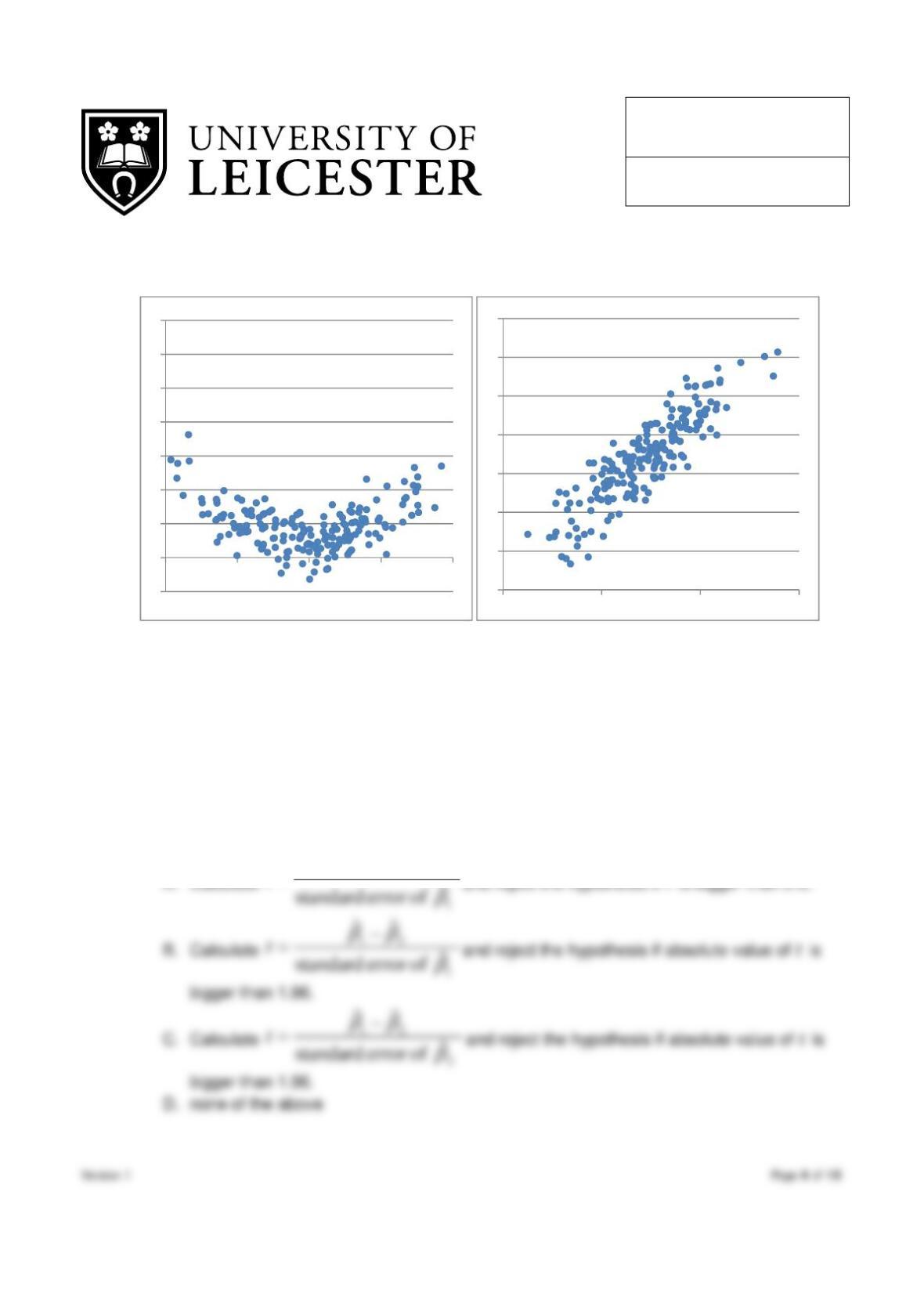
5) Consider the following scatterplots of a dependent variable Y against an independent variable
X. Which of the following plots shows a clear evidence of heteroskedasticity?
A. Only Plot 1
B. Only Plot 2
C. Both Plot 1 and Plot 2
D. None of them.
6) Consider the following regression model iiii uXXY
,22,110
. You can test the
hypothesis that 21
versus the alternative that 21
at the 5% significance level using
the following procedure:
ˆˆ
21
tand reject the hypothesis if t is bigger than 5%.
12345
Y
X
Plot1
0246
Y
X
Plot2