Question 1
0 / 1 point
Declining average total cost with increased production is one of the defining characteristics of a
natural monopoly.
True
False
Question 2
0 / 1 point
The two characteristics of a competitive market are 1) many buyers and sellers in the market and
2) the goods offered by the various sellers are highly differentiated.
True
False
Question 3
0 / 1 point
A natural monopoly has economies of scale for most if not all of its range of output.
True
False
Question 4
0 / 1 point
A patent gives a single person or firm the exclusive right to sell some good or service for a specific
period of time.
True
False
Question 5
0 / 1 point
For a firm operating in a perfectly competitive industry, marginal revenue and average revenue are
equal.
True
False
Question 6
0 / 1 point
In studying oligopolistic markets, economists assume that
there is no conflict or tension between cooperation and self-interest.
it is easy for a group of firms to cooperate and thereby establish and
maintain a monopoly outcome.
each oligopolist cares only about its own profit.
strategic decisions do not play a role in such markets.
Question 7
0 / 1 point
When an oligopoly market reaches a Nash equilibrium,
the market price will be different for each firm.
the firms will not have behaved as profit maximizers.
a firm will have chosen its best strategy, given the strategies chosen by
other firms in the market.
a firm will not take into account the strategies of competing firms.
Question 8
0 / 1 point
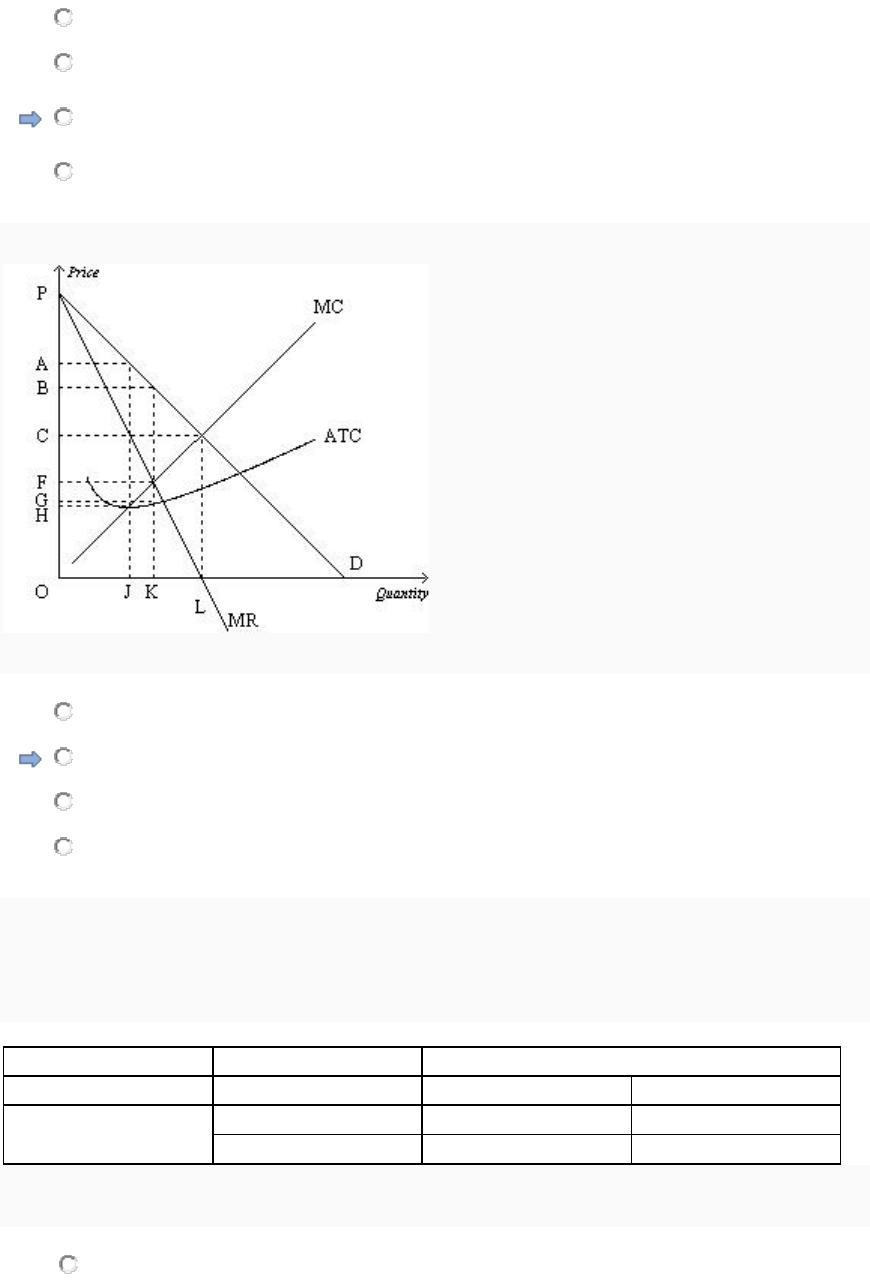
Figure 15-5
Refer to Figure 15-5. What price will the monopolist charge?
A
B
C
F
Question 9
0 / 1 point
Table 17-20
Nadia and Maddie are two college roommates who both prefer a clean common space in their dorm
room, but neither enjoys cleaning. The roommates must each make a decision to either clean or not
clean the dorm room’s common space. The payoff table for this situation is provided below, where
the higher a player’s payoff number, the better off that player is. The payoffs in each cell are shown
as (payoff for Nadia, payoff for Maddie).
Maddie
Clean
Don’t Clean
Nadia
Clean
(30, 30)
(7, 50)
Don’t Clean
(50, 7)
(10, 10)
Refer to Table 17-20. What is Maddie’s dominant strategy?
Maddie has no dominant strategy.

Maddie should always choose Clean.
Maddie should always choose Don’t Clean.
Maddie has two dominant strategies, Clean and Don’t Clean,
depending on the choice Nadia makes.
Question 10
0 / 1 point
Table 17-20
Nadia and Maddie are two college roommates who both prefer a clean common space in their dorm
room, but neither enjoys cleaning. The roommates must each make a decision to either clean or not
clean the dorm room’s common space. The payoff table for this situation is provided below, where
the higher a player’s payoff number, the better off that player is. The payoffs in each cell are shown
as (payoff for Nadia, payoff for Maddie).
Maddie
Clean
Don’t Clean
Nadia
Clean
(30, 30)
(7, 50)
Don’t Clean
(50, 7)
(10, 10)
Refer to Table 17-20. What is the Nash Equilibrium in this dorm room cleaning game?
Nadia: Clean
Maddie: Clean
Nadia: Don’t Clean
Maddie: Clean
Nadia: Clean
Maddie: Don’t Clean
Nadia: Don’t Clean
Maddie: Don’t Clean
Question 11
0 / 1 point
Implicit costs
do not require an outlay of money by the firm.
do not enter into the economist’s measurement of a firm’s profit.
are also known as variable costs.
are not part of an economist’s measurement of opportunity cost.
Question 12
0 / 1 point
Figure 14-4
Suppose a firm operating in a competitive market has the following cost curves:
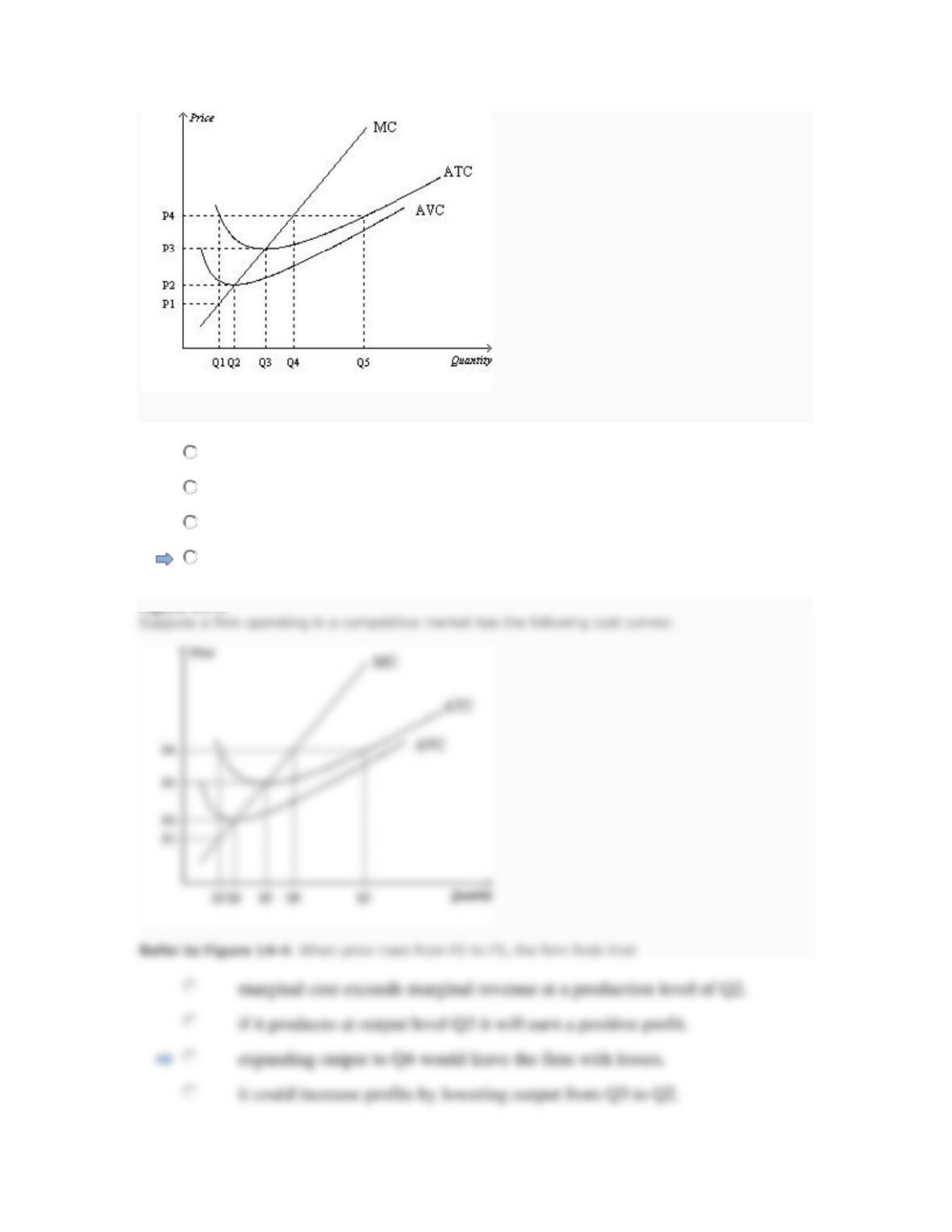
Refer to Figure 14-4. When price falls from P3 to P1, the firm finds that it
decreases its fixed costs.
should produce Q1 units of output.
should produce Q3 units of output.
should shut down immediately.
Question 13
0 / 1 point
marginal cost exceeds marginal revenue at a production level of Q2.
expanding output to Q4 would leave the firm with losses.
it could increase profits by lowering output from Q3 to Q2.