Lecture 03
ECE 404: Construction Technologies & Processes 1
Lecture 01
ECE 404: Construction Technologies & Processes 1
Sung-Woo MOON, Ph.D, P.E
Nazarbayev University
Department of Civil Engineering
LECTURE 3
EARTHMOVING MATERIALS &
OPERATIONS
September 05 , 2018
Lecture 03
ECE 404: Construction Technologies & Processes 3
ECE 404: Construction Technologies & Processes 3
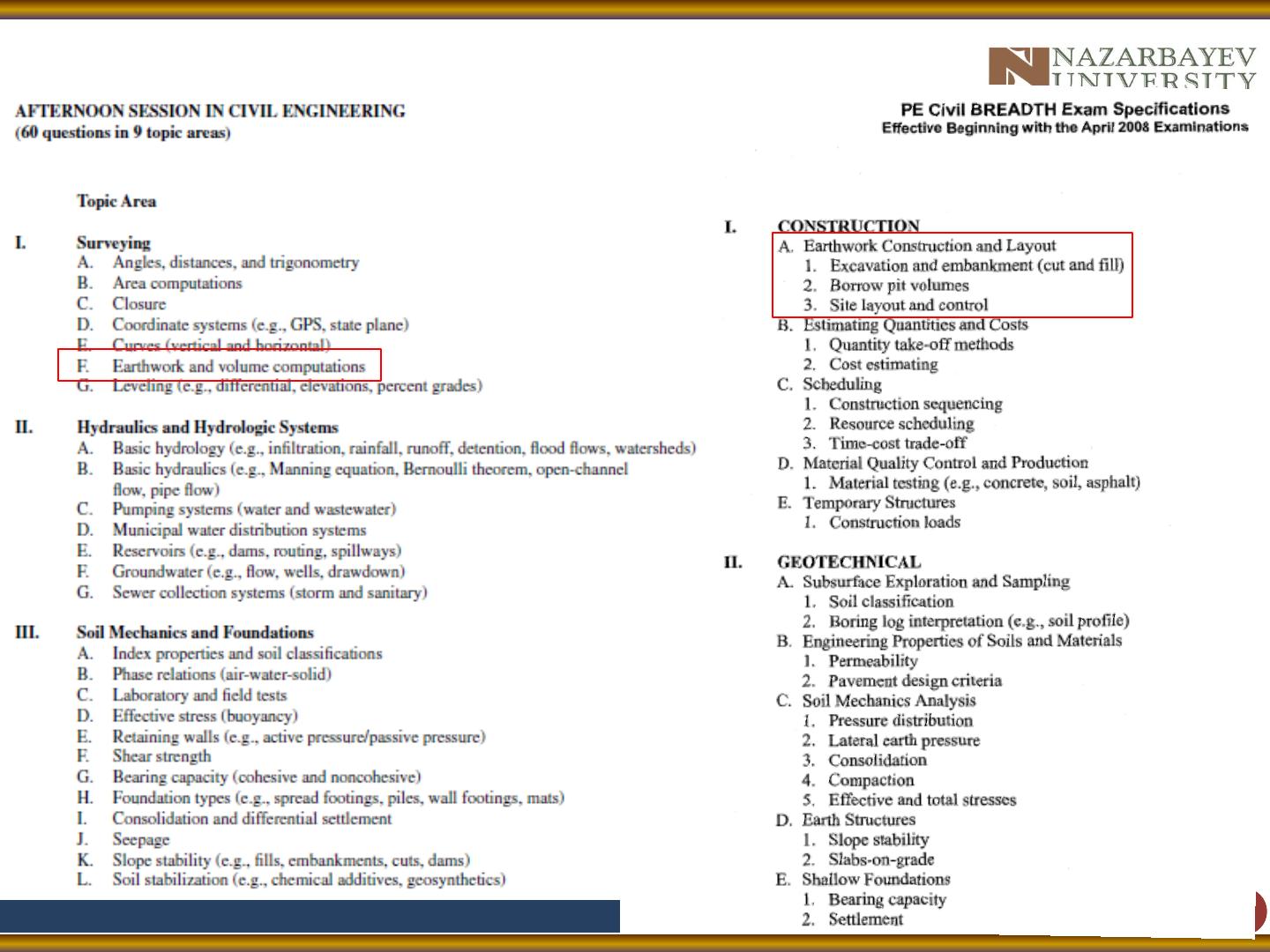
PROFESSIONAL ENGINEERING

Lecture 03
ECE 404: Construction Technologies & Processes 4
ECE 404: Construction Technologies & Processes 4
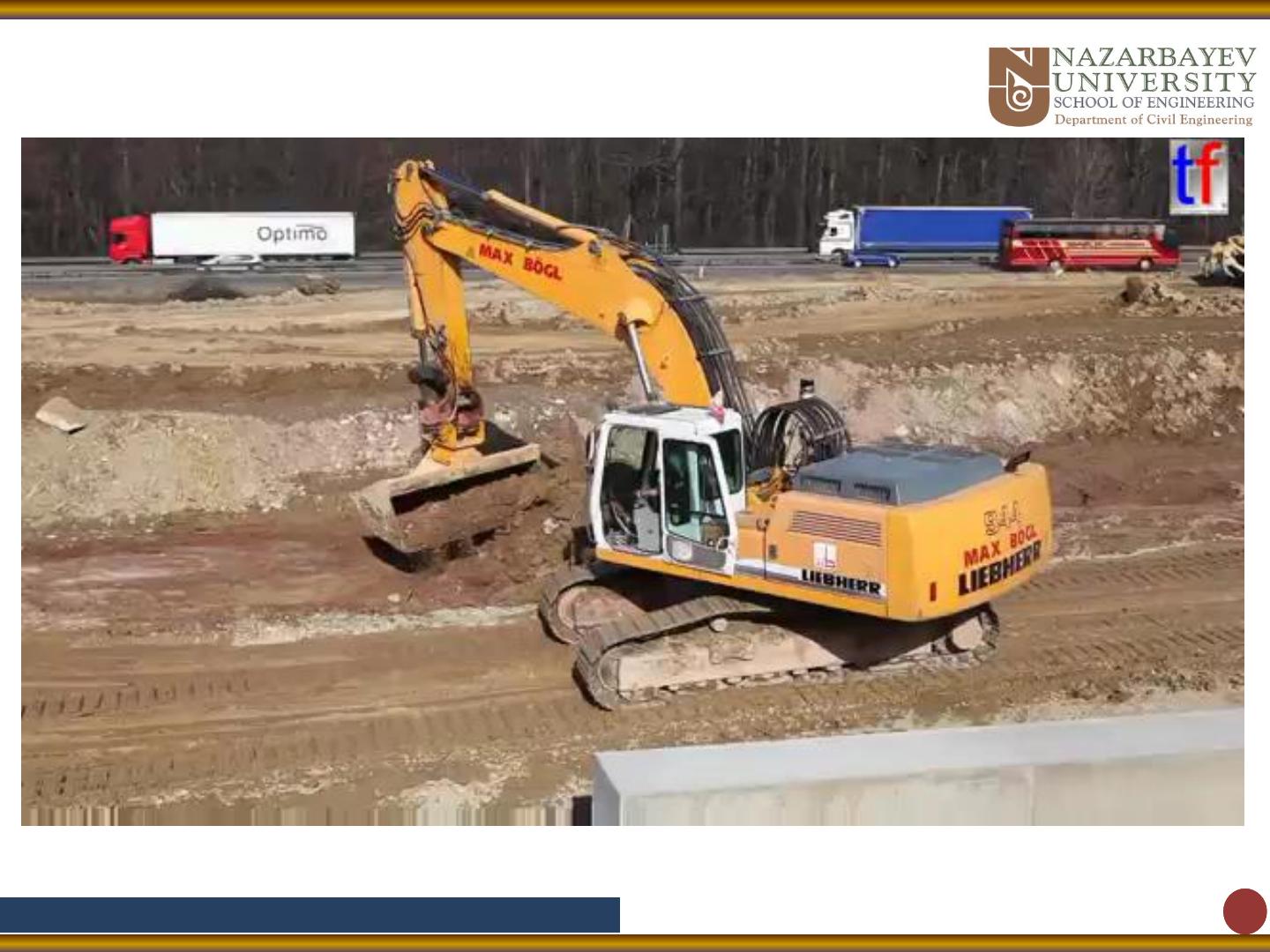
•Earthmoving is the process of moving soil or rock from
one location to another and processing it so that it meets
construction requirements of location, elevation, density,
moisture content.
•Earthmoving activities
–Excavating / loading / hauling / placing (dumping and spreading)
/ compacting / grading / finishing
•For efficient earthmoving process
–Accurate estimating of work quantities and job conditions
–Proper selection of equipment
–Competent job management
EARTHMOVING PROCESS
Lecture 03
ECE 404: Construction Technologies & Processes 5
ECE 404: Construction Technologies & Processes 5
EARTHMOVING PROCESS

Lecture 03
ECE 404: Construction Technologies & Processes 6
ECE 404: Construction Technologies & Processes 6
•Choice of equipment influences on the efficiency &
profitability of the construction operation
•Factors that should be considered in selecting equipment
for a project
–The ability of the equipment to perform the required work
•Maximize the profit produced by the equipment
•Achieve the lowest cost per unit of production
–Possible future use of the equipment
–Availability of parts and service
–Effect of equipment downtime on other construction equipment
and operations
EQUIPMENT SELECTION
Lecture 03
ECE 404: Construction Technologies & Processes 7
ECE 404: Construction Technologies & Processes 7
•Basic relationship for estimating the production
of all earthmoving equipment
𝐶𝑜𝑠𝑡 𝑝𝑒𝑟 𝑢𝑛𝑖𝑡 𝑜𝑓 𝑝𝑟𝑜𝑑𝑢𝑐𝑡𝑖𝑜𝑛 = 𝐸𝑞𝑢𝑖𝑝𝑚𝑒𝑛𝑡 𝑐𝑜𝑠𝑡 𝑝𝑒𝑟 ℎ𝑜𝑢𝑟
𝐸𝑞𝑢𝑖𝑝𝑚𝑒𝑛𝑡 𝑝𝑟𝑜𝑑𝑢𝑐𝑡𝑖𝑜𝑛 𝑝𝑒𝑟 ℎ𝑜𝑢𝑟
𝑃𝑟𝑜𝑑𝑢𝑐𝑡𝑖𝑜𝑛 = 𝑉𝑜𝑙𝑢𝑚𝑒 𝑝𝑒𝑟 𝑐𝑦𝑐𝑙𝑒 × 𝐶𝑦𝑐𝑙𝑒𝑠 𝑝𝑒𝑟 ℎ𝑜𝑢𝑟
Where,
Vol. per cycle ∶ average vol.of material moved per equipment
Cycles per hour ∶ the number of cycles actually achieved expected per hour
PRODUCTION OF EARTHMOVING
EQUIPMENT
Lecture 03
ECE 404: Construction Technologies & Processes 8
ECE 404: Construction Technologies & Processes 8
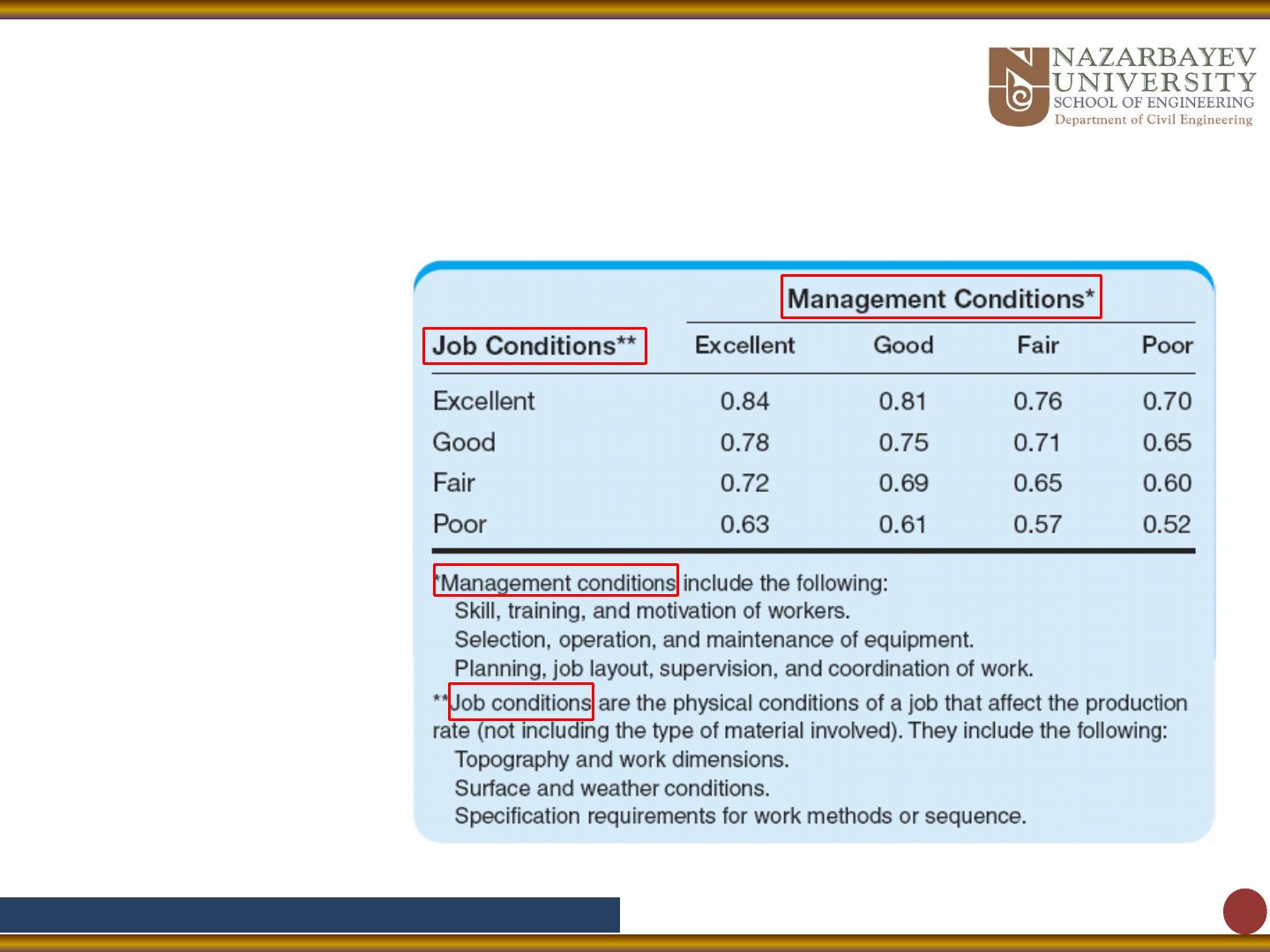
(From TM 5-331B, U.S. Department of the Army)
•Job efficiency factors for earthmoving
operations
PRODUCTION OF EARTHMOVING
EQUIPMENT (Cont’d)
Lecture 03
ECE 404: Construction Technologies & Processes 9
ECE 404: Construction Technologies & Processes 9
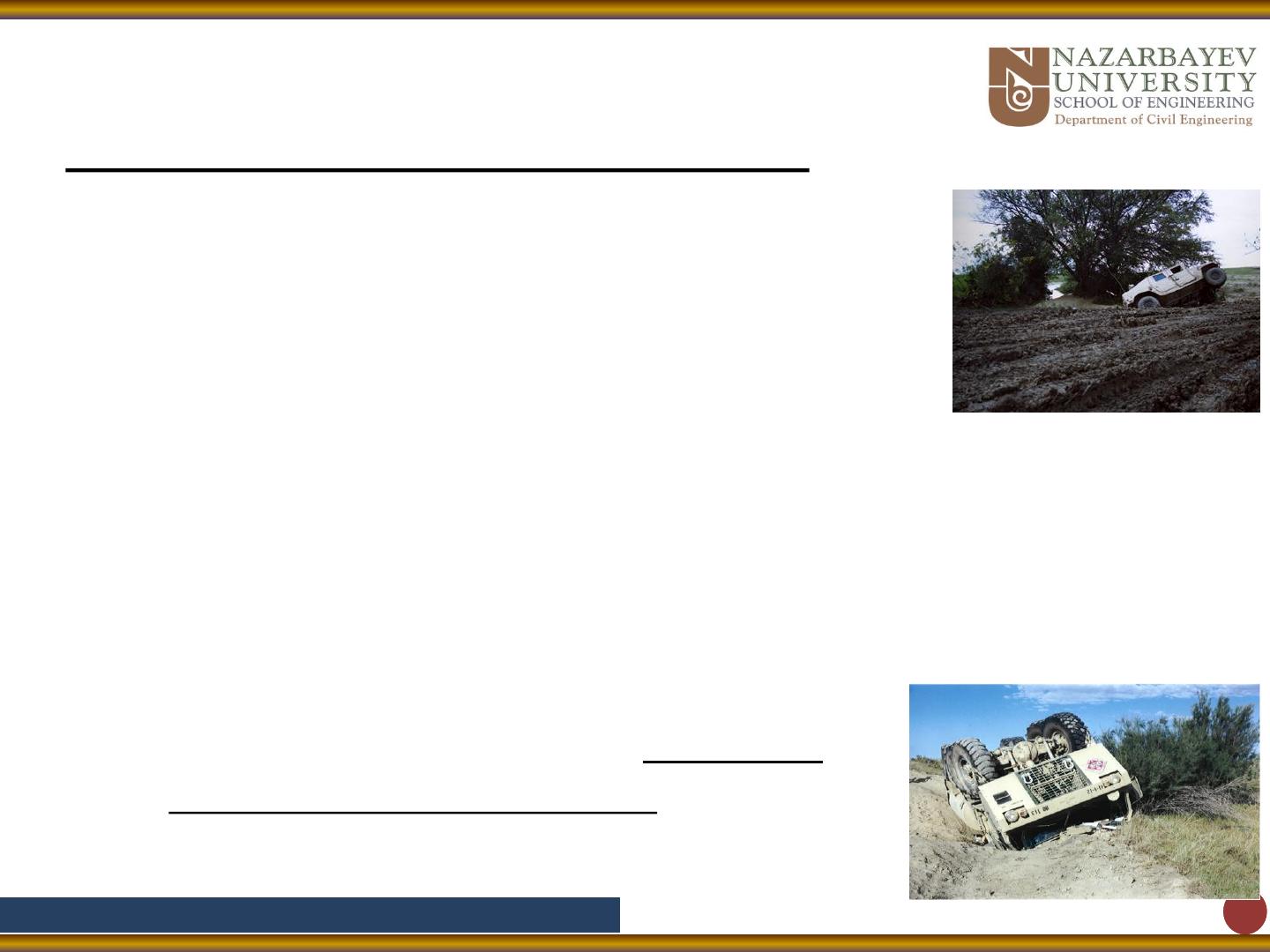
•Trafficability
–Ability of a soil to support the weight of
vehicles under repeated traffic
–Function of soil type and moisture conditions
–Factors impacting soil trafficability
•Soil strength / Slipperiness / Stickiness / Slope /
Stoniness
–Drainage, stabilization of haul routes, or the
use of low-ground pressure construction
equipment may be required when poor
trafficability conditions exist
EARTHMOVING MATERIALS:
GENERAL SOIL CHARACTERISTICS

Lecture 03
ECE 404: Construction Technologies & Processes 10
ECE 404: Construction Technologies & Processes 10
•Loadability
–Measure of the difficulty in excavating and loading a soil
•E.g. Loose granular soils vs. compacted cohesive soils and rock
•Soil unit weight (lbs/yd3or kg/m3)
–Used as measure of compaction
–Factor in determining the capacity of a haul
–Depend on soil type, moisture content, and degree of
compaction
•Moisture content
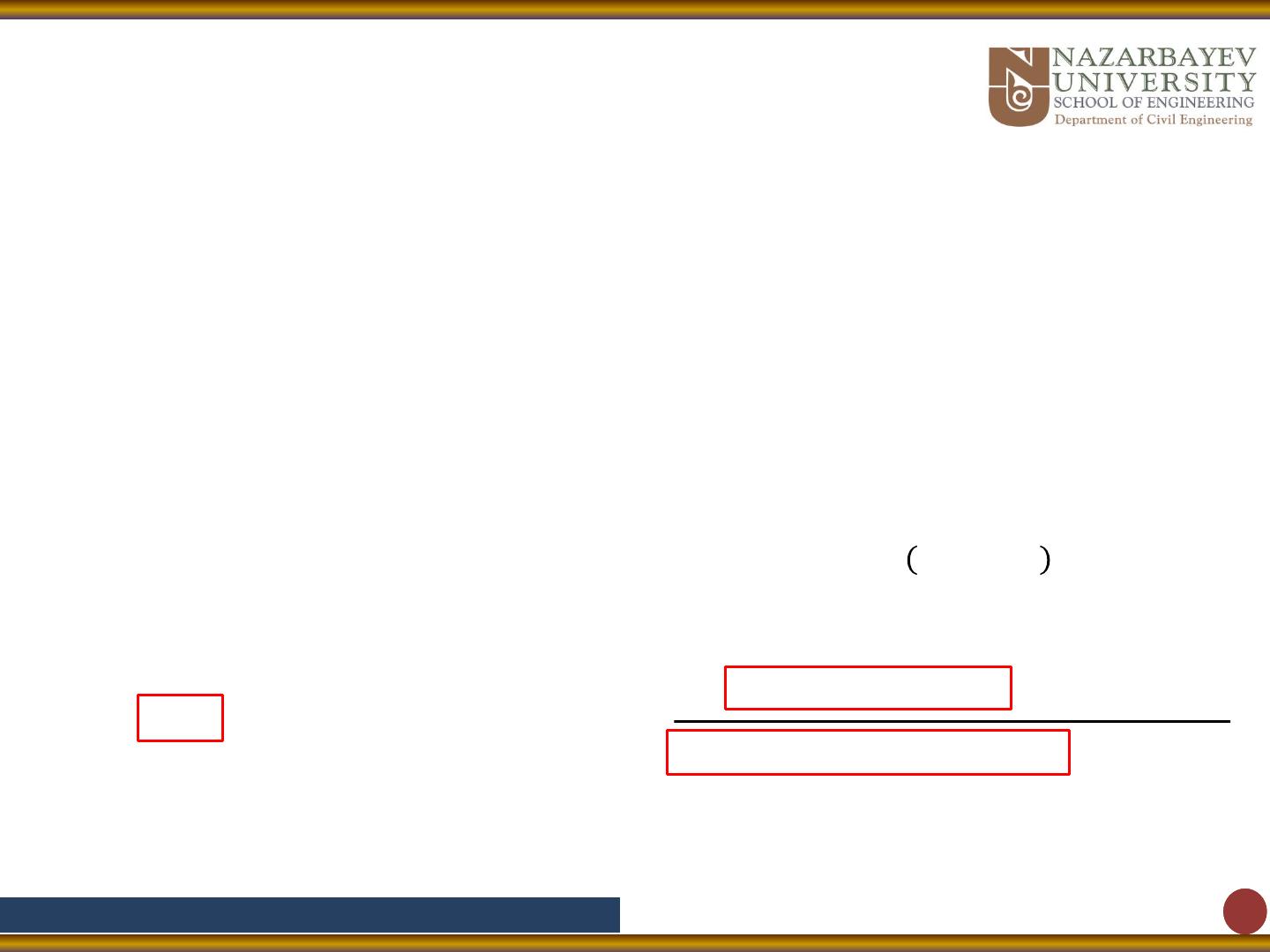
𝑀𝑜𝑖𝑠𝑡𝑢𝑟𝑒 𝑐𝑜𝑛𝑡𝑒𝑛𝑡 = 𝑀𝑜𝑖𝑠𝑡 𝑤𝑒𝑖𝑔ℎ𝑡 − 𝑑𝑟𝑦 𝑤𝑒𝑖𝑔ℎ𝑡
𝐷𝑟𝑦 𝑤𝑒𝑖𝑔ℎ𝑡 × 100
EARTHMOVING MATERIALS:
GENERAL SOIL CHARACTERISTICS
Lecture 03
ECE 404: Construction Technologies & Processes 11
ECE 404: Construction Technologies & Processes 11
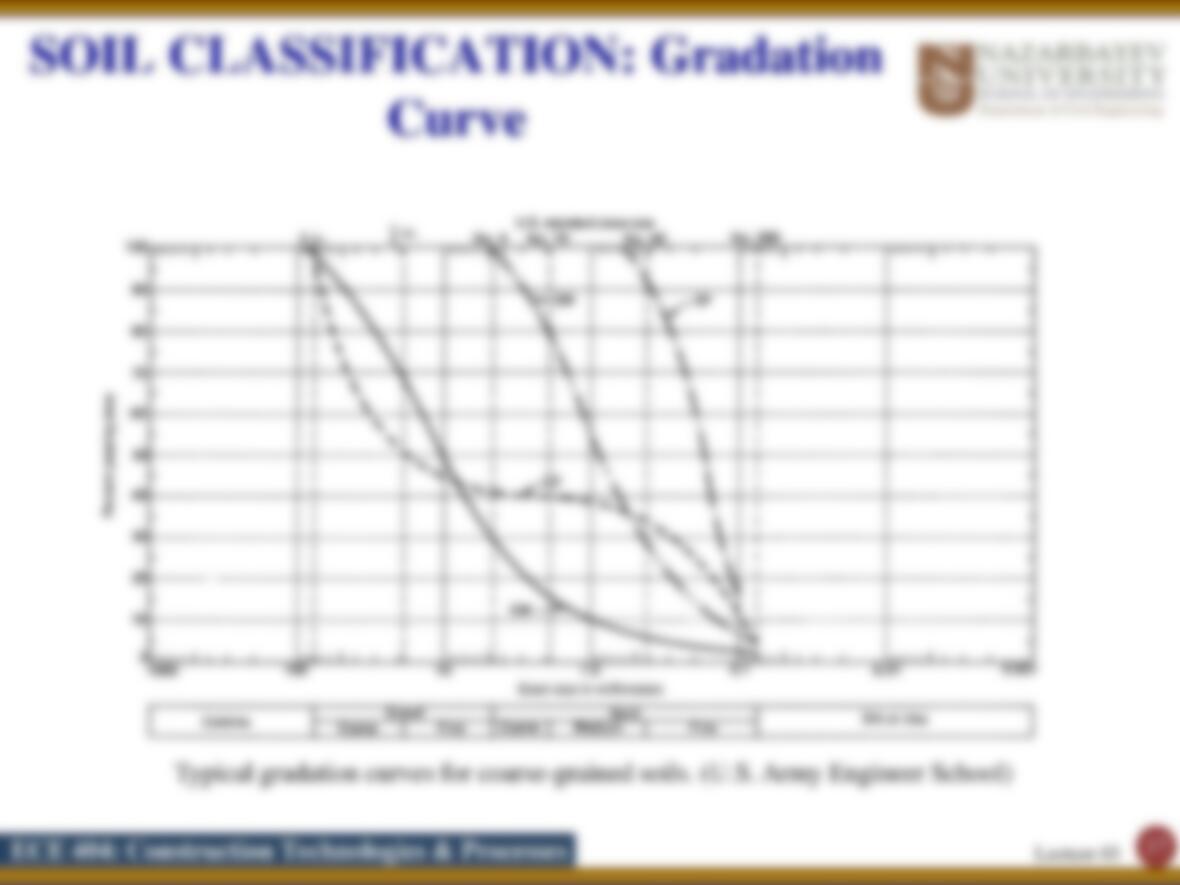
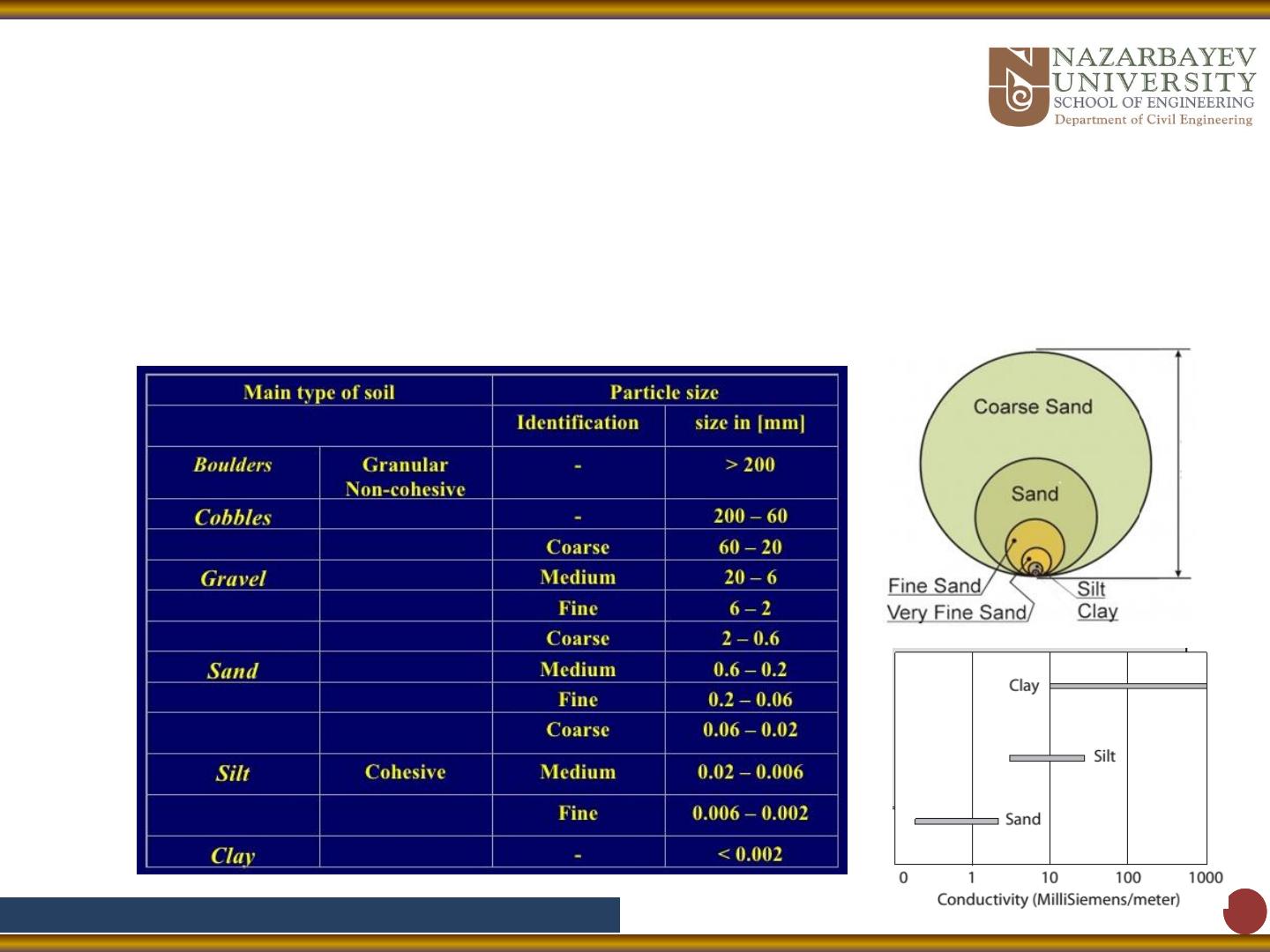
•Soil
–Consist of gravel, sand, silt, clay, and organic
materials
2mm
SOIL CLASSIFICATION
Lecture 03
ECE 404: Construction Technologies & Processes 12
ECE 404: Construction Technologies & Processes 12
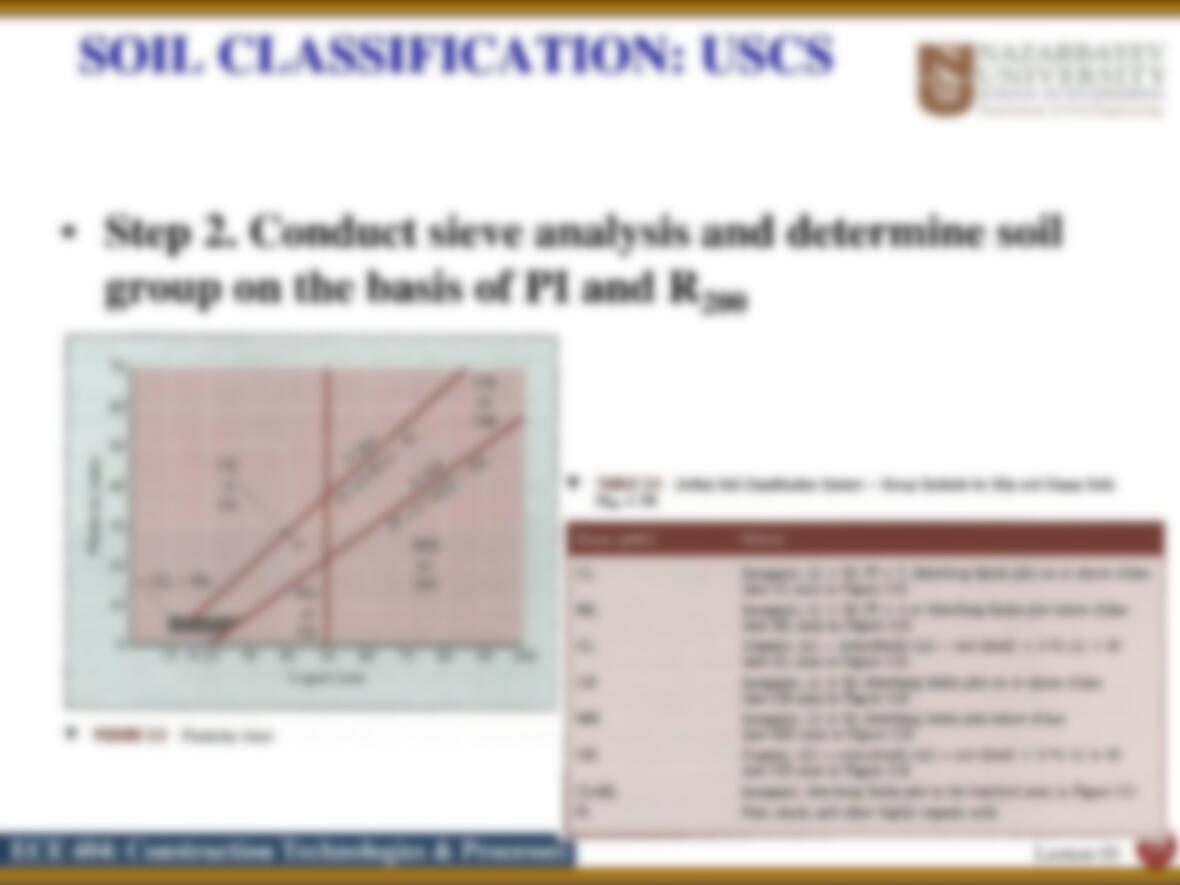
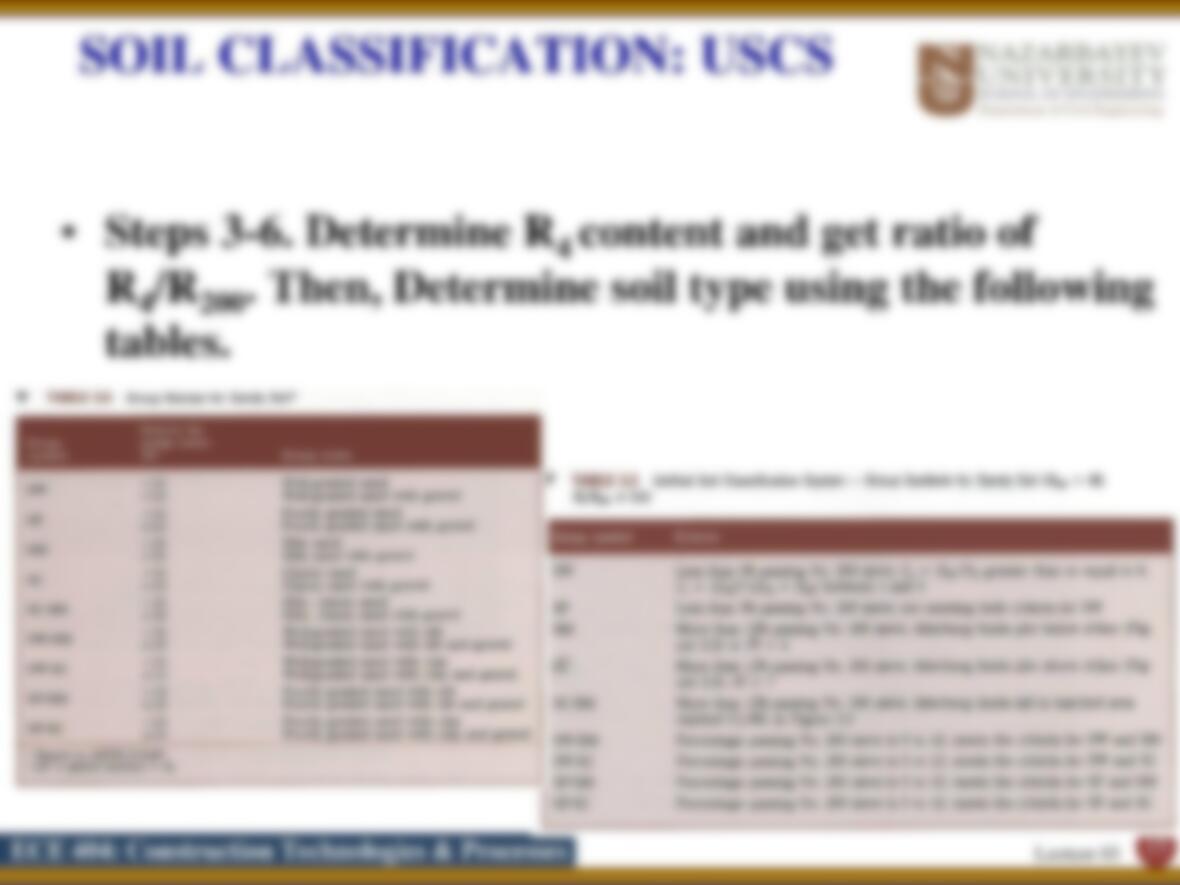
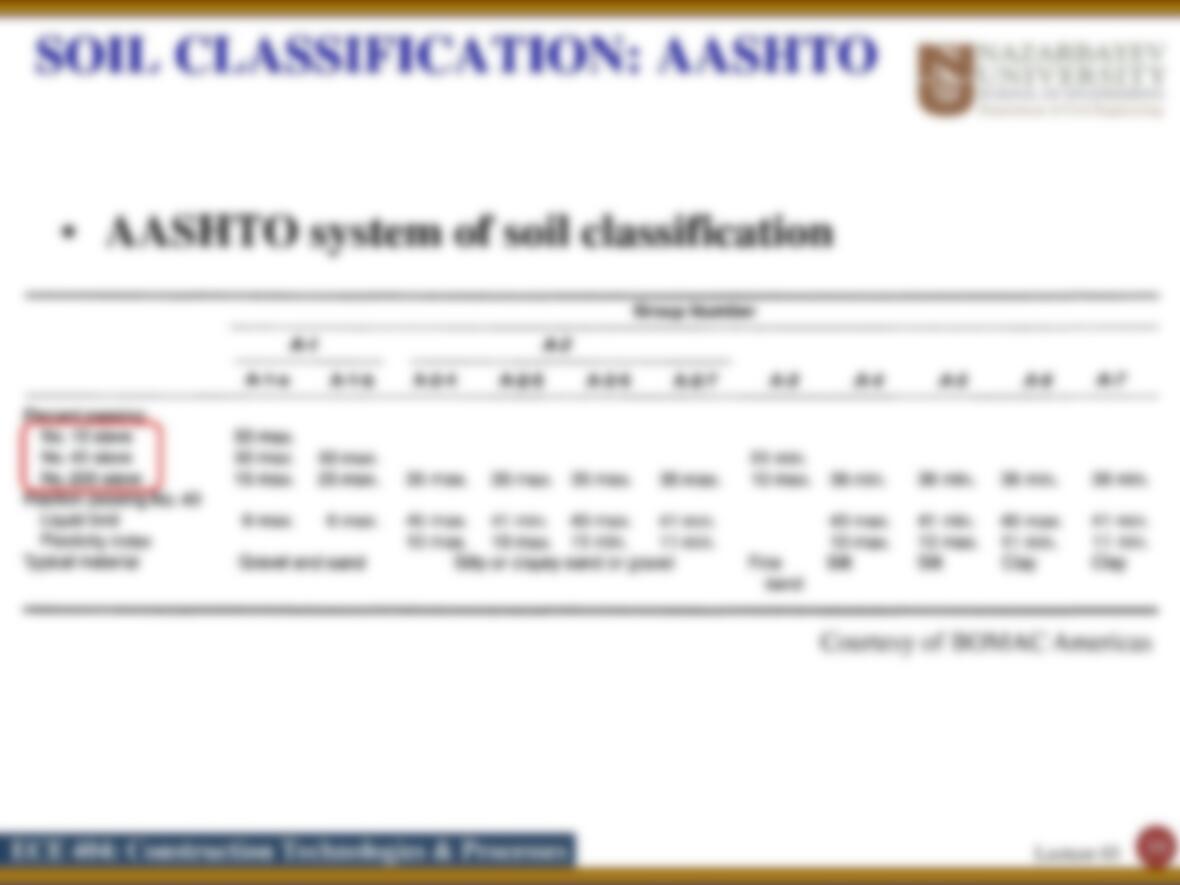
•Soil Classification Systems
–Two principal soil classification systems are used
for design and construction in the United States
•Unified Soil Classification System (USCS)
•AASHTO System (American Association of State
Highway and Transportation Officials)
•In both systems, soil particles 7.6 cm (3 in. ) or larger in
diameter are removed before performing classification
tests.
SOIL CLASSIFICATION
•Step 1. Determine Atterberg Limits
SOIL CLASSIFICATION: USCS
Liquid limit (LL) – Plastic limit (PL)