Chapter 7: The Costs of Production
84
CHAPTER 7
THE COST OF PRODUCTION
QUESTIONS FOR REVIEW
1. A firm pays its accountant an annual retainer of $10,000. Is this an economic cost?
Explicit costs are actual outlays. They include all costs that involve a monetary
transaction. An implicit cost is an economic cost that does not necessarily involve a
monetary transaction, but still involves the use of resources. When a firm pays an
annual retainer of $10,000, there is a monetary transaction. The accountant trades his
or her time in return for money. Therefore, an annual retainer is an explicit cost.
2. The owner of a small retail store does her own accounting work. How would you
measure the opportunity cost of her work?
Opportunity costs are measured by comparing the use of a resource with its alternative
uses. The opportunity cost of doing accounting work is the time not spent in other
ways, i.e., time such as running a small business or participating in leisure activity.
The economic, or opportunity, cost of doing accounting work is measured by computing
the monetary amount that the owner’s time would be worth in its next best use.
3. Please explain whether the following statements are true or false.
a. If the owner of a business pays himself no salary, then the accounting cost is zero,
but the economic cost is positive.
True. Since there is no monetary transaction, there is no accounting, or explicit, cost.
However, since the owner of the business could be employed elsewhere, there is an
economic cost. The economic cost is positive, reflecting the opportunity cost of the
owner’s time. The economic cost is the value of the next best alternative, or the
amount that the owner would earn if he took the next best job.
b. A firm that has positive accounting profit does not necessarily have positive
economic profit.
True. Accounting profit considers only the explicit, monetary costs. Since there may
be some opportunity costs that were not fully realized as explicit monetary costs, it is
possible that when the opportunity costs are added in, economic profit will become
negative. This indicates that the firm’s resources are not being put to their best use.
c. If a firm hires a currently unemployed worker, the opportunity cost of utilizing the
worker’s services is zero.
False. The opportunity cost measures the value of the worker’s time, which is
unlikely to be zero. Though the worker was temporarily unemployed, the worker still
possesses skills, which have a value and make the opportunity cost of hiring the
worker greater than zero. In addition, since opportunity cost is the equivalent of the
worker’s next best option, it is possible that the worker might have been able to get a
better job that utilizes his skills more efficiently. Alternatively, the worker could
have been doing unpaid work, such as care of a child or elderly person at home,
which would have had a value to those receiving the service.
4. Suppose that labor is the only variable input to the production process. If the
marginal cost of production is diminishing as more units of output are produced, what
can you say about the marginal product of labor ?
The marginal product of labor must be increasing. The marginal cost of production
measures the extra cost of producing one more unit of output. If this cost is
diminishing, then it must be taking fewer units of labor to produce the extra unit of
output, since the extra cost refers to the extra cost of the labor. If fewer units of labor
are required to produce a unit of output, then the marginal product (extra output

Chapter 7: The Costs of Production
85
produced by an extra unit of labor) must be increasing. Note also, that MC=w/MPL,
so that if MC is diminishing then MPL must be increasing for any given w.
5. Suppose a chair manufacturer finds that the marginal rate of technical substitution of
capital for labor in his production process is substantially greater than the ratio of the
rental rate on machinery to the wage rate for assembly-line labor. How should he alter his
use of capital and labor to minimize the cost of production?
To minimize cost, the manufacturer should use a combination of capital and labor so
the rate at which he can trade capital for labor in his production process is the same as
the rate at which he can trade capital for labor in external markets. The manufacturer
would be better off if he increased his use of capital and decreased his use of labor,
decreasing the marginal rate of technical substitution, MRTS. He should continue this
substitution until his MRTS equals the ratio of the rental rate to the wage rate. The
MRTS in this case is equal to MPK/MPL. As the manufacturer uses more K and less
L, the MPK will diminish and the MPL will increase, both of which will decrease the
MRTS until it is equal to the ratio of the input prices (rental rate on capital divided by
wage rate).
6. Why are isocost lines straight lines?
The isocost line represents all possible combinations of labor and capital that may be
purchased for a given total cost. The slope of the isocost line is the ratio of the input
prices of labor and capital. If input prices are fixed, then the ratio of these prices is
clearly fixed and the isocost line is straight. Only when the ratio or factor prices
change as the quantities of inputs change is the isocost line not straight.
7. Assume the marginal cost of production is increasing. Can you determine whether the
average variable cost is increasing or decreasing? Explain.
Marginal cost can be increasing while average variable cost is either increasing or
decreasing. If marginal cost is less (greater) than average variable cost, then each
additional unit is adding less (more) to total cost than previous units added to the total
cost, which implies that the AVC declines (increases). Therefore, we need to know
whether marginal cost is greater than average variable cost to determine whether the
AVC is increasing or decreasing.
8. Assume the marginal cost of production is greater than the average variable cost. Can
you determine whether the average variable cost is increasing or decreasing? Explain.
If the average variable cost is increasing (decreasing), then the last unit produced is
adding more (less) to total variable cost than the previous units did, on average.
Therefore, marginal cost is above (below) average variable cost. In fact, the point
where marginal cost exceeds average variable cost is also the point where average
variable cost starts to rise.
9. If the firm’s average cost curves are U-shaped, why does its average variable cost curve
achieve its minimum at a lower level of output than the average total cost curve?
Total cost is equal to fixed plus variable cost. Average total cost is equal to average
fixed plus average variable cost. When graphed, the difference between the U-shaped
total cost and average variable cost curves is the average fixed cost curve. Thus, falling
average variable cost and average fixed cost sum up to a falling average total cost
curve. Since average fixed cost continues to fall as more output is produced, average
total cost will continue to fall even after average variable cost has reached its minimum
because the drop in average fixed cost exceeds the increase in the average variable cost.
Eventually, the fall in average fixed cost becomes small enough so that the rise in
average variable cost causes average total cost to begin to rise.

Chapter 7: The Costs of Production
86
10. If a firm enjoys economies of scale up to a certain output level, and then cost
increases proportionately with output, what can you say about the shape of the long-run
average cost curve?
When the firm experiences increasing returns to scale, its long-run average cost curve
is downward sloping. When the firm experiences constant returns to scale, its long-run
average cost curve is horizontal. If the firm experiences increasing returns to scale,
then constant returns to scale, its long-run average cost curve falls, then becomes
horizontal.
11. How does a change in the price of one input change the firm’s long–run expansion
path?
The expansion path describes the combination of inputs that the firm chooses to
minimize cost for every output level. This combination depends on the ratio of input
prices: if the price of one input changes, the price ratio also changes. For example, if
the price of an input increases, less of the input can be purchased for the same total
cost, and the intercept of the isocost line on that input’s axis moves closer to the origin.
Also, the slope of the isocost line, the price ratio, changes. As the price ratio changes,
the firm substitutes away from the now more expensive input toward the cheaper
input. Thus, the expansion path bends toward the axis of the now cheaper input.
12. Distinguish between economies of scale and economies of scope. Why can one be
present without the other?
Economies of scale refer to the production of one good and occur when proportionate
increases in all inputs lead to a more-than-proportionate increase in output.
Economies of scope refer to the production of more than one good and occur when joint
output is less costly than the sum of the costs of producing each good or service
separately. There is no direct relationship between increasing returns to scale and
economies of scope, so production can exhibit one without the other. See Exercise (14)
for a case with constant product-specific returns to scale and multiproduct economies of
scope.
13. Is the firm’s expansion path always a straight line?
No. If the long run expansion path is a straight line this means that the firm always
uses capital and labor in the same proportion. If the capital labor ratio changes as
output is increased then the expansion path is not a straight line.
14. What is the difference between economies of scale and returns to scale?
Economies of scale measures the relationship between cost and output, i.e., when
output is doubled, does cost double, less then double, or more than double. Returns
to scale measures what happens to output when all inputs are doubled.
EXERCISES
1. Joe quits his computer-programming job, where he was earning a salary of $50,000 per
year to start his own computer software business in a building that he owns and was
previously renting out for $24,000 per year. In his first year of business he has the
following expenses: salary paid to himself $40,000, rent, $0, and other expenses $25,000.
Find the accounting cost and the economic cost associated with Joe’s computer software
business.
The accounting cost represents the actual expenses, which are $40,000+$0 +
$25,000=$65,000. The economic cost includes accounting cost, but also takes into
account opportunity cost. Therefore, economic will include, in addition to accounting
cost, an extra $24,000 because Joe gave up $24,000 by not renting the building , and
Chapter 7: The Costs of Production
an extra $10,000 because he paid himself a salary $10,000 below market ($50,000–
$40,000). Economic cost is then $99,000.
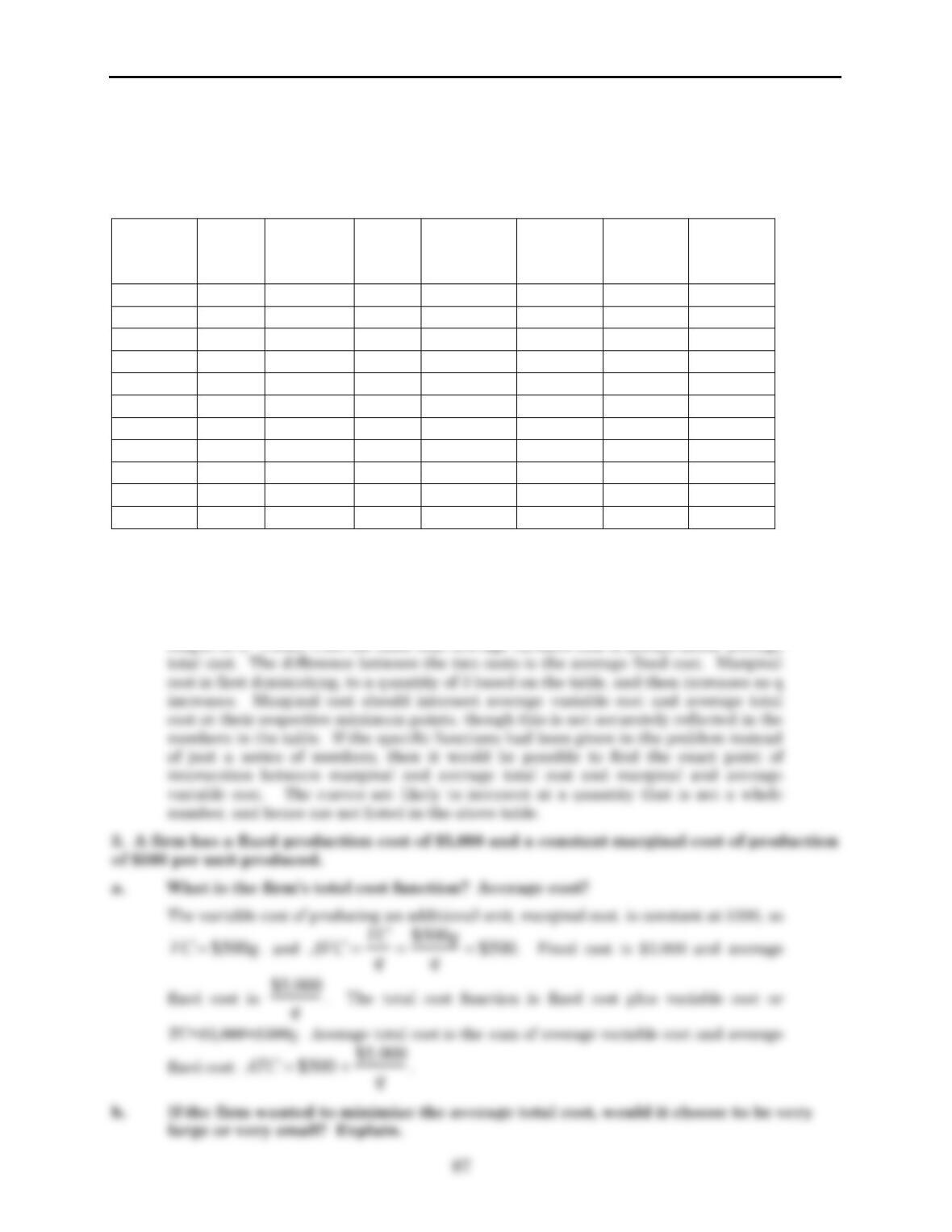
2. a. Fill in the blanks in the following table.
Units of
Output
Fixed
Cost
Variable
Cost
Total
Cost
Marginal
Cost
Average
Fixed
Cost
Average
Variable
Cost
Average
Total Cost
0
100
0
100
—
—
0
—
1
100
25
125
25
100
25
125
2
100
45
145
20
50
22.5
72.5
3
100
57
157
12
33.3
19
52.3
4
100
77
177
20
25
19.25
44.25
5
100
102
202
25
20
20.4
40.4
6
100
136
236
34
16.67
22.67
39.3
7
100
170
270
34
14.3
24.3
38.6
8
100
226
326
56
12.5
28.25
40.75
9
100
298
398
72
11.1
33.1
44.2
10
100
390
490
92
10
39
49
b. Draw a graph that shows marginal cost, average variable cost, and average total
cost, with cost on the vertical axis and quantity on the horizontal axis.
Average total cost is u-shaped and reaches a minimum at an output of 7, based on
the above table. Average variable cost is u-shaped also and reaches a minimum at an