DTM Chapter 2 Page 1 of 14
Chapter 2
Distribution Channels
2.1 What is a Channel of Distribution?
A channel of distribution is a collection of organizational units, institutions, or
agencies within or external to the manufacturer, which performs the functions
that support product marketing. The marketing functions include buying,
selling, transporting, storing, financing, bearing market risk and providing
marketing information. Any organizational unit, institution or agency that
performs one or more of these marketing functions is a member of a channel
of distribution.
The structure of a distribution channel is determined by the marketing
functions that a specific organization performs. The specific structure depends
to a large extent on the nature of the product and the firm’s target market.
Management must determine channel structure within the framework of the
firm’s corporate and marketing objectives, its operating philosophy, its
strengths and weaknesses, and its infrastructure of manufacturing facilities
and warehouses. Channel structure affects (1) control over the performance
of functions, (2) the speed of delivery and communication and (3) the cost of
operations.
2.2 Channel Intermediaries
In the olden days a company or person made a product and the consumer
bought it direct from the manufacturer. However, this is rarely the case today.
The manufacturer or producer and the consumer may be geographically
separated. The consumer does not want to visit many different manufacturers
or producers in order to buy their goods and the producers do not want to
deliver to all the outlets stocking their products. The use of a middleman, or a
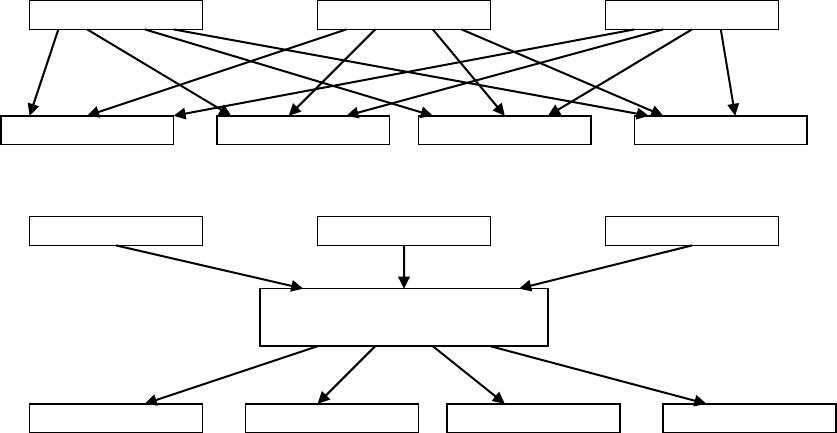
channel intermediary, contributes to efficiency, which is illustrated Figure 2–1.
In the situation without a middleman, a total of twelve contacts or transactions
are required for each producer to service each customer. On the other hand,
with the introduction of a middleman, only seven transactions or contacts are
required. The introduction of the middleman contributes to cost-effectiveness.
In summary, the advantage of a channel intermediary is in reducing the
number of contacts or transactions, thereby reducing the total cost to the
customer.
DTM Chapter 2 Page 2 of 14
Figure 2-1 Comparison between Distribution Channel with and without
Intermediary
2.3 The Functions of Channel Intermediaries
The emergence of channels of distribution has shortened the time in the
process of exchange of goods from the manufacturers to the customers. Their
functions can be classified into the following six main areas.
(a) Channel intermediaries reduce market contact
Marketing channels develop because intermediaries (e.g. wholesalers and
retailers) make the marketing process more efficient by reducing the number
of market contact. This is illustrated in Figure 2-1. Specialization in production
creates efficiency and the advantage of an intermediary is greater as the
number of specialized producers increases. Moreover, a manufacturer selling
to low-volume customers could reduce selling and logistics costs substantially
by using an intermediary.
(b) Channel intermediaries provide possession, time, and place utility
Channel intermediaries create possession utility through the process of
exchange, the result of the buying and selling functions. They provide time
utility by holding inventory available for sale. And they provide place utility by
physically moving goods to the market.
(c) Channel intermediaries enable the adjustment of the discrepancy
of assortment by performing the function of sorting and assorting
The assortment of goods and services held by a producer and the
assortments demanded by the customer often differ. The primary function of
Distribution channel with an intermediary
Direct distribution channel with no intermediary
Producer 1
Producer 2
Customer 1
Producer 3
Customer 2
Customer 3
Customer 4
Producer 1
Producer 2
Producer 3
Customer 1
Customer 2
Customer 3
Customer 4
Channel intermediary
DTM Chapter 2 Page 3 of 14
channel intermediaries is to adjust this discrepancy by performing the
following “sorting” process.
• Sorting out
This sorts a heterogeneous supply of products into stocks that are
homogeneous.
• Accumulating
This brings together similar stocks from different sources.
• Allocating
This breaks a homogeneous supply into smaller lots.
• Assorting
This builds up assortments of goods for resale, usually to retail
customers.
Customers may demand a much broader assortment of goods and services
than that provided by a single manufacturer. Specialization develops in the
exchange process to reduce distribution costs. Hence, the customer’s desire
for discrepancy of assortment drives the producer to use intermediaries to
reach the customer, leading to improved distribution efficiency.
(d) Channel intermediaries provide routinization of transactions
The cost of distribution can be minimized if transactions are routine. Marketing
agency form channel intermediaries to make routinization possible. Channel
cooperation and efficiency are improved by the routine handling of
transactions. Logistics operations can be made more efficient by using the
same processes. They may be even more efficient if third parties are utilized.
(e) Channel intermediaries facilitate the searching process by
customers
Buyers and sellers engage in a process in which consumers try to satisfy their
consumption needs and producers attempt to predict those needs. Channel
intermediaries facilitate the process of searching when institutions are
organized by separate lines of trade and provide information to their markets.
If the searching process is successful, allocation and assorting will take place,
resulting in benefits to both customer and producer.
(f) Channel intermediaries reduce costs
The use of a channel intermediary reduces some or all of the following costs:
• Selling costs (because fewer market contacts are required).
• Transportation costs (the use of intermediaries may result in fewer but
larger volume shipments).
• Inventory carrying costs (if the intermediary takes ownership).
• Storage costs.
• Order processing costs.
• Customer service costs.
2.4 Types of Channel Intermediaries
Channel intermediaries provide a variety of services, for example, providing
variety for the consumer, breaking down bulk purchases into more easily
manageable quantities, assisting with promotional activities and enabling a
much wider geographic dispersion.
There are three main types of channel intermediaries: agents, wholesalers
and retailers.
• Agents
Agents are used extensively in export markets, especially when the producing
company does not have a detailed knowledge of the export market, when the
producer’s ambitions are limited or when the level of sales does not make the
cost of a full-time team worthwhile.
Agents usually work in one of the following two ways: –
(a) They obtain orders from customers, pass these to the producer and
then take a commission on the agreed price. In this case, the contract
is between the producer and the customer. No stock-holding.
(b) They purchase goods from the producer and sell them directly to