Created:
June 1999 Last update:
AFMH, ASM DSP_L1_T1
Created:
June 1999 Last update:
Jan 2017
Discrete-Time
Signals: Review
DSP_L1_T1
Develop the notion of a discrete-time (d-t) signal and a d-t
system.
Define a d-t signal and its properties,
and perform operations on these signals.
Tutorial:
Solve problems related to the above.
MATLAB Exercises
Chap. 1, ‘’Digital Signal Processing, Sanjit K. Mitra.
LEARNING OBJECTIVES
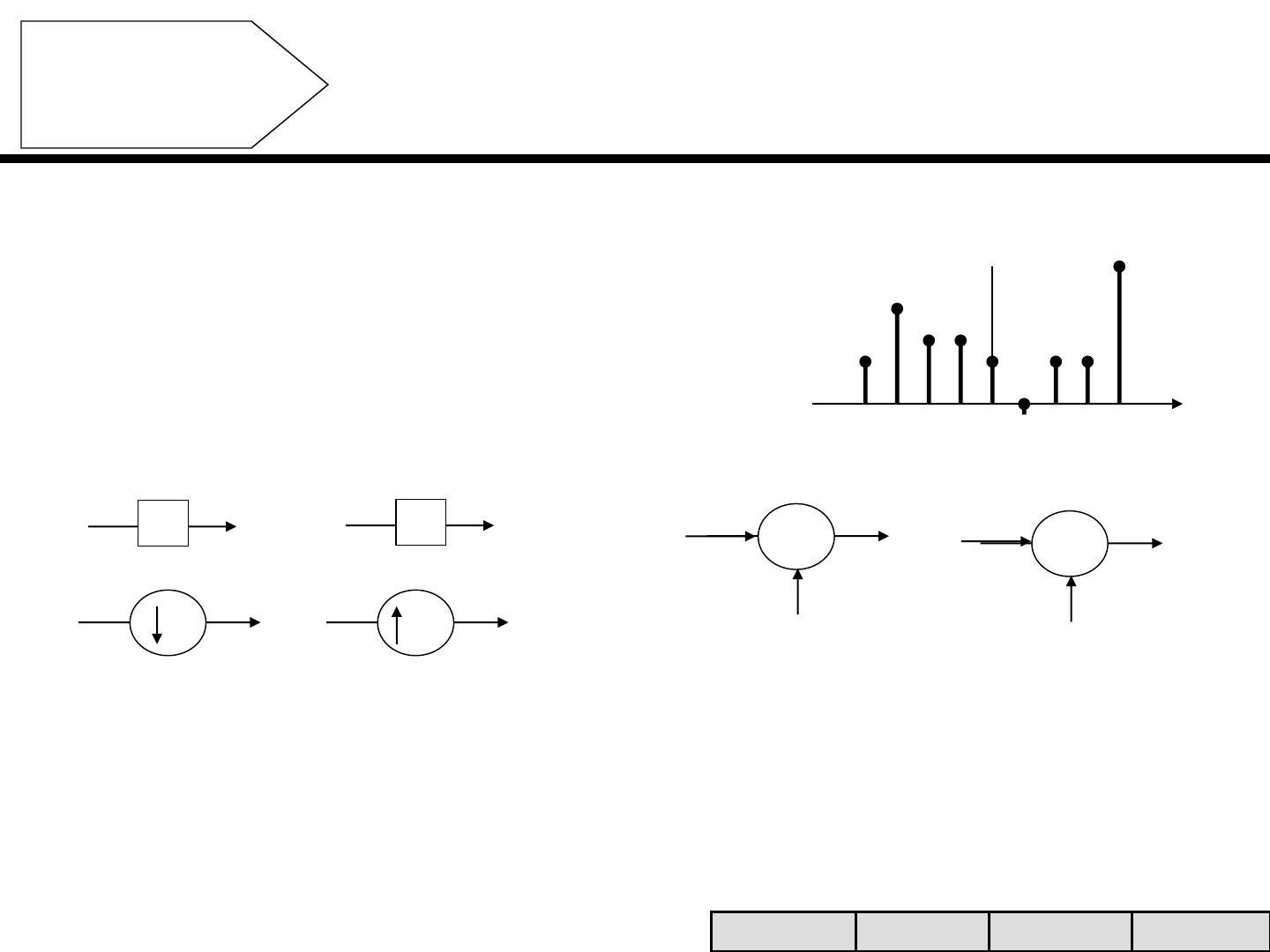
x[n]
n
-4 -3 -2 -1 0 1 2 3 5
… …
-N
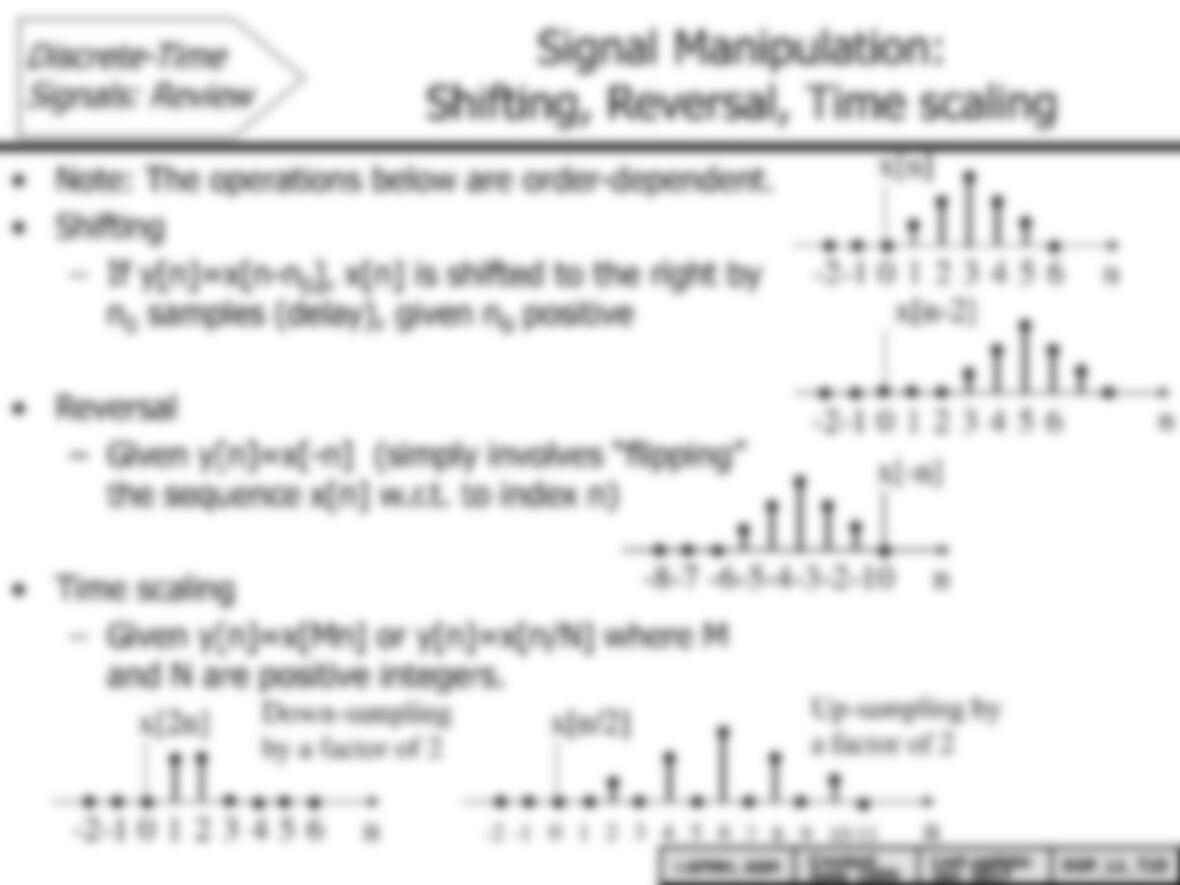
x[n] x[n-N] x[-n]
x[n]
x[2n]
x[n] 2x[2n]
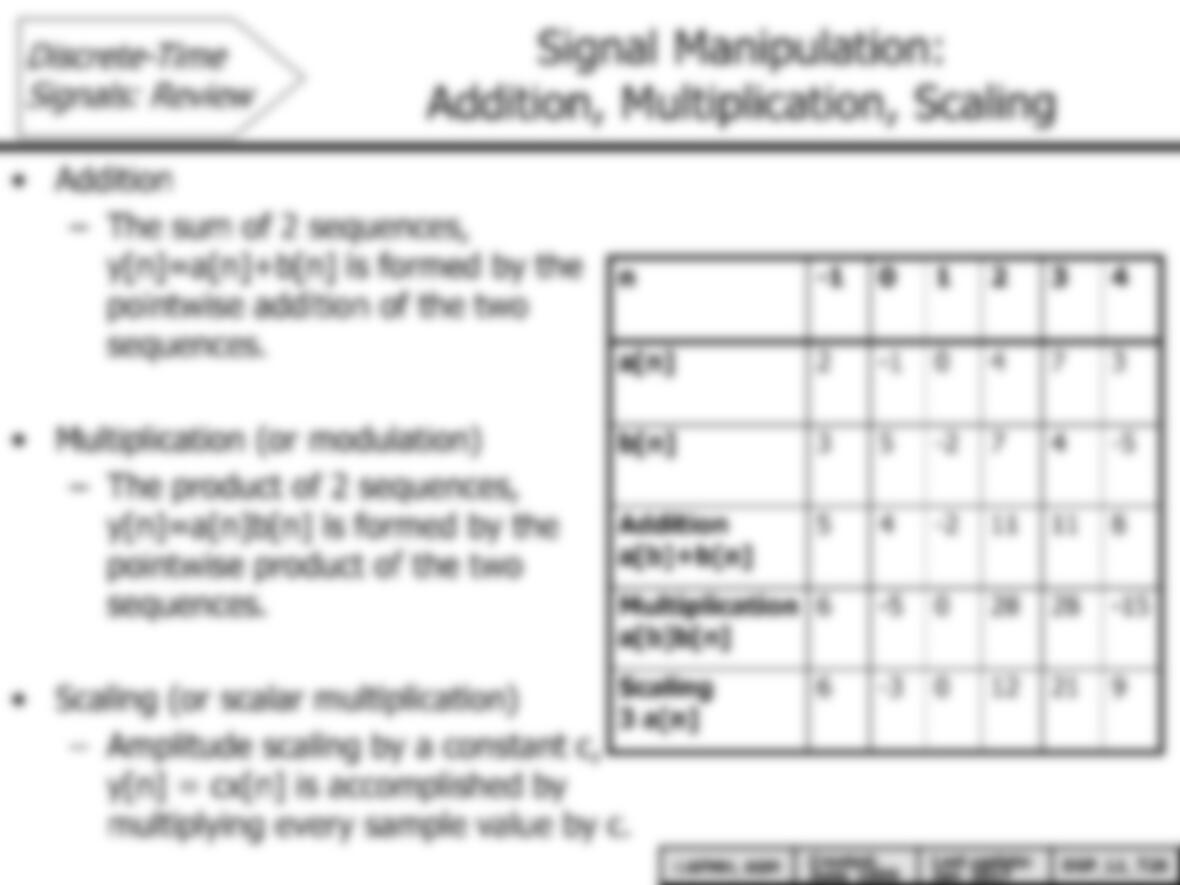
x[n] 2b[n]
a[n] +/–y[n] x[n] xy[n]
b[n] or scaling by c
Created:
June 1999 Last update:
AFMH, ASM DSP_L1_T2
Created:
June 1999 Last update:
Jan 2017
Discrete-Time
Signals: Review
DSP_L1_T2
Exercise
•Take out a sheet of paper
•Brainstorm & discuss with neighbors & write down:
–What do you think is meant by a signal?
–Why we need to study signal processing?
–What are the applications of signal processing?
Created:
June 1999 Last update:
AFMH, ASM DSP_L1_T3
Created:
June 1999 Last update:
Jan 2017
Discrete-Time
Signals: Review
DSP_L1_T3
Discrete-Time Signals
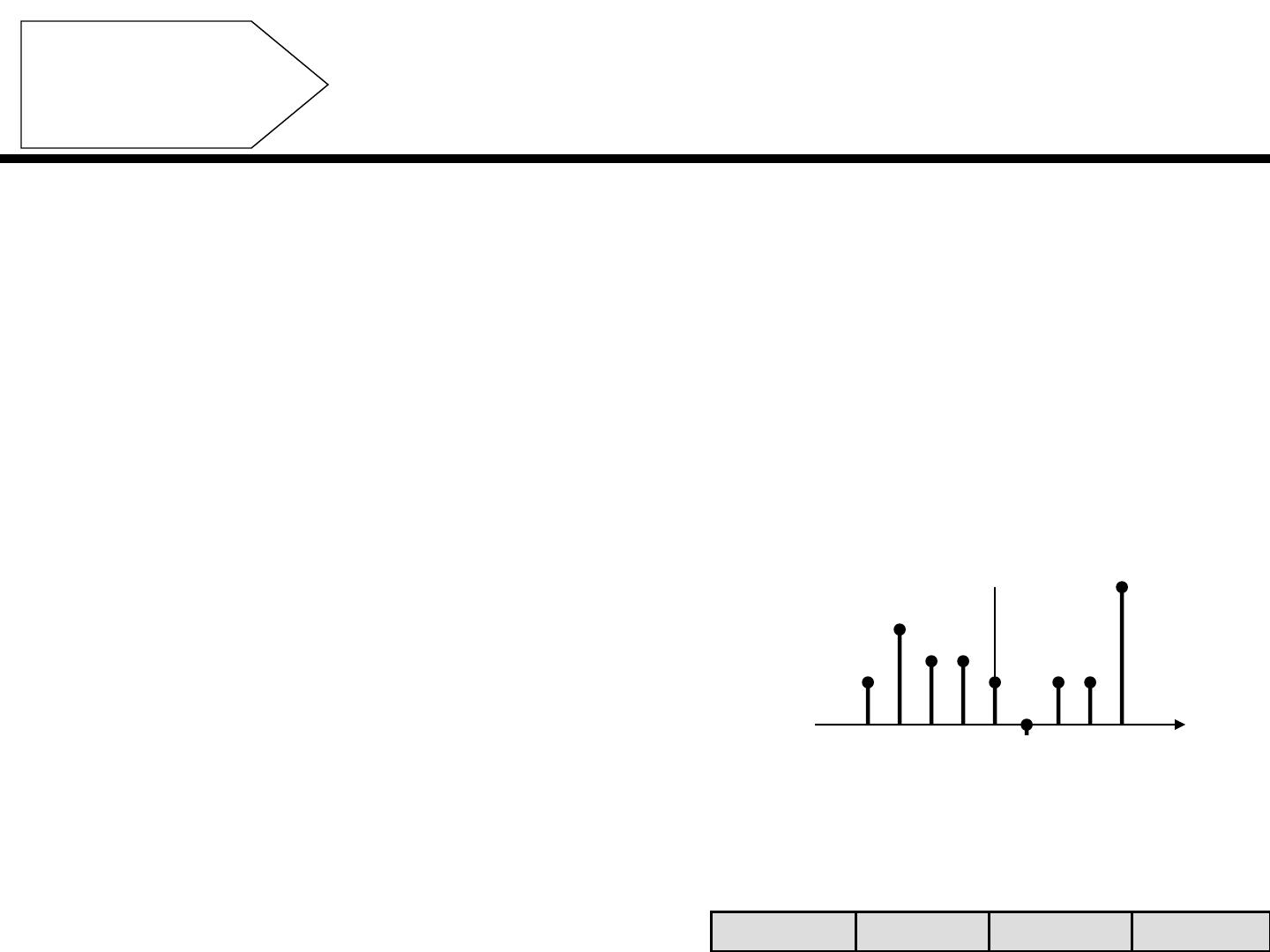
•A discrete-time signal is an indexed
sequence of real or complex
numbers. Thus, it is function of an
integer-valued variable, n and is
denoted by x[n].
•x[n] is generally referred to as a
function of time. A d-t signal is
undefined for noninteger values of
n.
•A real-valued signal x[n] will be
represented graphically in the form
of a
lollipop
plot as shown.
x[n]
n
-4 -3 -2 –1 0 1 2 3 5
… …
…)522023342(...][nx
Created:
June 1999 Last update:
AFMH, ASM DSP_L1_T4
Created:
June 1999 Last update:
Jan 2017
Discrete-Time
Signals: Review
DSP_L1_T4
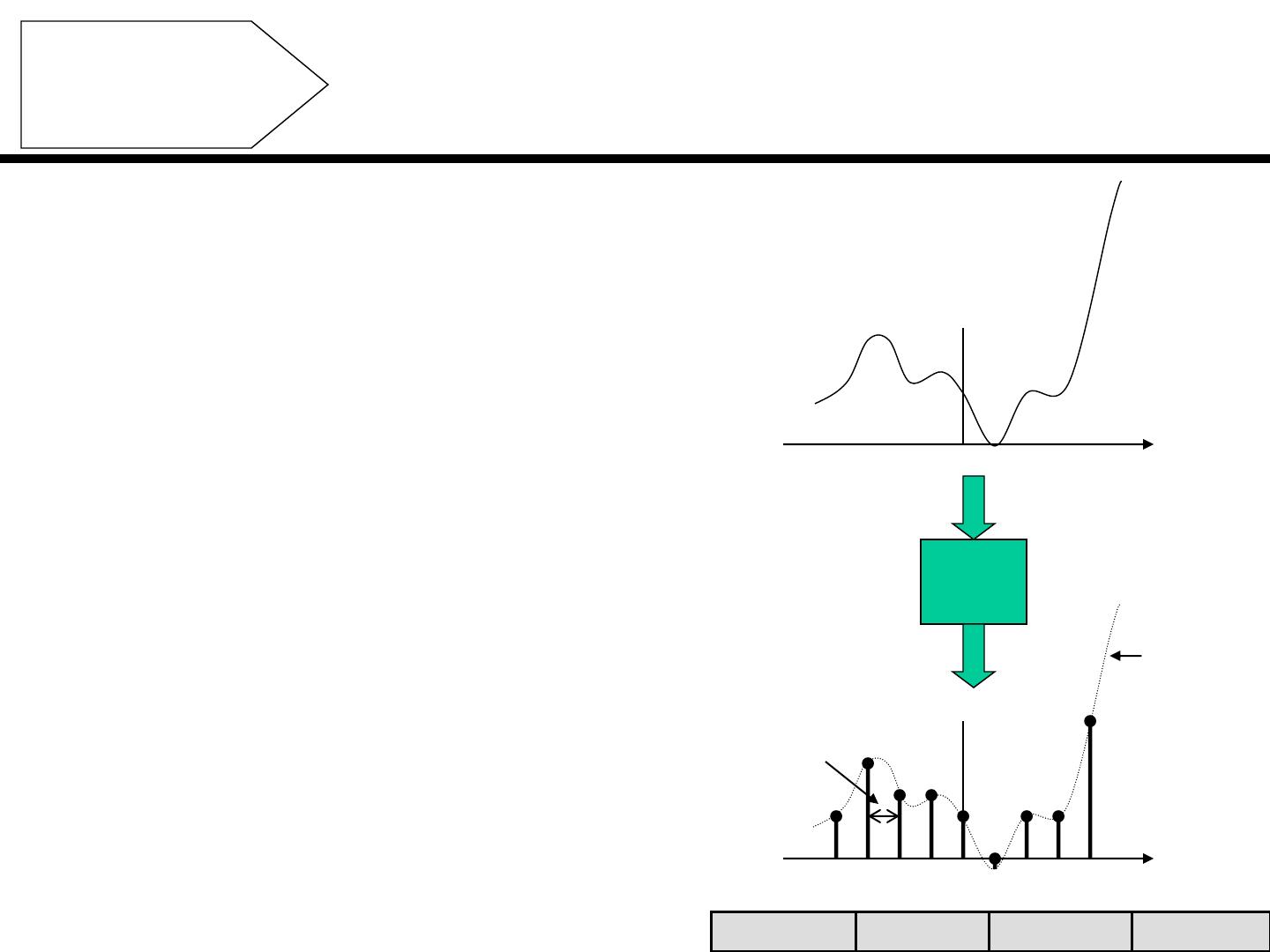
•Discrete-time signals or sequences are
often derived by sampling a
continuous-time signal, such as
speech, with an analog–to-digital (A/D)
converter.
•For example, a c-t signal xa(t) that is
sampled at a rate of fs=1/Tssamples
per second produces the sampled
signal x[n], which is related to xa(t) as
follows:
x[n] = xa(nTs)
•Not all d-t signals are obtained in this
manner. Eg. Daily stock market prices,
population statistics, etc.
Generating a D–T Signal or Sequence
x[n]
n
-4 -3 -2 –1 0 1 2 3 5
Sampling
interval, Ts
xa(t)
xa(t)
t
A/D
Created:
June 1999 Last update:
AFMH, ASM DSP_L1_T5
Created:
June 1999 Last update:
Jan 2017
Discrete-Time
Signals: Review
DSP_L1_T5
Complex Sequences
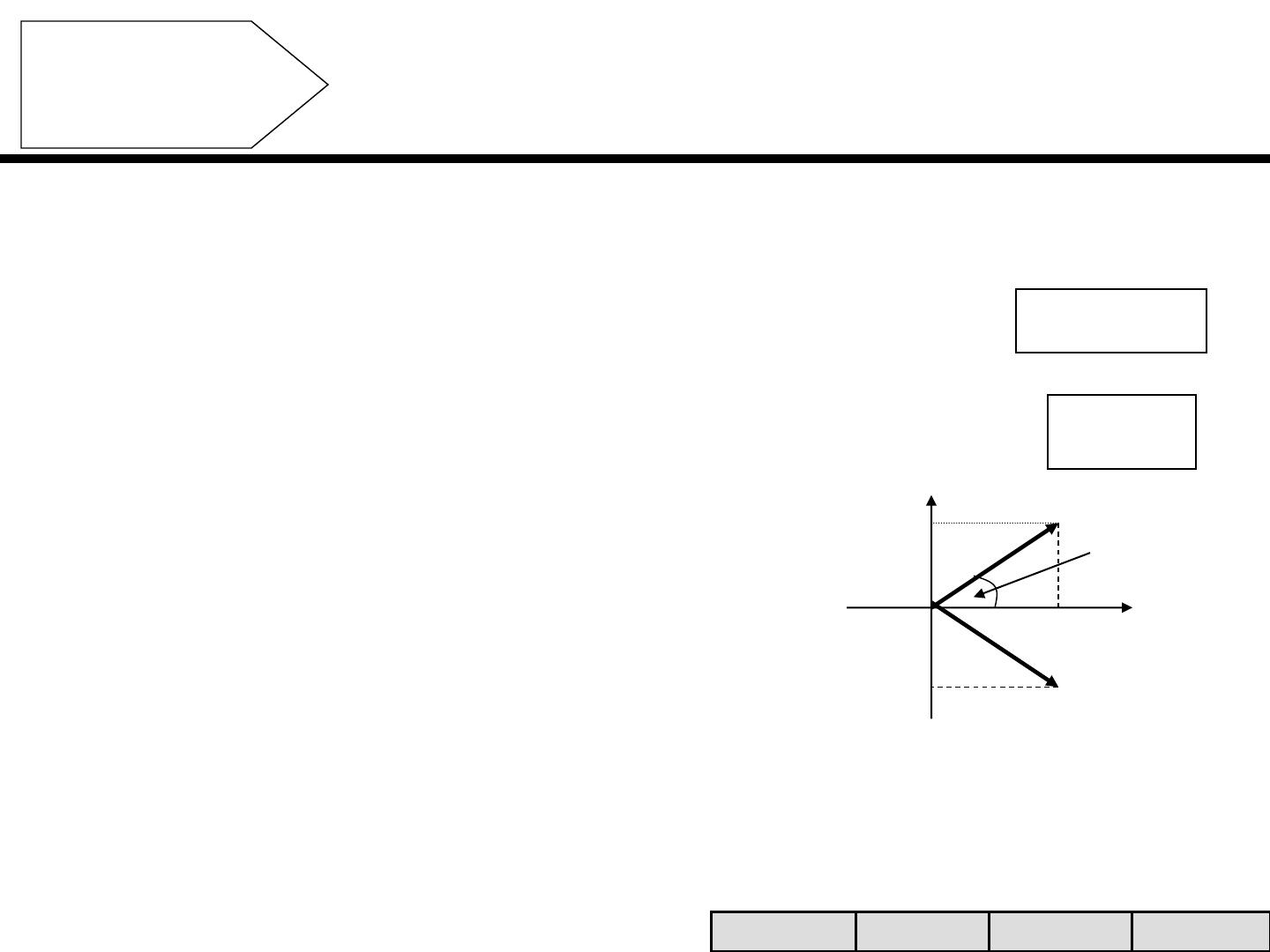
•In general, a d-t signal may be complex–valued. In digital communications,
complex signals arise naturally. A general complex signal x(t) may be
expressed either in terms of its real and imaginary parts,
z[n] = Re{z[n]} + j Im{z[n]}
or in polar form in terms of its magnitude and phase,
z[n] = |z[n]| exp[j arg{z[n]}]
•The magnitude may be derived as follows:
|z[n]|2= Re2{z[n]} + Im2{z[n]}
•The phase may be found using
arg{z[n]} = tan-1[Im{z[n]}/Re{z[n]}]
•If z[n] is a complex sequence, the complex conjugate denoted by z*[n] is
formed by changing the sign on the imaginary part of z[n]:
z*[n] = Re{z[n]} – j Im{z[n]} = |z[n]| exp[-j arg{z[n]}]
z = reif
z = a + jb
b
aRe
Im
tan-1 b/a
-b
z[n]
z*[n]
,…),(...,][ jdcjbanz
Created:
June 1999 Last update:
AFMH, ASM DSP_L1_T6
Created:
June 1999 Last update:
Jan 2017
Discrete-Time
Signals: Review
DSP_L1_T6
Exercise
•Write down:
–What do you think is difference between discrete, digital
and analog signal?
–Give examples of each of these type?
Discrete-Time
Signals: Review
Fundamental Sequences:
Unit Impulse Sequence
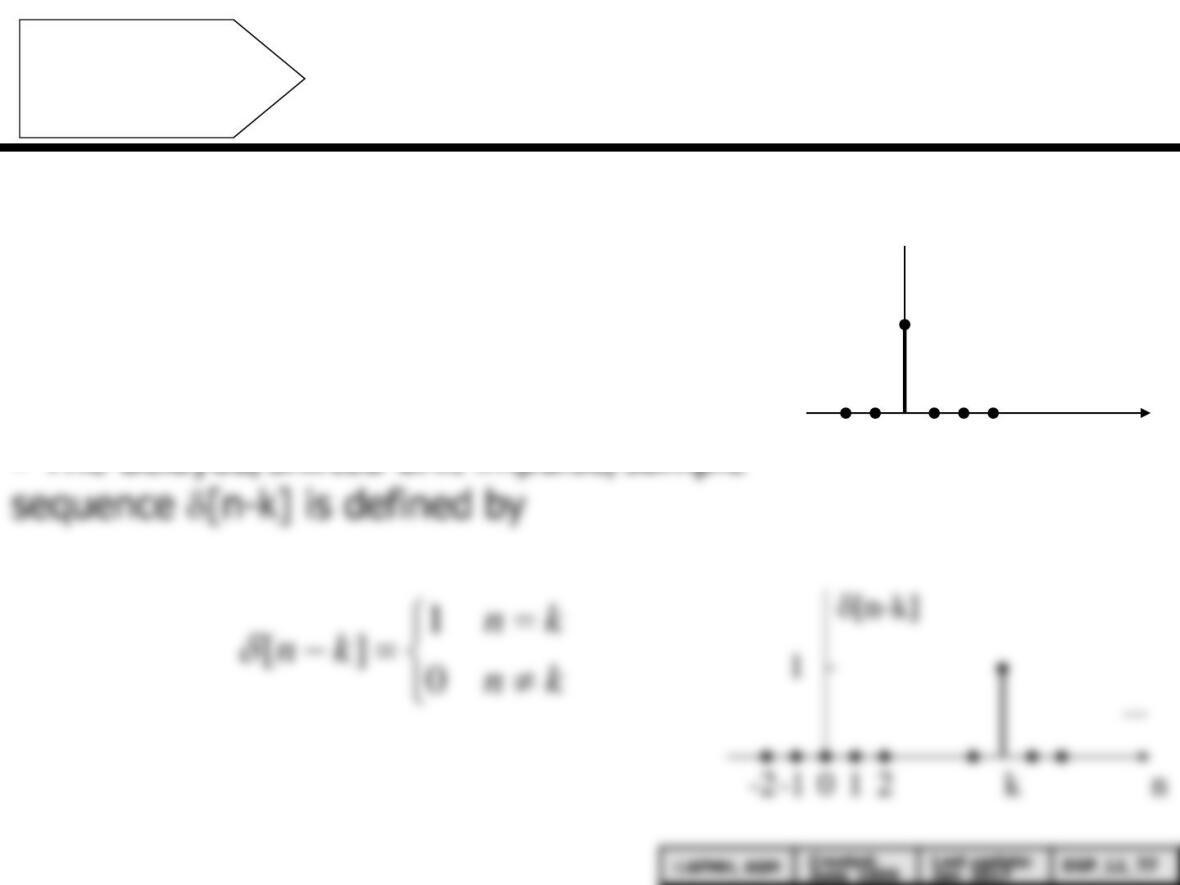
•The
unit impulse
(or
unit sample
) sequence
d
[n], is defined as
n
n
n
00
01
][
d
d[n]
1
n-2-1 0 1 2 3
][n
d