1. What is activity utilization at every step in the process? What is the direct labor
utilization?
In the simplest of words utilization is a measure of time spent working. It is the ratio between the
time worked and time that could have been spent working.
i.e. Utilization =
Actual time spent working÷ Time available for work
We are specifically looking at two types of utilization here. First we will look into the utilization
for each of the departments and then we look into direct labor utilization. The details of how the
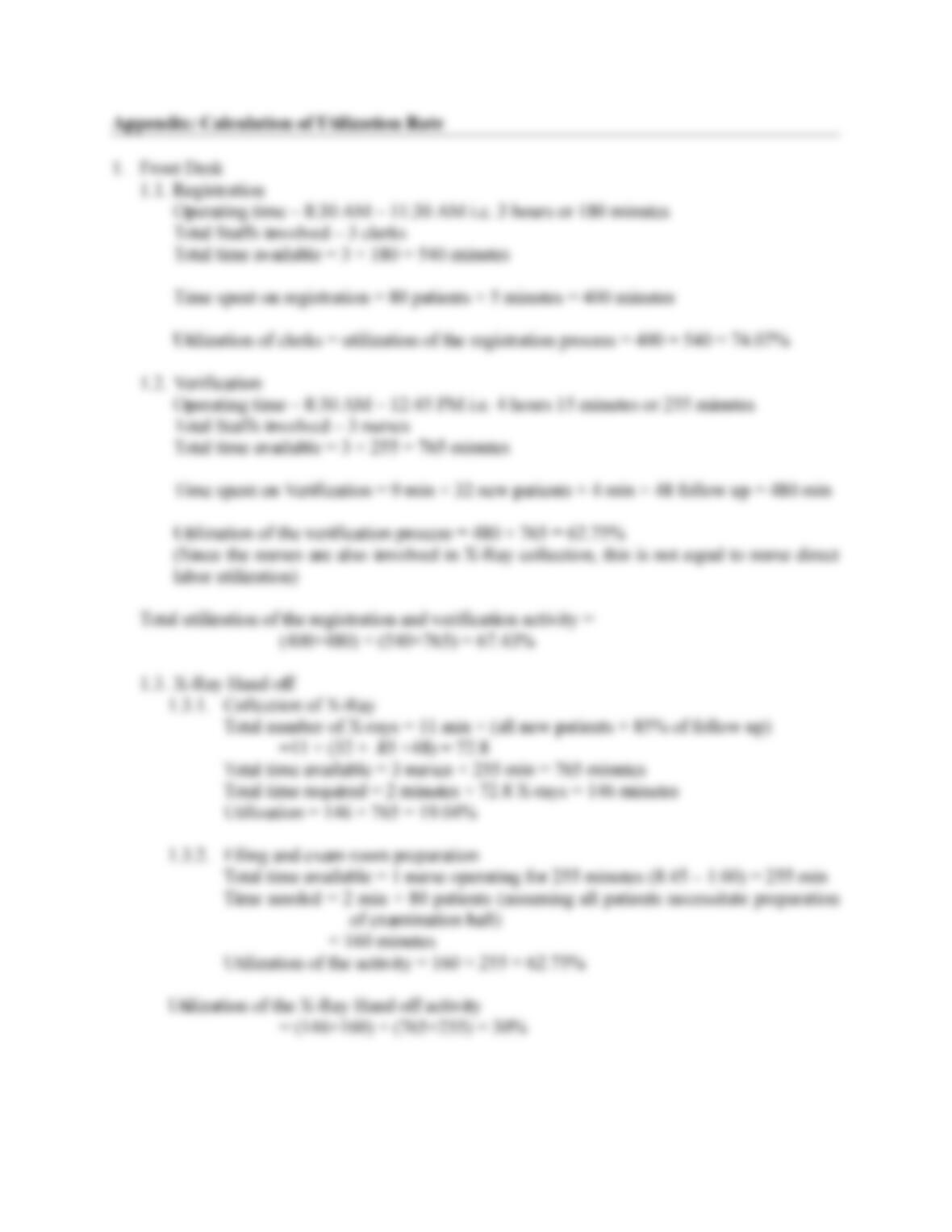
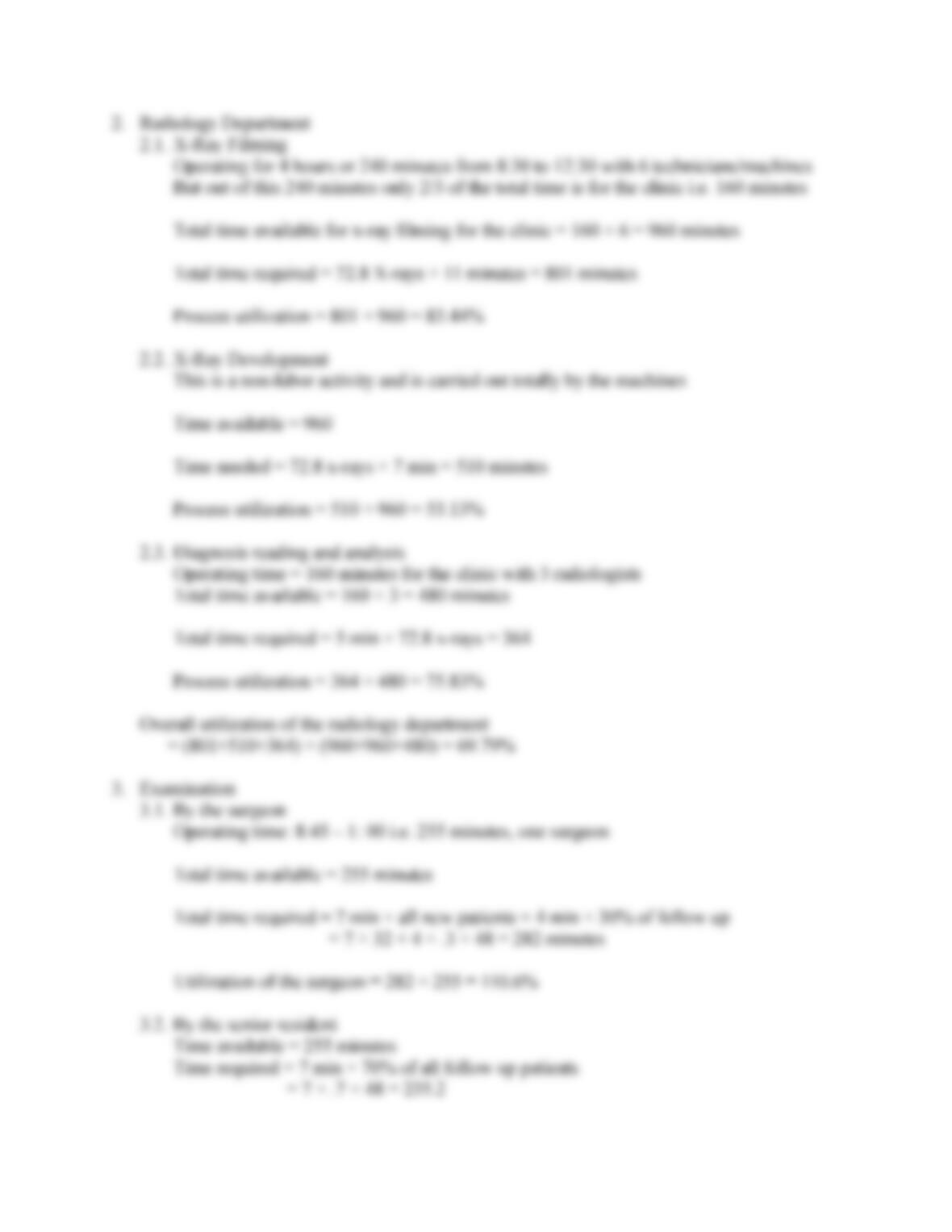
calculations were done are provided in Appendix.
Activity Utilization
For the purpose of calculating activity utilization, we look into the utilization of each of the four
departments – Front office (registration and verification), X-ray and radiology, X-ray hand off
and examination. For calculations we add all the times spent by all the staffs at each department
doing their tasks and divide this sum by the sum of the total man minutes available at each
department.
From the calculation of the utilization we can see that the overall utilization of the clinic is
76.36%. This logically seems a good utilization rate but a bit higher utilization could be targeted
for.
Looking at the 4 departments individually, the examination activity looks very much utilized at a
rate of 97.6%. This department looks to be under very high pressure and a little bit of variability
in could cause lots of problems. And as we will see in the next section, the employees including
the surgeon, cast technician and senior resident are all under immense pressure with the
surgeon’s utilization exceeding 100%.
The front desk that is responsible for the registration, verification, collection of X-Rays and
filing/preparation of examination room is utilized at a rate of 76.02%, which is comparable to the
clinic’s overall utilization and cannot be called over utilized. The X-Ray and radiology
department seems to be underutilized at just about 70%. Given the very long waiting times at this
department, a serious process improvement looks essential.
Direct Labor Utilization
The surgeon is being utilized for almost 110% i.e. he has to work more than the time he is
supposed to work and hence the complaint from him about being over utilized looks fair. The
senior resident also has a utilization rate of 92.23% and can be regarded fair enough although a
comparison to other human resources and the overall clinic utilization might make them look

over utilized as well. The third member of the examination hall in the cast technician has a
utilization rate of 90.03% and is also a good utilization rate. The nurses are being utilized at a
rate of 77.05% whereas the clerks are being utilized at a rate of 74.07%.
If we consider the radiology/X-Ray department as a part of the clinic then the labor utilization
for the technicians and the radiologists are 83.44% and 69.79% respectively.
2. How is variability affecting capacity at the clinic? How can variability be controlled?
Most of the data are variable in nature based on their occurrences. Here, we are concerning about
the flow of patients in a pediatric orthopedic clinic. We cannot control the number and type of
patient flow for check up in a clinic. We can only manage and schedule the resources available in
a clinic in efficient manner so that the service could be delivered in optimized way.
Based on collected data, it shows that clinic examines about 80 patients each half of the day, of
which 60 percent returns for follow up appointment. In this case clinic can predict, in advance,
the case and its nature of about 48 patients who register for follow-up every day. According to
the exhibit 3, the bottleneck of all the process seems to be the radiology department where
patients have to wait 58 minutes on an average and also has high standard deviation of 22
patients.
The high waiting time and also a very large standard deviation shows that the variability at this
department is very high. The Radiology Department is used by the Pediatric, Urology and Chest
Clinic and the ER. This leads to varying demands that depend on patient arrivals for each
department which causes variability in the amount of time a patient has to wait to get treated.
The more patients, the more likely the wait time will increase.
One way to control this variability would be to improve scheduling of the clinic with the other
departments. Test can be performed to see when the machines are used the least amount of time
and try to schedule appointments then. Also additional equipment purchases and staff may be
considered to reduce the effect of variability.
Similarly, the nature of the X-Ray needed is also affecting the variability at the clinic.
Depending on the type of X-ray, the machine needs major adjustment. Here, the variable nature
of incoming patients affects the time taken for X-ray due to the adjustment needed to switch
between upper and lower extremities. The variable requirement of patient can, somewhat be
controlled by using each machine to take either upper or lower extremities’ X-Ray. The six
available machines can be dedicated to a certain type of X-Ray based on the previous data. But
the flexibility in the machines should still be retained to address situations where need do not
follow the trends.

The hospital might also think of buying a new X-Ray machine which would help reduce the
waiting time (but we cannot say for sure) and also help control variability to some extent.
However, given the cost of the new machine and more importantly given that the utilization of
the X-Ray filming process is only about 80% and the X-Ray development is only about 60%,
better scheduling can certainly give better results even with the existing number of machines.
3. Where is the bottleneck in the process? What are the capacity constraints at the clinic?
Bottlenecks are the hindrances and obstructions to the processes that cause waits and delays.
Bottlenecks interrupt the natural flow and determine the pace at which the whole process works.
In this case the bottleneck in the processes is inherent in the wait times and the utilization rates at
some of the departments and activities.
The major bottlenecks in the case are seen in the radiology department and the examination hall.
In the radiology department, the patients might have to wait up to double the time they spend at
any other department. Patients are required to wait in reception area of radiology department
until X-ray machine is available. Depending on the type of X-ray image, machine has to be
adjusted and to adjust the machine from one extremity to other it took several minutes. After X-