
James&Feucht&
&&&&&&
In&this&report,&the&analysis&of&the&Dow&Jones&
efficiency&will&be&scrutinized&and&probed&to&
detect&the&realistic&outcome&of&its&readings.&
&
&
The&Dow&Jones&Efficiency&
Dow&Jones&Efficiency& &
ii&
Dow$Jones$Efficiency$
&
&
&
&
&
&
&
&
&
Authorship$
James$Feucht$
Lewis8Clark$State$College$
500$8th$Avenue$
Lewiston,$Idaho$83501$
Jmfeucht2570@lcmail.lcsc.edu$$
27$November$2016$
&
&
&
&
Dow&Jones&Efficiency& &
iii&
&
Table&of&Contents&
Introduction&………………………………………………………………………………………………….&iv&
History&…………………………………………………………………………………………………………&iv&
Efficiency&……………………………………………………………………………………………………..&vi&
Profitability&…………………………………………………………………………………………………&viii&
Outline&………………………………………………………………………………………………………….&x&
Bibliography&………………………………………………………………………………………………….&xi&
Bibliography&………………………………………………………………………………………………….&xi&
&
Dow&Jones&Efficiency& &
iv&
Introduction&
&
The&Dow&Jones&Industrial&Average&(DJIA)&is&a&priceCweighted&average&of&30&
significant&stocks&traded&on&the&New&York&Stock&Exchange&and&the&NASDAQ.&
Founded&in&1896&by&Charles&Dow&and&his&business&partner&Edward&Jones,&the&Dow&
Jones&Industrial&Average&was&designed&to&serve&as&a&proxy&for&the&broader&U.S.&
economy.&The&index&was&created&to&provide&as&a&simple&mean&of&tracking&U.S.&market&
performance&in&an&age&when&information&flow&was&often&a&limited&resource.&The&
average&is&priceCweighted,&and&to&compensate&for&the&effects&of&stock&splits&and&other&
adjustments,&it&is¤tly&a&scaled&average.&Instead&of&the&Dow&being&the&value&of&
the&actual&stocks,&it&is&the&sum&of&the&component&prices÷d&by&a&divisor,&so&as&to&
generate&a&consistent&value&for&the&index.&Even&though&the&Dow&is&used&to&gauge&the&
performance&of&the&American&economy,&the&index’s&performance&continues&to&be&
influenced&by¬&only&corporate&and&economic&reports,&but&also&by&domestic&and&
foreign&political&events&such&as&war&and&terrorism.&
&
History&
& &
Edward&Jones&and&Charles&Dow&created&the&“Dow&Jones”&in&1896&as&a&
measuring&unit&for&economic&success&or&downfall.&It&is&compiled&of&30&different&
priceCweighted&significant&stocks&traded&throughout&the&New&York&Stock&Exchange&
(NYSE)&and&the&National&Association&of&Securities&Dealers&Automated&Quotations&
Dow&Jones&Efficiency& &
v&
(NASDAQ).&Originally,&the&Dow&only&included&12&stocks&in&its&beginnings,&which&
included&General&Electric&(GE)&and&other&stocks&that&pertained&to&mainly&cotton,&
sugar,&tobacco,&and&railroad&stocks.&Twenty&years&into&the&future,&AT&T&would&enter&
the&list,&the&only&other&stock&that&would&remain&on&the&list&up&to¤t&time.&The&
year&1932&was&a&time&period&of&change&for&the&Dow&when&eight&stocks&were&replaced&
in&the&depth&of&the&Great&Depression&due&to&consumer&goods&becoming&less&of&an&
importance.&Fast&forward&to&1997,&the&time&of&the&Dow’s&most&extensive&change&in&
the&index’s&modern&history.&Newcomers&Johnson&&&Johnson,&WalCMart,&Travelers&
Cos.&And&HewlettCPackard&replaced&stalwarts&such&as&Texaco&and&Woolworth&due&to&
the&growth&and&expansion&of&the&US&economy.&NASDAQ&stocks&are&implemented&into&
the&Dow&Jones&in&1999,&which&included&Microsoft,&Intel,&Home&Depot&and&SBC&
Communications,&these&stocks&were&coined&the,&“New&Economy”&stocks.&The&Dow,&in&
its&first&changes&in&more&than&four&years,&dropped&three&stocks&that&were&members&
when&Eisenhower&was&president.&Eastman&Kodak,&International&Paper&and&an&old&
formation&of&AT&T&were&removed.&In&their&place,&a&group&of&companies&were&added:&
AIG,&Pfizer&and&Verizon.&AIG&would&later&get&caught&up&in&the&2008&financialCindustry&
slide&and&leave&the&index.&SBC&Communications&eventually&acquired&AT&T&and&
adopted&its&name,&returning&it&to&the&Dow&by&2005.&The&famous&Dow&stock&arrived&at&
the&close&of&trading&on&March&18th,&2015,&Apple.&&
Dow&Jones&Efficiency& &
vi&
&
&
Efficiency&
& As&the&worlds&most&trusted&business&news&and&financial&information&outlet,&
the&efficiency&of&the&Dow&Jones&is&something&to&be&discussed.&Calculating&the&DJIA&
today&isn’t&as&simple&as&adding&up&the&stocks&and&dividing&it&by&the&total&number&of&
stocks&accounted&for,&30.&Stock&splits&and÷nds&were¬&implemented&into&the&
original&factors&of&the&Dow&Jones&Index.&For&example,&if&a&trading&company&at&$300&
implements&a&2CforC1&split,&the&number&of&its&shares&doubles,&and&the&price&of&each&
share&becomes&$150.&This&change&in&price&brings&down&the&average&even&though&
there&is&no&fundamental&change&in&the&stock.&To&absorb&the&effects&of&the&price&
changes&from&splits,&those&calculating&the&DJIA&developed&the&Dow&divisor,&a&number&
adjusted&to&account&for&events&like&splits&that&is&used&as&the&divisor&in&the&calculation&
of&the&average.&&
Dow&Jones&Efficiency& &
vii&
& To&calculate&the&Dow&Jones&Industrial&Average,&the¤t&prices&of&the&30&
stocks&that&make&up&the&index&are&added&and&then÷d&by&the&Dow&divisor,&which&
is&constantly&being&modified.&To&demonstrate&how&this&works,&we&will&create&a&mock&
index,&the&Feucht&Mock&Average&(FMA).&The&FMA&is&composed&of&10&stocks,&which&
total&$1,000&when&their&stock&prices&are&added&together.&The&FMA"ed&in&the&
media&is&therefore&100&($1,000/10).&&
& Now&lets&say&that&one&of&the&stocks&in&the&FMA&average&trades&at&$100&but&
undergoes&a&2CforC1&split,&which&reduces&its&stock&price&to&$50.&If&the&divisor&remains&
unchanged,&the&calculation&for&the&average&would&give&us&95&(950/10).&This&would&
not&be&accurate&because&the&stock&split&merely&changed&the&price,&but¬&the&value&
of&the&company&as&a&whole.&To&compensate&for&the&effects&of&the&split,&we&have&to&
adjust&the&divisor&downward&to&9.5&so&the&index&remains&at&100&(950/9.5)&and&more&
accurately&reflects&the&value&of&the&stock&in&the&average.&&
& The&methodology&behind&calculating&the&DJIA’s&index&is&known&as&the&priceC
weighted&method.&On&top&of&having&to&deal&with&stock&splits,&the&downside&to&this&
method&is&that&it&doesn’t&reflect&the&fact&that&a&$1&change&for&a&$10&stock&is&much&
more&significant,&percentage&wise,&than&a&$1&change&for&a&$100&stock.&Due&to&the&
problems&associated&with&priceCweighted&method,&most&other&major&indexes,&such&
as&the&S&P&500,&are&marketCcapitalization&weighted.&
& Despite&all&its&negatives&the&Dow&is&still&one&of&the&most&watched&indicators&
for&stock&market&performance.&After&110&years&as&a&marker&of&major&market&
developments,&the&DJIA&is&still&one&of&the&most&recognized&and&cited&of&all&market&
indexes.&&
Dow&Jones&Efficiency& &
viii&
Profitability&
& &
MultiCbillion&market&caps&almost&always&mean&multibillionCdollar&revenue&
streams,&and&the&Dow’s&30&components&certainly&meet&that&criterion.&The&lowest&
annual&revenue&reported&by&any&Dow&company&for&the&most&recent&fiscal&year&was&
Visa,&sitting&at&$11.8&billion,&&which&is&still&larger&than&the&GDP&of&66&countries&or&
territories.&The&combined&annual&revenue&of&all&30&Dow&companies&is&$2.83&trillion&
as&of&their&most&recent&budget&years,&which&would&earn&the&Dow&Jones&fifth&place&in&
the&global&GDP&if&it&were&an&independent&country.&That&would&mean&that&it&would&
still&be&larger&than&the&combined&GDP’s&of&France,&Brazil,&Italy,&Spain,&and&Mexico.&
Every&component&of&the&Dow&Jones&is&profitable.&The&combined&net&income&for&the&
last&fiscal&year&added&up&to&$325&billion,&that&is&enough&to&buy&all&but&two&Dow&
companies,&excluding&ExxonMobil&and&Microsoft.&Although&many&Dow&Jones&
components&also&include&large&foreign&cash&hoards,&the&profit&stream&would&still&be&
only&enough&to&account&for&oneCsixth&of&the&$1.95&trillion&American&companies&have&
now&stored&abroad.&
& &
Synopsis&
&With&the&Dow&Jones&being&a&large&enough&sum&combined&to&pay&off&a&quarter&
of&America’s&national&debt,&it&does&hold&weight&to&its&credibility.&By&isolating&30&
major&companies&that&dealt&with&a&large&majority&of&the&American&wealth,&you&can&
compare&its&efficiency&to&the&overall&wellbeing&of&the&U.S.&economy.&With&this&being&
Dow&Jones&Efficiency& &
ix&
said,&there&are&also&many&other&indexes&via&the&stock&market&to&dictate&economic&
growth.&For&example,&the&S&P&500&measures&the&value&of&stocks&of&the&500&largest&
corporations&by&market&capitalization&listed&on&the&New&York&Stock&Exchange&or&
Nasdaq.&Although&it&is&less&publically&known&than&the&Dow&Jones,&it&provides&
valuable&insight&into&the&stock&market&and&economy.&&
& The&Nasdaq&Composite&Index&is&also&a&very&valuable&measurement&to&take&
into&account&while&overlooking&the&stock&market.&It&has&received&the&name,&“tech&
stock”&index.&It&tracks&stocms&traded&electronically&on&the&Nasdaq&market&exchange,&
also&called&the&overCtheCcounter&market.&It&is&a&broadCbased&index&including&more&
than&3,000&companies,&many&of&which&are&highCtech&and&emerging&industries.&&
& In&my&opinion,&to&truly&execute&a&legitimate&oversight&into&the&economy&via&
the&stock&market,&it&would&require&more&than&just&one&index&to&form&a&conclusion.&
While&the&Dow&Jones&does&provide&great&insight&into&the&biggest&companies&in&
America,&the&S&P&500&and&Nasdaq&Composite&also&give&key&information&to&measure&
the&smaller&and&emerging&growth&of&the&economy,&which&cannot&be&forgotten.&Small&
business&employs&85%&of&the&workforce&in&the&United&States,&proving&that&the&
economy&cannot&be&measured&solely&based&off&of&the&wealthiest&companies&in&our&
country.&
&
&
Dow&Jones&Efficiency& &
x&
Outline&
1. History&
a. Edward&Jones&and&Charles&Dow&created&the&Dow&in&1896.&
b. Used&as&a&measuring&unit&of&economic&success/downfall.&&
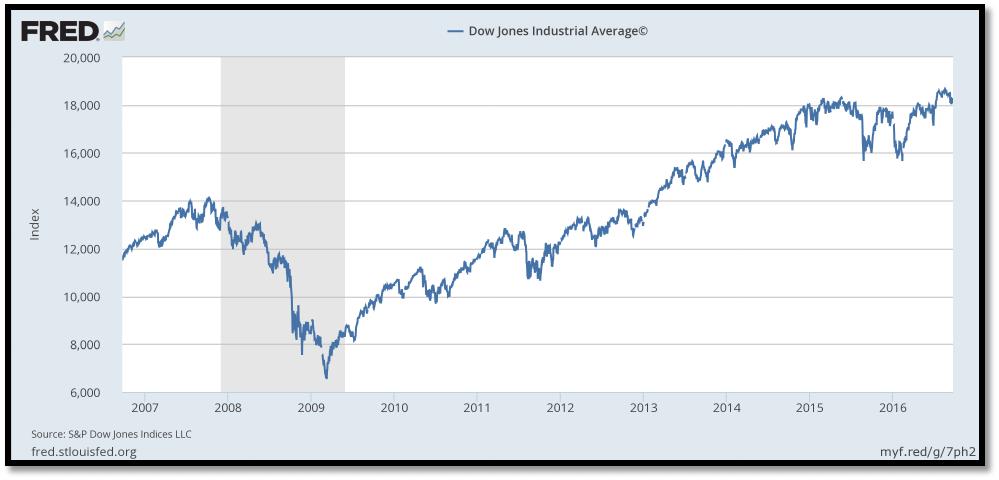
c. Has&climbed&from&a&low&of&6,627&in&2008&to&an&astonishing&18,576&
currently.&
2. Efficiency&
a. Measures&30&different&priceCweighted&significant&stocks&traded&on&the&
NYSE&and&the&NASDAQ.&
b. Worlds&most&trusted&business&news&and&financial&information&in&a&
variety&of&information.&
3. Stocks&in&the&Dow&Jones&
a. 3M,&American&Express,&Apple,&Boeing,&Caterpillar,&Chevron,&Cisco,&
CocaCCola,&Disney,&DD,&Exxon&Mobile,&GE,&Goldman&Sachs,&Home&Depot,&
IBM,&Intel,&Johnson&&&Johnson,&JPMorgan&Chase,&McDonald’s,&Merck,&
Microsoft,&Nike,&Pfizer,&Procter&&&Gamble,&Travelers&Companies&Inc.,&
United&Technologies,&UnitedHealth,&Verizon,&Visa,&WalCMart.&
4. Profitability&
a. Has&there&been&a&consistent&trend&between&the&Dow&Jones&and&the&
reality&of&the&stock&market?&
b. Does&it&favor&the&average&consumer&or&the&Wall&Street&broker?&
&

Dow&Jones&Efficiency& &
xi&
Bibliography&
Graphics,&W.&N.&(n.d.).&Retrieved&September&21,&2016,&from&Wall&Street&Journal:&
http://graphics.wsj.com/djiaCcomponentsChistory/&&&
(n.d.).&Dow$Jones$Industrial$Average.&Retrieved&Septmber&24,&2016,&from&FRED:&
http://fred.stlouisfed.org/series/DJIA&
Staff,&I.&(2016).&How$Now,$Dow?$What$Moves$The$DJIA?&Retrieved&September&21,&
2016,&from&Investopedia.com:&
http://www.investopedia.com/article/02/082702.asp&
Zager,&D.&R.&(2016,&October&4).&Dow&Jones&Efficiency.&(J.&Feucht,&Interviewer)&
Lewiston,&Idaho.&
&
&
Bibliography&&
Interview:&Dustin&R.&Zager&D.A.&Davidson&Financial&Advisor&9/?/16&&
Dow&Jones&Industrial&Average©.&(n.d.).&Retrieved&September&24,&2016,&
from&https://fred.stlouisfed.org/series/DJIA&
Graphics,&W.&N.&(n.d.).&Ins&and&Outs&of&the&Dow&Jones&Industrial&Average.&
Retrieved&September&21,&2016,&from&http://graphics.wsj.com/djiaC
componentsChistory/&

Dow&Jones&Efficiency& &
xii&
Staff,&I.&(2013).&How&Now,&Dow?&What&Moves&The&DJIA?&Retrieved&
September&21,&2016,&from&
http://www.investopedia.com/articles/02/082702.asp&
&