Case copyright held by the National Center for Case Study Teaching in Science, University at Buffalo, State University of New York. Origi-
nally published November 16, 2020. Please see our usage guidelines, which outline our policy concerning permissible reproduction of this work.
Credit: Image by apasciuto, cc by 2.0, <https://www.ickr.com/photos/apasciuto/32632336250/in/photostream/>.
NATIONAL CENTER FOR CASE STUDY TEACHING IN SCIENCE
Part I – Ocean Acidiffcation 101
Brandy and Ashley were on a plane heading to Miami for a vacation. ey were working their way through a stack of
magazines they had bought at the newsstand in the airport.
Ashley: Hey Brandy, did you see this article about the ocean?
Brandy: Yes, but I didn’t understand a lot of what they were talking about. Do you understand it?
Ashley: Sure, I can try to point out a few things. Here, take another look and we can search for information to
fill in what we don’t know.
Read the article: “Oceans Turn More Acidic an Last 800,000 Years” by L. Morello from Scientiffc American (2010).
<http://www.scientificamerican.com/article/acidic-oceans/>
Brandy: I guess my first question after reading the article is, what’s actually in ocean water? I assumed ocean
water was just made of salt, like what we use in food.
Question 1: What are the major ions and gases found in ocean water?
Brandy: at’s a lot more than salt!
Ashley: ere are some things added by human activity that can affect it too.
Question 2: Give examples of different natural events and man-made activities that can affect ocean chemistry.
Brandy: Well there are other things in the water, but what’s the big deal? How exactly is the ocean changing?
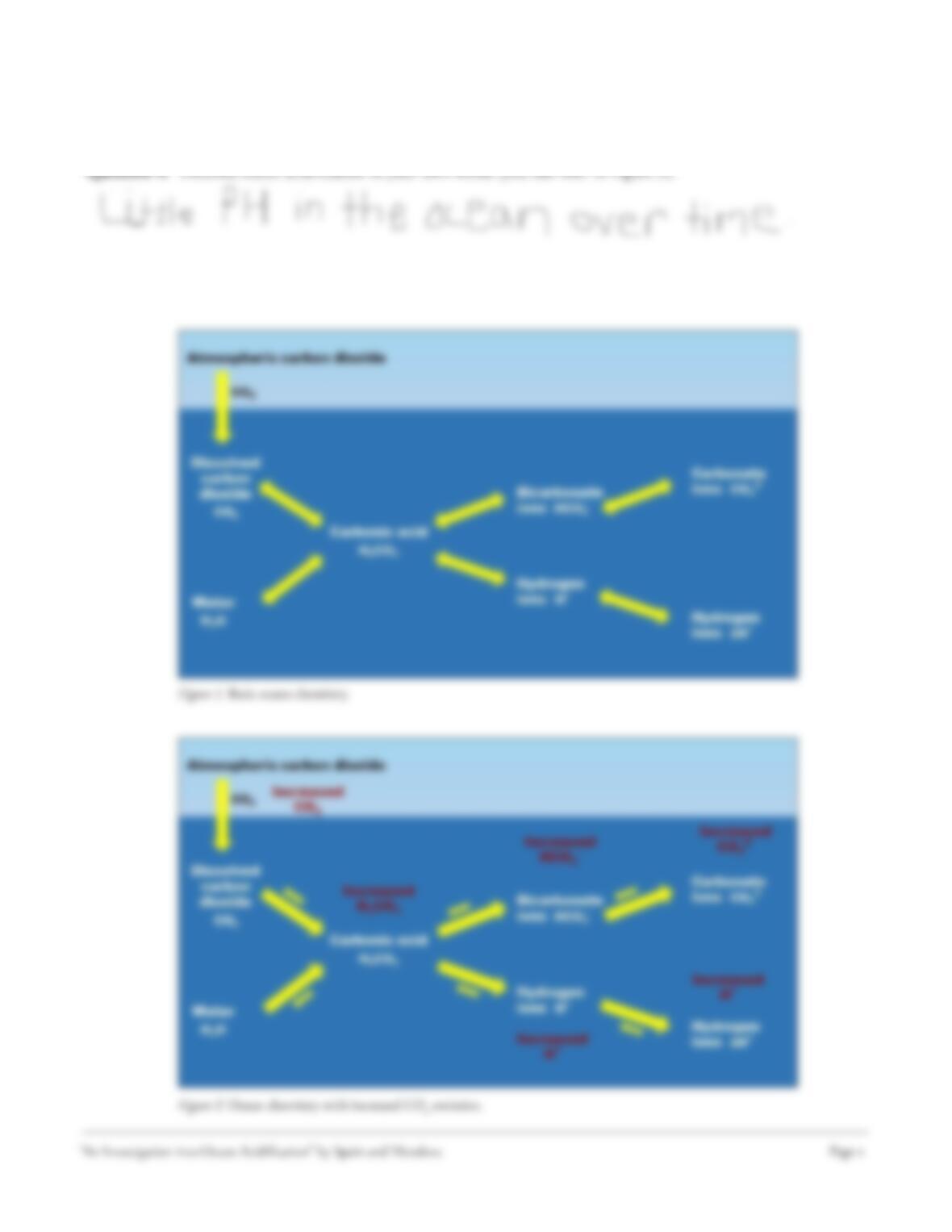
Question 3: Referring to Figure 1 (see next page), what kind of reactions are happening that affect ocean chemistry?
(Hint: the ions found in the ocean combine in different forms to create biologically active compounds,
such as HCO3
− .)
An Investigation into Ocean Acidiffcation
by
Diara D. Spain and Vanessa M. Mendoza
Natural Sciences and Mathematics
Dominican University of California, San Rafael CA
NATIONAL CENTER FOR CASE STUDY TEACHING IN SCIENCE
Ashley: So you see, there is quite a bit going on in the ocean. If you look at the reaction it is easy to see that
CO2 is affecting ocean chemistry.
Brandy: Yes, I can see that happening, but why is that changing the acid level of the ocean?