Vol.:(0123456789)
Reading and Writing
https://doi.org/10.1007/s11145-020-10083-9
1 3
The origin ofcentrality deficit intext memory
andcomprehension bypoor comprehenders: athink‑aloud
study
MenahemYeari1 · ShirleyLantin1
© Springer Nature B.V. 2020
Abstract
The present study employed a think-aloud method to explore the origin of a cen-
trality deficit (i.e., poor recall of central ideas) found in poor comprehenders (PC).
Moreover, utilizing the diverse think-aloud responses, we examined the overall qual-
ity of text processing employed by PC during reading, in order to shed more light on
the cognitive underpinnings underlying their poor comprehension and memory after
reading. To address these goals, adolescents with good and poor comprehension,
matched on reading (decoding) skills, were asked to state aloud whatever comes
to their mind during the reading of two expository texts. After reading, the partici-
pants freely recalled text ideas and answered multiple-choice questions on the texts.
Results indicated that PC exhibited lower performance than good comprehenders
(GC) on the recall and comprehension tasks. The think-aloud protocols indicated
that PC generated fewer responses than GC that reflect high-level, deep text process-
ing, and more responses that reflect low-level, surface text processing. Furthermore,
compared to GC, PC reinstated fewer prior text ideas, with this reduction being sig-
nificantly greater for central than for peripheral ideas. Finally, the proportions of
deep processing responses in general were positively associated with participants’
performance on recall and comprehension tasks. These findings suggest that PC
exhibit poor text comprehension and memory, particularly of central ideas, because
they construct a low-quality, poorly-connected text representation during reading,
and produce fewer, less-elaborated retrieval cues for subsequent text comprehension
and memory. This explanation is further illuminated in the context of previous find-
ings and theoretical accounts.
Keywords Centrality deficit· Main ideas· Poor comprehenders· Reading
comprehension· Text recall· Think-aloud
* Menahem Yeari
Menahem.Yeari@biu.ac.il
1 School ofEducation, Bar-Ilan University, Ramat-Gan52900, Israel

M.Yeari, S.Lantin
1 3
Introduction
Poor comprehenders (PC), also referred to as individuals with specific read–
ing comprehension deficit, are readers who experience significant difficulties in
reading comprehension despite adequate reading ability (i.e., word decoding)
and normal (non-verbal) intelligence (Cain & Oakhill, 2007; Hulme & Snowl–
ing, 2011; Snowling & Hulme, 2012). In efforts to explore the sources of this
comprehension disorder, various language and cognitive skills, such as vocabu–
lary knowledge, inference generation, monitoring, and working memory, have
been examined in PC (for a review, see Cain & Oakhill, 2007). Surprisingly, their
ability to identify, process, and remember central (main) ideas, which are impor–
tant for the overall comprehension of a text, have hardly been examined in PC. A
recent study by Yeari and Lev (2020), which examined several types of central–
ity skills in PC, demonstrated their difficulty in recalling central ideas that they
had successfully identified, attended, and recognized during and after reading.
The present study was designed to illuminate the causes underlying this specific
retrieval difficulty, using a think-aloud method. In addition, utilizing the diverse
think-aloud responses, we examined the nature and quality of online text process–
ing employed by PC during reading and its effect on offline poor comprehension
and memory they exhibit after reading.
Centrality eect andfidecit
Identifying central ideas during text processing and allocating sufficient cogni–
tive resources to process and encode these ideas in long-term memory is a crucial
skill for successful comprehension and learning of texts (Gersten, Fuchs, Wil–
liams, & Baker, 2001; Jitendra, Kay, & Xin, 2000; Meyer, Brandt, & Bluth, 1980;
Stevens, Slavin, & Farnish, 1991). Consistent with this notion, numerous stud–
ies have found that skilled readers recall more central than peripheral ideas after
reading (Britton, Meyer, Hodge, & Glynn, 1980; Britton, etal., 1986; Brown &
Smiley, 1977; Cirilo & Foss, 1980; Hyönä & Niemi, 1990; Keenan & Brown,
1984; Kintsch, Kozminsky, Streby, McKoon, & Keenan, 1975; Meyer, 1975;
Thorndyke, 1977; Yeari & Lev, 2020; Yeari etal., 2015, 2017; Yeari, Vakil, Schi–
fer, & Schiff, 2019). This superior recall of central ideas was referred to as cen–
trality effect (Miller & Keenan, 2009).
Interestingly, a centrality effect has been observed in disabled readers as well,
albeit in a weaker manner than in skilled readers. Specifically, disabled readers
recalled significantly fewer central ideas than their skilled peers, whereas no or
a lesser reduction has been observed in recalling peripheral ideas. This so-called
centrality deficit (Miller & Keenan, 2009), i.e., inferior recall of central ideas, was
found with poor readers (i.e., decoders) (Eamon, 1978; Miller & Keenan, 2009;
Smiley, Oakley, Worthen, Campione, & Brown, 1977), individuals with attention
disorder (Miller etal., 2013; Yeari etal., 2019), and individuals with unspecified
learning disabilities (Carlisle, 1999; Curran, Kintsch, & Hedberg, 1996; Hansen,

1 3
The origin ofcentrality deficit intext memory andcomprehension…
1978; Worden & Nakamura, 1982). A centrality deficit was also found in readers
who exhibited low performance in reading comprehension tests, whose decoding
skills had not been assessed (Drum, 1985; Winograd, 1984).
Centrality skills offipoor comprehenders
To the best of our knowledge, only two studies have examined the presence of cen-
trality deficit in PC, who had adequate decoding skills and no other learning dis-
abilities or attention disorder. In one study, Yuill and Joscelyne (1988) examined
the centrality effect after reading in 7–8 year-old good and poor comprehenders,
who were matched on reading skills and vocabulary knowledge. In this study, which
was primarily designed to examine the contribution of organizational cues to story
comprehension, participants read eight short stories accompanied with integrative
or non-integrative title and pictures. Each story included three central ideas—set-
ting/problem, initiating event, and direct consequence—and seven peripheral ideas,
defined by the researchers’ analysis of story grammar (Stein & Glenn, 1979). Par–
ticipants were asked to recall freely as much as they could remember from the story,
and answer comprehension questions after each story. Yuill and Joscelyne did not
find any difference in overall recall and the size of centrality effect between the two
groups. Both good and poor comprehenders recalled, to the same extent, more cen-
tral ideas than peripheral ones. They concluded that poor comprehenders are able to
discriminate between central and peripheral ideas, and prefer the processing of the
former during reading, despite their poor understanding of the story (as indicated by
their low scores on the comprehension questions).
In a recent study, Yeari and Lev (2020) examined several centrality skills of
adults with poor reading comprehension, who have normal word reading skills and
non-verbal intelligence. Specifically, they compared the extent that poor and good
comprehenders identify, attend, store, and retrieve central and peripheral ideas dur–
ing and after reading expository texts. To do so, participants read three texts, whose
ideas’ centrality level pre-estimated by human raters, while their eye-movements
were monitored during reading. After reading, participants were asked to recall,
recognize, and rate the centrality level of text ideas. Yeari and Lev found that PC
recalled significantly fewer central ideas than good comprehenders (GC) (along
with comparable recall of peripheral ideas; i.e., a centrality deficit), whereas no dif-
ference was found between the groups in (re)reading times and frequency and cor–
rect recognition proportions of central and peripheral ideas. A milder difficulty was
found for PC in estimating the centrality level of text ideas, which was more difficult
to interpret. Yeari and Lev concluded that PC have a specific difficulty in retrieving
central ideas which they had successfully attended and stored in long-term memory.
They suggested that this retrieval difficulty may be an outcome of their poor integra-
tion and inferential skills (Bowyer-Crane & Snowling, 2005; Cain & Oakhill, 1999;
Cain, Oakhill, Barnes, & Bryant, 2001; Oakhill, 1982, 1984; Yeari, Elentok, etal.
2017), particularly their ability to establish intra-text connections during reading and
construct retrieval cues for text recall after reading.

M.Yeari, S.Lantin
1 3
Based on theories of text processing and memory (Kintsch, 1998; Myers &
O’Brien, 1998; Singer & Kintsch, 2001), Yeari and Lev (2020) explained that a
retrieval of a text idea is facilitated or “cued” by the retrieval of other text ideas
which are conceptually connected with it, through spreading activation process that
occurs in the mental (network) representation of the text. Central ideas, which are
theoretically and empirically connected with more text ideas than peripheral ones
(Trabasso & van den Broek, 1985; Trabasso, van den Broek, & Suh, 1989; van den
Broek & Trabasso, 1986), benefit from more retrieval cues and are thus retrieved
to a greater extent than peripheral ideas. PC, who have exhibited low performance
in answering comprehension questions that require the integration of multiple text
ideas (Cain & Oakhill, 1999; Oakhill, 1982, 1984), presumably form fewer inter–
connections between text ideas during reading, and consequently benefit from fewer
retrieval cues for text ideas, particularly central ones, during text recall after reading.
Therefore, they have more difficulties than their peers in retrieving central ideas that
are available in their long-term memory. The present study was designed to examine
this hypothesis more directly, by employing a think-aloud procedure.
Think‑aloud byfipoor comprehenders
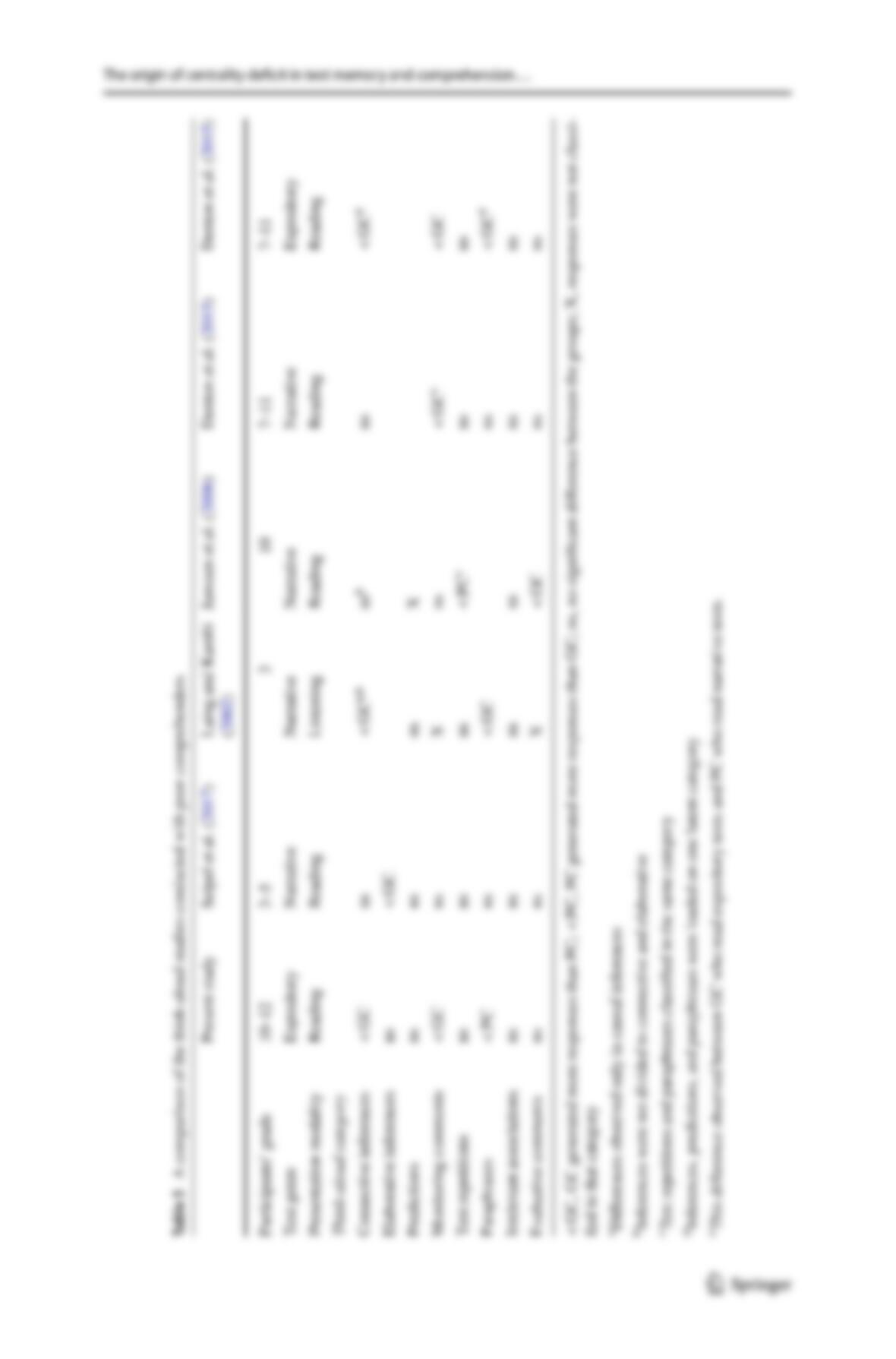
Several studies have used a think-aloud method to explore the nature of online text
processing by PC (Denton etal., 2015; Janssen, Braaksma, & Rijlaarsdam, 2006;
Laing & Kamhi, 2002; Magliano & Millis, 2003; Seipel, Carlson, & Clinton, 2017).
In these studies, poor and good comprehenders were instructed to say aloud what-
ever comes to their mind following reading or listening to sequential text segments.
This procedure aimed to uncover immediate, spontaneous comprehension processes
that take place during text processing, when comprehenders attempt to comprehend
and remember texts. Comparing the quality of text processing by poor and good
comprehenders, these studies were generally consistent in demonstrating that GC
generate more responses than PC which reflect high-level, deep text processing,
such as connecting text ideas, inferring from prior knowledge, and monitoring com-
prehension (see Discussion for a finer comparison of the results obtained in these
studies). Note, however, that different assessments were used to diagnose PC in
these studies (e.g., teachers’ rating, standardized tests, national tests), and none of
them tested and/or compared the reading abilities of poor and good comprehend-
ers (Denton etal., 2015, used word reading scores as exclusion criterion; Laing &
Kamhi, 2002, examined PC who received lower scores than GC in a word-reading
test). Moreover, these studies did not examine performance in offline tasks after
text processing (Denton etal., 2015; Janssen etal., 2006; Magliano & Millis, 2003;
Seipel et al., 2017), and/or did not distinguish between the processing of central
and peripheral text ideas (Denton etal., 2015; Janssen etal., 2006; Laing & Kamhi,
2002; Magliano & Millis, 2003).
In one recent study, Seipel etal. (2017) used a think aloud procedure to exam-
ine the manner that 3rd-to-5th grade poor and good comprehenders process impor–
tant ideas of narrative texts. Ideas were considered important if they had more than
five causal connections with other text ideas or contained a main or supporting goal.

1 3
The origin ofcentrality deficit intext memory andcomprehension…
Think-aloud responses, which were collected after each sentence of two short sto-
ries, were classified into various processing categories, including connections with
prior text ideas, elaborations by prior knowledge, predictions, monitoring responses,
paraphrases, text repetitions, irrelevant associations, and emotional responses (see
Seipel etal.’s Table2, next section, and “Appendix 1’’ for further clarification of
these categories). The first four categories were considered as high-level processes
that support the construction of a coherent, valid text representation, whereas the
last four categories were considered as low-level processes, which are less effective
in constructing useful, comprehensible representation of the text. Seipel etal. did
not find a significant difference between poor and good comprehenders in process-
ing the important ideas, although PC generated fewer high-level responses than GC
across text sentences. They did find that PC generated fewer high-level responses
than GC at the end of the text, and more low-level responses following poorly-con-
nected sentences preceding a highly-connected sentence, that completed a sub-goal
in the story. These findings suggest that PC employ similar processes as GC in pro-
cessing important ideas during reading of narrative texts. Nevertheless, a follow-up
study which will compare the likelihood of specific responses (e.g., connections)
following central (i.e., important) versus peripheral ideas by decoding-matched
groups of good and poor comprehenders, is required to draw firmer conclusions.
Furthermore, the quality of online text processing by poor and good comprehend-
ers should be compared directly with offline performance in comprehension and/or
memory tasks completed by the same sample of participants.
The present study
The aim of the present study was three-fold. First, we planned to replicate the cen-
trality deficit found in PC (i.e., inferior recall of central ideas; Yeari & Lev, 2020).
This replication was essential, given that one of the two studies that compared the
size of centrality effect in GC and PC did not observe any deficit for PC (Yuill &
Joscelyne, 1988). Second, we explored the origin of the centrality deficit found in
PC following the reading of expository texts (Yeari & Lev, 2020). Specifically, a
think-aloud method was employed in this study to examine the hypothesis that poor
formation of intra-text connections during reading underlies the centrality defi-
cit found in text recall by PC after reading. Third, utilizing the diverse think-aloud
responses, we examined the overall quality of text processing adopted by PC dur–
ing reading, in order to shed more light on the cognitive underpinnings underlying
their poor comprehension and memory after reading (Cragg & Nation, 2006; Hua
& Keenan, 2014; Laing & Kamhi, 2002; Meyer etal., 1980; Yeari, Elentok etal.,
2017).
To address these goals, adolescents with poor and good comprehension, matched
on word reading ability and non-verbal intelligence, were asked to state aloud what-
ever comes to their mind during the reading of two expository texts. To encourage
natural, spontaneous text processing as much as possible, we allowed participants to
avoid responding whenever they felt that nothing came to their mind. Think-aloud
responses were classified into eight processing categories (Linderholm & Van den

M.Yeari, S.Lantin
1 3
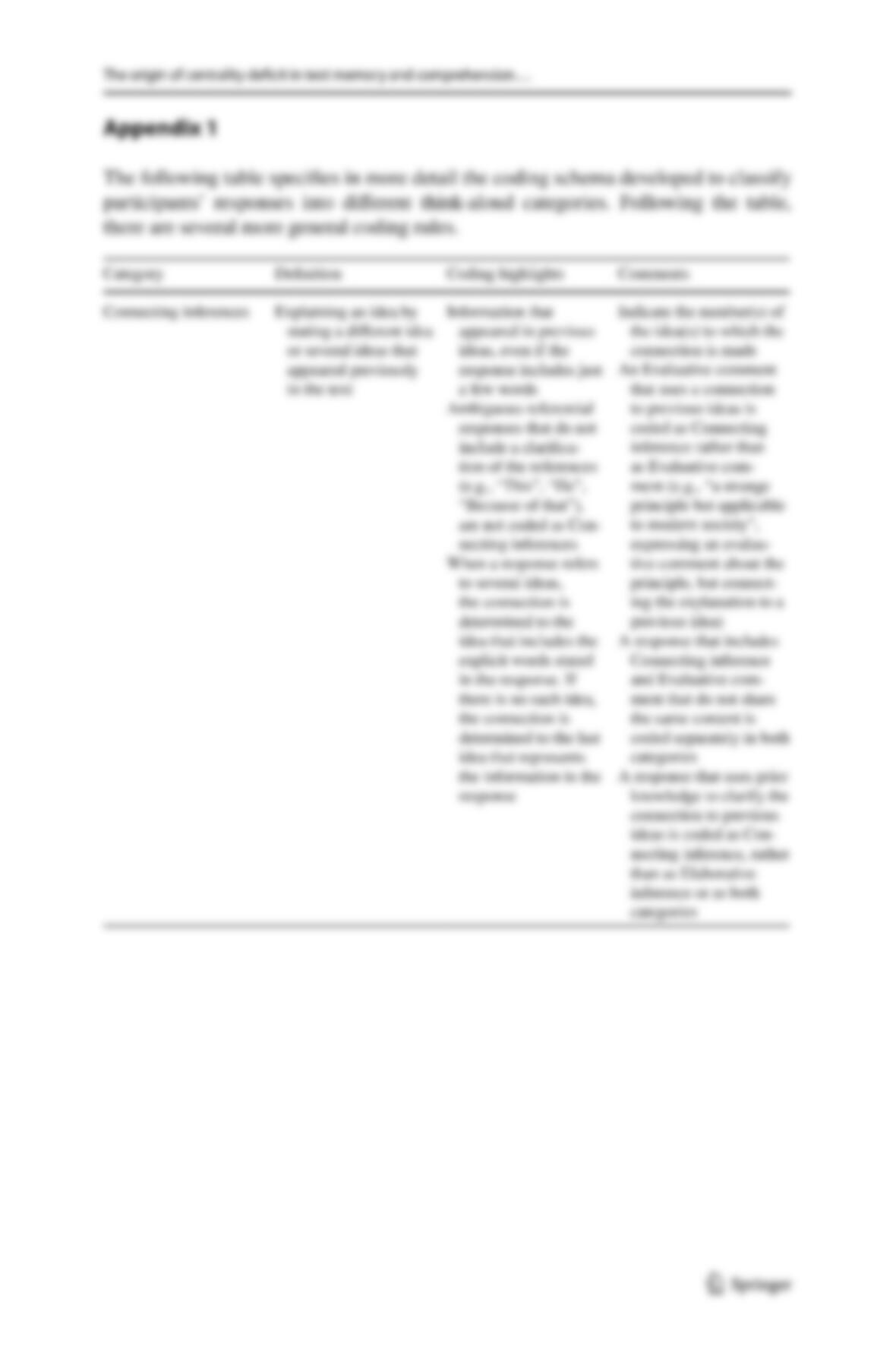
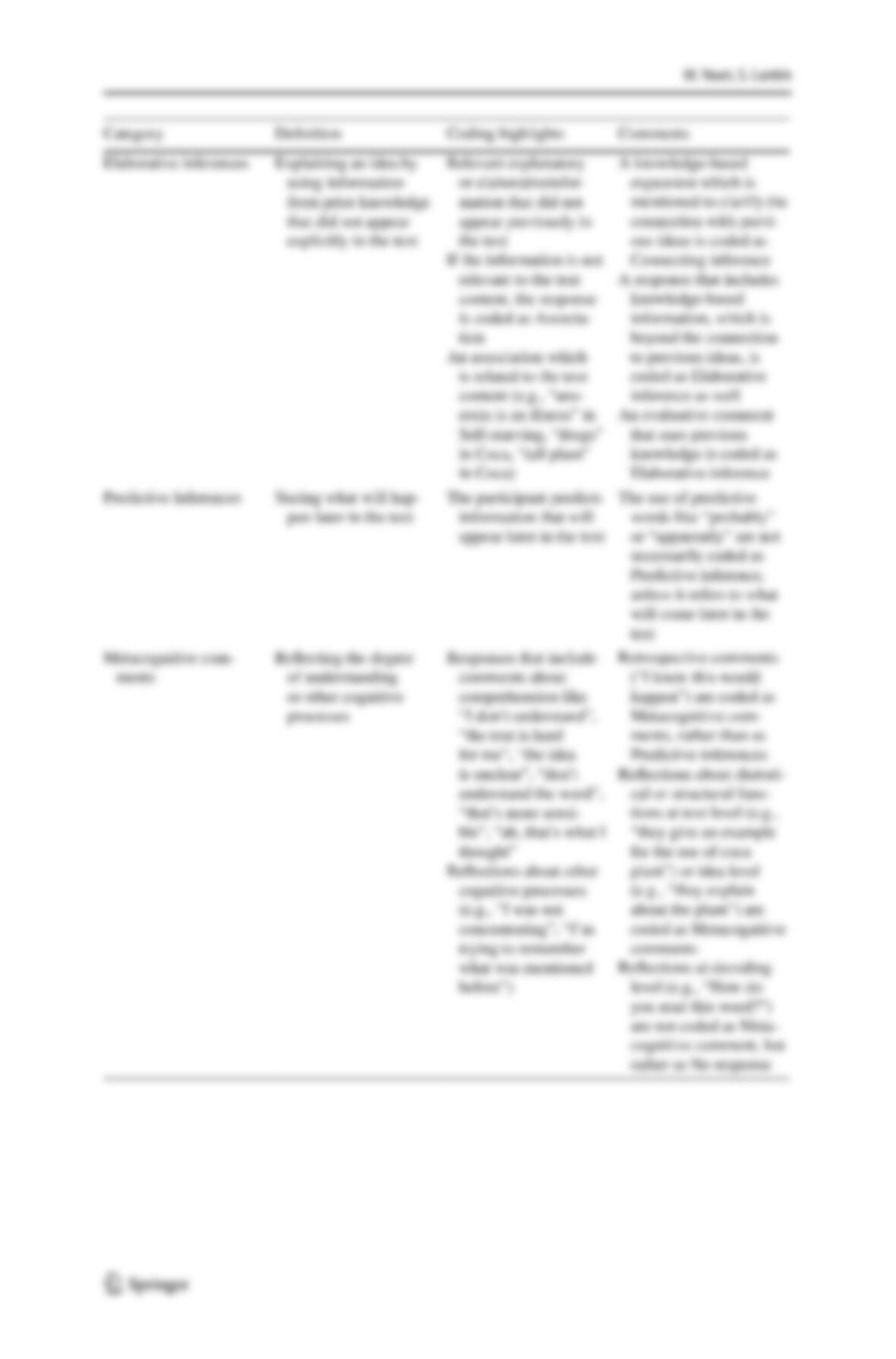
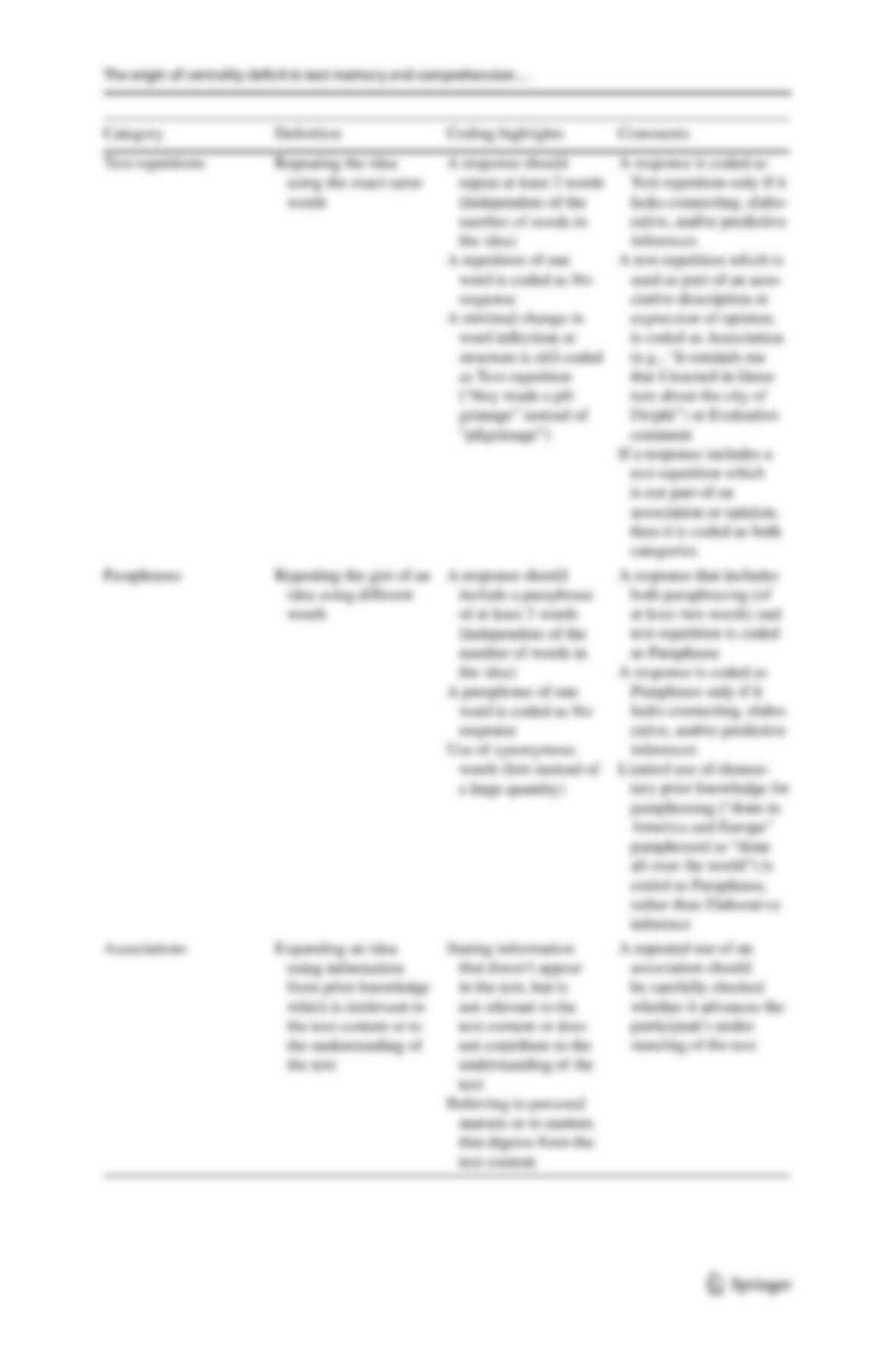
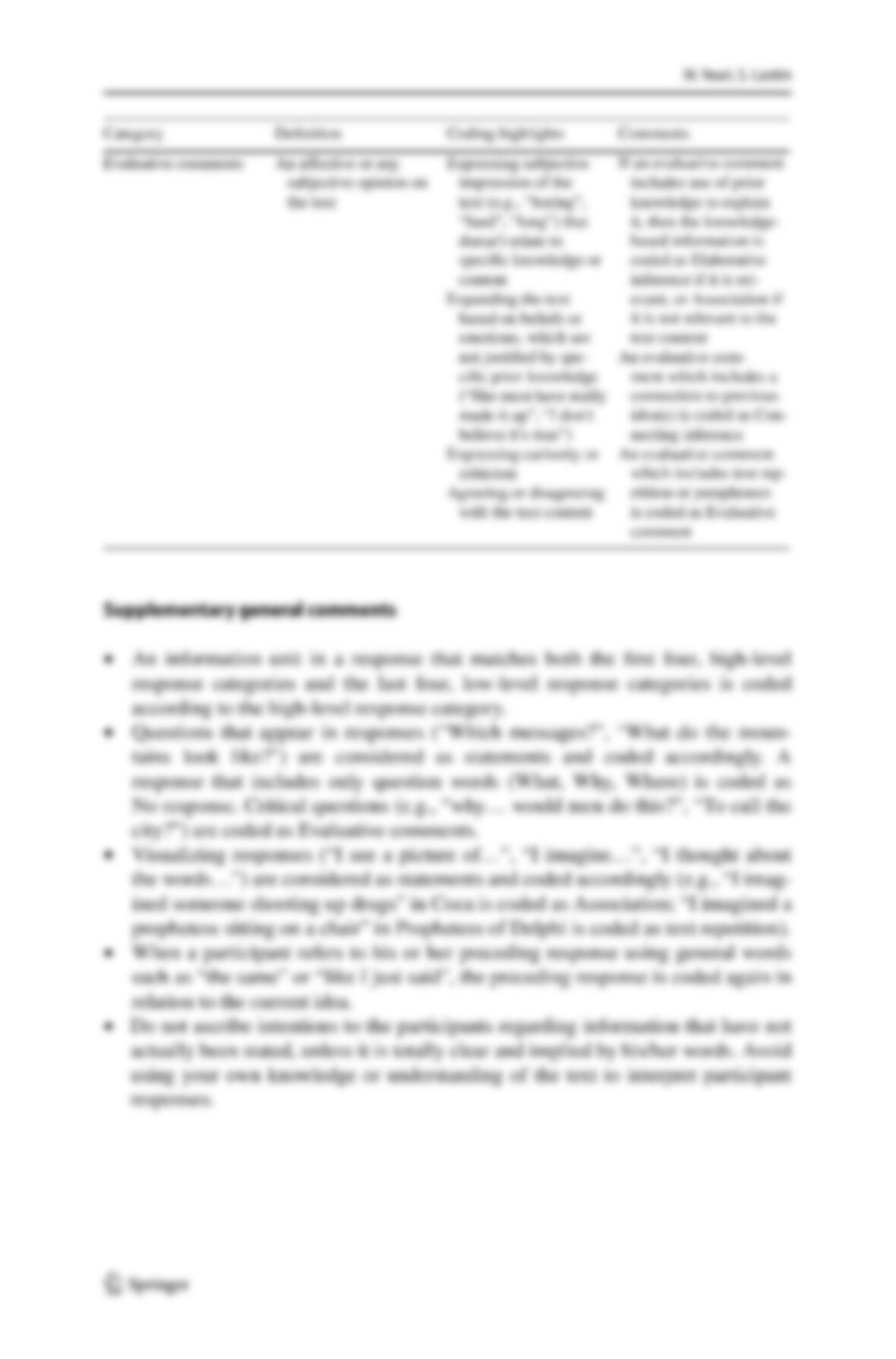
Broek, 2002; Seipel etal., 2017) (see “Appendix 1’’ for a detailed, complete coding
schema): (1) Connective inferences—the participants explicitly reinstated text ideas
that appeared previously in the text, with or without supplementary information
inferred from prior knowledge; (2) Elaborative inferences—the participants inferred
relevant, explanatory information from prior knowledge, without reinstating prior
text ideas; (3) Predictions—the participants specified anticipation of possible infor–
mation that might appear later in the text; (4) Monitoring comments—the partici-
pants reflected on their own mental processes, such as comprehension (e.g., “I did
not understand the sentence”), attention (e.g., “I was not concentrating”), reasoning
(e.g., “it makes sense to me”), or memory processes (e.g., “I’m trying to remember
what was mentioned before”); (5) Text repetitions—the participants repeated infor–
mation that appeared in the text idea they had just read; (6) Paraphrases—the par–
ticipants used their own words to specify information which appeared in the text
idea; (7) Irrelevant associations—the participants stated information that was irrel-
evant, unnecessary, and/or did not support text comprehension; (8) Evaluative com-
ments—participants specified their own subjective opinions of the text, which were
unrelated to its specific semantic content (e.g., “the text is interesting”).1
After participants had finished the reading and thinking aloud tasks, they freely
recalled text ideas and answered comprehension questions on the texts. In addi-
tion to the think-aloud setting, the participants read one additional expository text,
sentence-by-sentence, without the requirement to think-aloud during reading. This
control condition was added to ensure that any differences expected between poor
and good comprehenders in the tasks after reading would not be an outcome of the
think-aloud procedure itself employed during reading (Laing & Kamhi, 2002; Van
Neste, Hayden, Lorch, & Milich, 2015).
To address the first research goal, i.e., replicating the centrality deficit found in
PC, we compared the extent to which GC and PC recalled central and peripheral
ideas. We expected to replicate both centrality effect and centrality deficit in PC
(Hypothesis 1). That is, we predicted that both GC and PC would recall more central
than peripheral ideas after reading (i.e., centrality effect). However, this difference
should be smaller in PC as compared to GC (i.e., centrality deficit), due to a greater
reduction in recall of central ideas as compared to peripheral ideas.
To address the second research goal, i.e., exploring the origin of centrality deficit
in PC, we compared the extent to which GC and PC established intra-text connec-
tions from and to central and peripheral ideas during reading. Connections ‘from’
referred to those text ideas which induced connective inference responses described
above, whereas connections ‘to’ refer to those text ideas which were reinstated in
the connective inference responses. This distinction was important, because it is
possible that central ideas establish more intra-text connections than peripheral
ideas throughout reading by their reinstatement during the processing of succeed-
ing ideas (i.e., connections to) more than by connecting them to preceding ideas
during their own processing (i.e., connections from). Based on the hypothesis that
poor formation of intra-text connections underlies the centrality deficit found in PC
1 Responses were also scored as valid-plausible or invalid-implausible ones. However, we analyzed only
the valid responses, because the proportions of invalid responses were low (> 3%) and similar in the two
groups.
The origin ofcentrality deficit intext memory andcomprehension…
(Yeari & Lev, 2020), we predicted that PC would establish fewer intra-text connec-
tions than GC, particularly from and/or to central ideas (Hypothesis 2). Operation-
ally, we expected that PC would exhibit a smaller difference in comparison to GC
in the number of connective inferences they would generate following the central as
compared to peripheral ideas (i.e., connections from text ideas), and/or in the num-
ber of central as compared to peripheral ideas mentioned in their connective infer–
ences (i.e., connections to text ideas).
To address the third research goal, i.e., exploring the cognitive underpinnings
underlying poor comprehension and memory of PC after reading, we compared the
overall quality of text processing employed by GC and PC during reading. Specifi-
cally, we distinguished between responses reflecting high-level, deep text processing,
such as connective inferences, elaborative inferences, predictions and monitoring,
and responses that represent low-level, surface text processing, such as text repeti-
tions, paraphrases, irrelevant associations and affective evaluations (King, 2007;
Linderholm & Van den Broek, 2002; McCrudden, Schraw, & Hartley, 2006; Press-
ley & Afflerbach, 1995; Seipel etal., 2017; Van den Broek, 1994; Van den Broek,
Lorch, Linderholm, & Gustafson, 2001). Then we examined the association between
online performance measured by the think-aloud task and offline performance meas-
ured by the free recall and comprehension tasks. We expected that PC would exhibit
poor recall and comprehension after reading (Hypothesis 3; Cain & Oakhill, 1999;
Cragg & Nation, 2006; Hua & Keenan, 2014; Yeari, Elentok etal., 2017), employ