Dissertation Akshat Sekhsaria (TP026263)
Table of contents
Abstract………………………………………………………………………………..5
Acknowledgment………………………………………………………………………5
Chapter 1 (Introduction)
Introduction…………………………………………………………………………….6
Background and gap identification……………………………………………………6
Virtualization…………………………………………………………………………..7
Research motivation……………………………………………………………………9
Research problem………………………………………………………………………9
Research question……………………………………………………………………..9
Aims and Objectives…………………………………………………………………..9
Research flowchart……………………………………………………………………10
Summary………………………………………………………………………………10
Chapter 2 (Literature review)
Literature review 1……………………………………………………………………11
Literature review 2……………………………………………………………………16
Conclusion of literature review………………………………………………………21
Limitations and gap identification…………………………………………………..21
Conclusion……………………………………………………………………………24
Chapter 3 (Research methodology)
Research methodology………………………………………………………………..25
Research approach and justification………………………………………………….25
Research design………………………………………………………………………..26
Asia Pacic University(APU) 1

Dissertation Akshat Sekhsaria (TP026263)
Data collection…………………………………………………………………………26
Questionnaire elements……………………………………………………………….26
Questionnaire layout………………………………………………………………….26
Questionnaire reliability………………………………………………………………27
Questionnaire response format……………………………………………………….27
Questionnaire content validity……………………………………………………….27
Data analysis method…………………………………………………………………28
Ethical consideration………………………………………………………………….28
Conclusion…………………………………………………………………………….29
Chapter 4(Data analysis and Result)
Characteristics of the respondents……………………………………………………29
Questionnaire description……………………………………………………………..31
Findings………………………………………………………………………………..44
Conclusion……………………………………………………………………………..46
Chapter 5 (Deliverable)
Implementation plan………………………………………………………………….46
Critical success factors………………………………………………………………46
Risk …………………………………………………………………………………..47
Planning………………………………………………………………………………48
Pre change………………………………………………………………………….52
Process of change…………………………………………………………………..52
Impacts……………………………………………………………………………….52
Management after change……………………………………………………………52
Asia Pacic University(APU) 2

Dissertation Akshat Sekhsaria (TP026263)
Conclusion……………………………………………………………………………..52
Chapter 6 (Conclusions and Recommendations)
Introduction……………………………………………………………………………53
Conclusion relating to research problem……………………………………………..53
Recommendation………………………………………………………………………53
Limitation………………………………………………………………………………53
Self-review……………………………………………………………………………..54
Future research…………………………………………………………………………55
Appendices
Appendix A (Bibliography)…………………………………………………….……..56
Appendix B (Project proposal)………………………………………………………..58
Appendix C ( Questionnaire)…………………………………………………………64
Appendix D (Log sheets)
References…………………………………………………………………………….66
Figures
Figure 1(Basic virtualization)…………………………………………………………8
Figure 2(Research flowchart)…………………………………………………………10
Figure 3(Existing problems)………………………………………………………….15
Figure 4(Virtualization benefits)……………………………………………………..17
Figure 5(Benefits)……………………………………………………………………..17
Figure 6(Servers virtualized)………………………………………………………….17
Figure 7(Concerns)……………………………………………………………………24
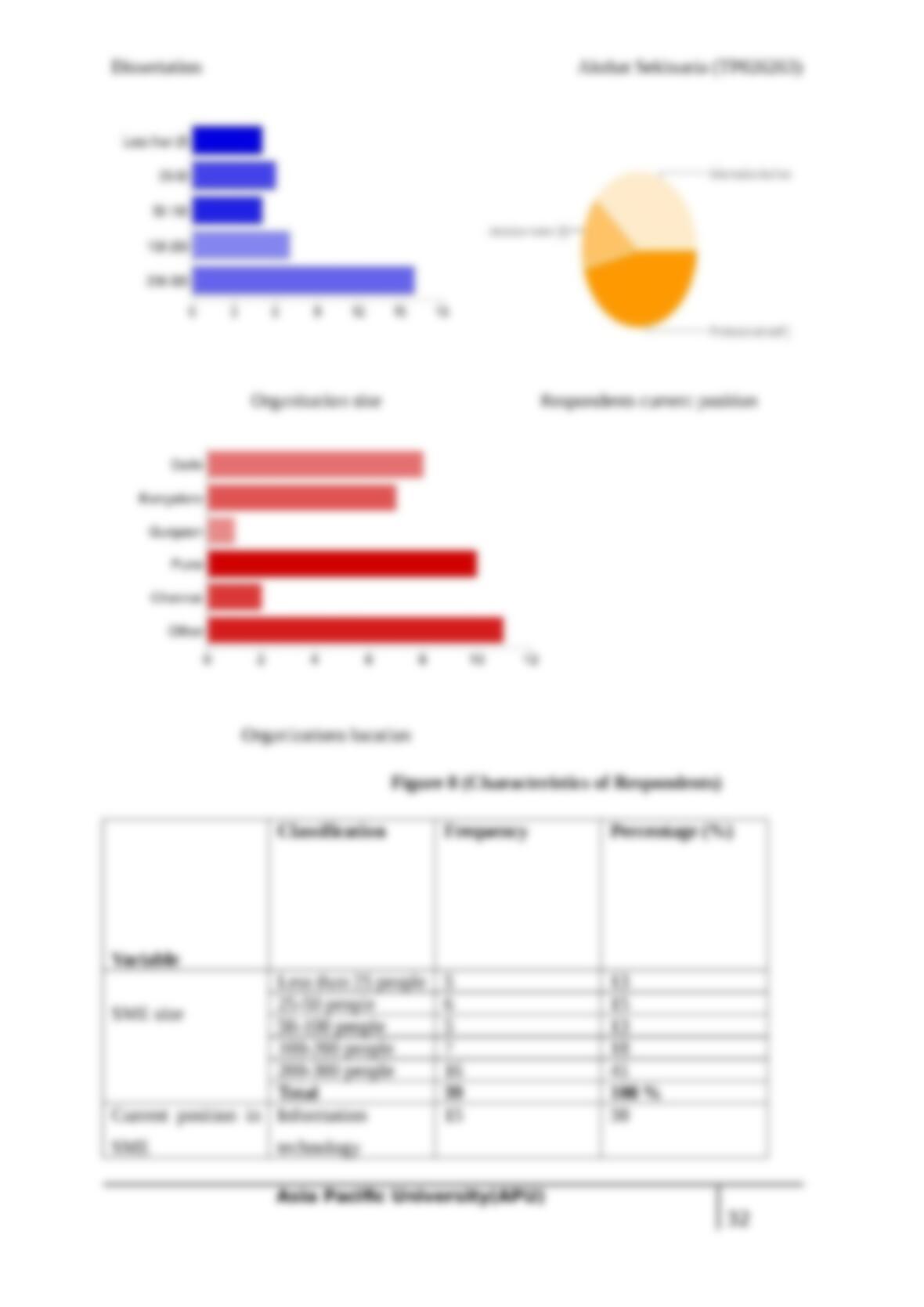
Figure 8(Respondents characteristics)………………………………………………..30
Asia Pacic University(APU) 3

Dissertation Akshat Sekhsaria (TP026263)
Figure 9(Implementation plan) ……………………………………………………….47
Tables
Table 1(Content validity of questionnaire)……………….…………………………..28
Table 2 (Characteristics of respondents)…………………………………………………30
Asia Pacic University(APU) 4

Dissertation Akshat Sekhsaria (TP026263)
Abstract: – Indian SME market is one of the biggest markets in the world and is very crucial
for economic development of India. But in today’s world SME’s are not able to keep up with
overwhelming technological advancements, continuously increasing and changing customer
market in India. SME’s pulled back by their existing problems are not considering
technological advancements like virtualization as a solution to the problems and consider
them as luxury of large enterprises. Large enterprises have already moved from physical to
virtual environment and have gained benefits in terms of savings on energy, cost and space.
This virtual environment is based upon the use of “virtualization” technology. Virtualization
in a brief is “using something that is not there”. In technical terms it is a technology which
creates virtual of server, operating system and storage which are referred as server
virtualization, network and storage virtualization respectively. It separates operating system,
network, desktop, application from their physical constraints which are then replaced with
software named “Hypervisor” which does the entire complex task. Entities think that they are
using physical hardware as a whole but hypervisor divides it in an efficient way by isolating
entities from each other. Purpose of using virtualization is saving money on hardware,
upgrades, energy consumption, and infrastructure space and to become flexible towards
changing business requirement.
Research focused on identifying the problems existing in Indian SME’s. Further study on
virtualization technologies business benefits in relation to the identified problems in SME’s
was done. Limitations in current model and virtualization technology were identified.
Reasons for not adopting virtualization technology in Indian SME’s were exploited. Further
an implementation plan was derived from studies done in literature review and data analysis
in order to help SME’s adapt and implement virtualization technology. In the end
recommendations and future research area were discussed.
Acknowledgement: – I would like to thank my supervisor Ms. Margaret Subramaniam for
her consistent guidance throughout the dissertation period. Without her guidance on the
dissertation flow and topic this research would not have been possible. I would also like to
thank Asia pacific university (APU) for providing students with required study material
which was beneficial in proceeding with dissertation.
Asia Pacic University(APU) 5

Dissertation Akshat Sekhsaria (TP026263)
CHAPTER I (Introduction)
Introduction: – Bhasin, 2007 describes SME’s as businesses with employees between 250 to
300 and are independent. According to (Raju, 2010) (Kalra 2009), performing a study on
past, present and future of SME’s in India, SME sector is the backbone of Indian economic
growth and in recent years have shown more growth than industrial sector. Indian SME
market is second largest in world after China with 24 million SME’s functioning currently
(Murthy, 2011) It is continuously increasing with the growth rate of 2 percent and contributes
40 percent of the country’s GDP (Gross domestic product), supported by Bharat, 2010. Thus
it’s not wrong to assume that success of India relies on success of SME’s.
But in the past because of increasing international exposures, customer demands,
globalization, improving technological environment and liberalization, SME’s are facing
challenges in being competitive (Karmakar, 2012), which is not a good sign for developing
India’s economy. SME’s are set back by limited IT budget, degraded and fewer
infrastructures, energy crisis which leads to decreased or no response to business changes.
This is not only affecting the competitive edge of SME’s but also the biggest industry in the
world (Murthy, 2011).
Thus research uses recent studies to identify existing problems and challenges in SME’s in
India and analyzing virtualizations benefits and proposing them as a solution to the problems.
Background and gap identification: – According to Raina, 2012 , country head of private
solutions, Indian SME market is worth 5 billion US dollars and above 11 million of SME’s
are producing over 8000 products . Indian SME is very important to Indian economy and
contributes 60 percent to Indian GDP (Gross domestic product) agreed by Guleria, 2012,
Chaturvedi, 2012, country head of multimedia group. According to a study conducted by
European-Indian SME business council (EISBC) on Indian SME market in 2012, identifies it
as the backbone of Indian economy. Not only because of large industrial output produced by
SME’s but also because of job opportunities created. Currently around 60 million people are
employed by SME’s in India supported by SME chamber of India, 2012.
Asia Pacic University(APU) 6

Dissertation Akshat Sekhsaria (TP026263)
Thus Indian SME market is very important to economic growth of India but there are still
some gaps existing which have decreased the rate of growth recently due to financial
consolidation (Chaturvedi, 2012), limited technology acceptance (SME world, 2011) ,less
innovation, uncertain market, fund shortages, global competition (SME chamber of India,
2012). Although there has been as many as 1600 Indo-German collaboration to boost SME’s
technologically (Mukherji, 2012 but still there is a lot need to done in terms of efficiency,
infrastructure utilization, cost savings etc. (Raina, 2012).
All these gaps which are keeping SME’s from gaining competitive advantage will be filled
using virtualization technology. Challenges will be identified and focused throughout the
research and virtualization technology will be proposed as solution with critical analysis on
business advantages of this technology.
Virtualization: – Virtualization is a technology that separated computer hardware from
software i.e. operating system and this hardware is then emulated using software called as
“hypervisor” which is responsible for virtualization. Hypervisor allows installing a new OS
on an existing one which is called as virtual machines (Burford, 2008) .According to Powell,
2009 these virtual machines are in the form of data or a single file which can be easily moved
from one place to another (Burford, 2008).
Actual concept of virtualization dates back in 60’s and 70’s when concept of time sharing
first came in and IBM came up with this idea in 1972 (Ganore, 2011). According to Palmer,
2012 and Bumforth, 2011 virtualizations allows visible results when in come to cost saving
over energy, hardware, infrastructure space, management and time to market for a product or
service, supported by Huang, 2012 and John, 2012 and can be very useful for benefit of
Indian SME’s. Most common virtualization practices are discussed briefly here.
Server virtualization: – Server virtualization is a technique of using underlying
hardware for many virtual machines with the use of hypervisor (Ou, 2006)
(http://www.techrepublic.com/article/introduction-to-server-virtualization/6074941).
That is single physical resources like CPU, memory, NIC (network interface card) and
storage are represented as multiple logical resources to guest OS over hypervisor.
Thus savings made on space, energy, hardware and cooling. It can be of three types
which are full virtualization (no OS modification), Para virtualization (where OS is
modified), emulation (where OS is modified but run on an software emulated CPU)
Asia Pacic University(APU) 7
Dissertation Akshat Sekhsaria (TP026263)
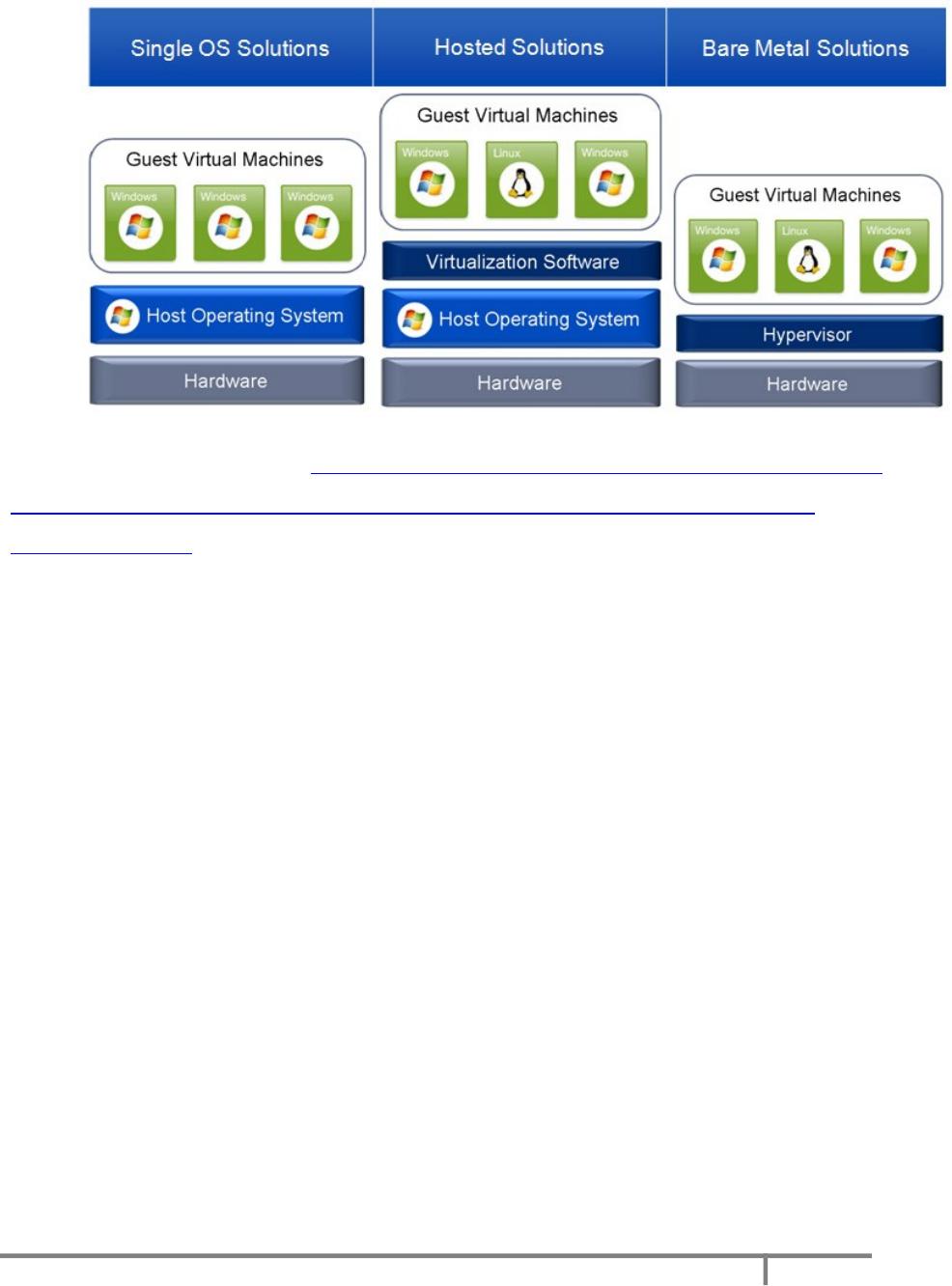
and bare metal virtualization (Where virtualization software is installed directly on
hardware thus no guest OS) (Stricland, 2012). Basic virtualization is shown in figure
1 below.
Figure 1( Source (http://www.clickitcaribbean.com/en/products/96-howtos-and-
documents/75-what-is-infrstructure-virtualization-and-citrix-end-to-end-virtualization-
model.html?start=2 ))
Network virtualization: – Network virtualization is a technique to use a single
physical network infrastructure as many virtual networks (VN) by dividing the
resources and isolating them from each other. These virtual networks then satisfy
many users (Application) which are unaware of the fact that they are currently using a
small fraction of large infrastructure that is multiple instances of single physical
infrastructure network isolated from each other , supported by Strassman, 2008 .
Desktop virtualization: – According to Young, 2008 Desktop virtualization allows a
single machine to host many other machines and a crash in one of the machines will
not affect other. This is done by just adding a thin client which is a computer that
depends on other computer (server) (Burford, 2008), Strassman, 2008.
Research motivation: – Indian SME market although is one of the biggest market in all over
the world but in 21st century with technological advancements and globalization, it has been
left behind by SME market of Asian countries like China, Singapore and Malaysia. These
countries have already moved to virtualization and Indian SME’s still limited with their IT
budget, managerial skills, infrastructure are lacking behind. According to kumar, 2012
Asia Pacic University(APU) 8

Dissertation Akshat Sekhsaria (TP026263)
innovation is very crucial driving factor for SME’s. But with current situations in Indian SME
market there is less or no space for innovation. Thus main motivation behind this research
was to use virtualization technology as a solution to problems in SME’s and regain
competitiveness in Asian markets.
Research problem: – Kumar, 2012 believes that Indian SME’s are lacking in their market
because of lack of innovation, supported by SME chamber of India, 2012 and Murthy, 2011
blames this on lack of IT support, less financial resources and infrastructure limitations.
Kalra, 2012 adds less data security and technology advancements as the main reason for less
innovation. Most of the times SME’s are busy in keeping up the existing services running and
less or no focus is on innovation. During this period of depression for SME’s supported by
Kambhar, 2009, there is a need of all round solution to improvise SME’s condition. Thus
focus area of this research will be on identifying the existing problems in SME’s and
proposing virtualization technology as a solution using studies related to business advantages
of virtualization.
Aims and objectives: – Aims and objectives of this research focus on performing a deep
study on current situation of small and medium enterprise in India. Since SME’s are the
largest contributors to the industrial economy of India supported by Kumar, 2012 and are
very important for development of country. This research will try proposing virtualization
technology for over all improvisation of SME’s.
The main aim of this research is to change the way business is done in Indian SME’s using
benefits of virtualization technology as a solution.
Objectives: –
I. Importance of SME to India and identification of problems in SME’s
II. Assessing virtualization technology impact and advantages for business.
III. Identify the reasons which are keeping SME’s to implement virtualization.
IV. To propose an efficient and effective virtualization implementation plan as a
solution to problems of SME’s along.
Summary: – This chapter provides a brief introduction of Indian SME market and its
importance to the Indian economy. It also describes the motivation behind research and
potential problems that need to be suppressed. To do so virtualization technology and its
Asia Pacic University(APU) 9

Dissertation Akshat Sekhsaria (TP026263)
importance are also described along with the questions which will be answered after
completion of research are also stated.
CHAPTER II (Literature review)
Introduction: – This section performed critical study on Indian SME market to identify
problems and challenges. Further a deep research on business benefits of virtualization was
also done in order to propose it as a solution to challenges faced by SME’s. Also
virtualization technology was evaluated against the problems identified in Indian SME’s.
Literatures have been reviewed keeping in mind the objectives specified in chapter 1.
Problems in Indian SME’s
According to Asia pacific economic corporation (APEC), in APEC region 90 percent of the
business is done by SME’s and are 60 percent of the employment comes from these. Indian
SME market being the second largest in Asia pacific region is very important for the growth
of India economically (Kalra, 2009) supported by Raju, 2009. Leading businesses which
contributes to the GDP (Gross domestic product) of India have organizations located in states
like Bangalore, Delhi, Chennai, Pune etc. (Patil, 2012), (Venugopal, 2012). Thus SME’s
which are located in these areas are considered developed.
But recently due to various problems Indian SME market has lost its competitive advantage
to neighbors (Malaysia, Singapore, China etc.) in APEC region and is lacking behind.
According to study conducted on challenges in MSME (Micro, small and medium enterprise)
by (Murthy, 2011) in India, SME’s are facing challenges like lack of IT support, financial
resources, human resources and infrastructure space. According to Symantecs report on data
security in Bangalore,India, (Siliconindia, 2012) , Indian SME’s outsource most of their work
to be cost effective but this causes constant data flows which due to absence of security, is
lost in many cases. Another research done by Symantech in 2011, (Business standard, 2011),
shows that SME’s in Bangalore, India don’t take any disaster data recovery measures prior to
Asia Pacic University(APU)
10

Dissertation Akshat Sekhsaria (TP026263)
a disaster, which makes them more vulnerable to data loss, which in past have cost about 35
percent of SME’s a total blow out from industry (SiliconIndia, 2012).
According to Kalra, 2012 , SME’s in India are less aware of security concerns and technology
advancements and in this age of globalization survival and growth is difficult without
undertaking these concerns.
Chatterji, 2012 believes that one of the reasons why SME’s are not adopting security
measures and technological advancements is because of their less limited budget. They
consider these as enablers to reduce cost rather than additional costs (Patankar, 2012). There
is no support from finance sector to SME’s in India which is the main reason behind
problems faced by the SME’s. According to Kambhar, 2009, sometimes economy grows and
reaches peak and then fall down. This period is called depression. Kambhar believes that
Indian SME’s are going through a period of depression. With so much pressure financially
SME’s are left with no other option than keeping up the services with current budget. This
leaves no space for innovation, thus either SME’s are stuck at a place or they pull back from
the market (Chatterjee, 2012). In this world of globalization and modernization, Bajpai, 2012,
believes that inflation and depreciation of Indian rupee has also added to SME’s financial
problems. Although there has been a 32 percent increase in funds for industrial sectors but
with 24 million SME’s (Kalra, 2009) and large number of large enterprises these funds are
not enough. A paper focusing on financial challenges faced by SME’s in India states that this
sector need more government support which is not there (Rewari, 2008). Gala, 2010 supports
this by stating that there has been continuous drop in governments financial support for
SME’s which makes them reliable on family, friends and private funding thus reduced
chances to keep up with changing technology and changing business environment. With
increasing industrialization and competitiveness, SME’s have to be innovative with limited
budget in order to survive (Bhasin, 2007) .
CIOL, 2012, while conducting a study on need and challenges for SME in India, also accuses
less financial empowerment as a reason behind handicapped response towards business
change (Kalra, 2009). Another study done by CIOL in 2011 states that to be competitive in
industry, business opportunities need to be identified initially, which SME’s in India is
struggling to do. SME’s according to Siddiqui, 2011 proceed in a business as usual way, in
which they are not aware of the advancements in technology and business environment.
Asia Pacic University(APU)
11
Dissertation Akshat Sekhsaria (TP026263)
Beuzeval, 2012 , cofounder of Radar global company in Hong Kong, while performing a
research on SME market in India, China and other Asian countries opposes the point of no
government support but believes this support to be very slow which is the reason behind
decreased business confidence index (BCI) (The level of optimism shown by employees
working in a company towards companies progress and economy growth) in Indian SME
market. According to MSME news network, 2012 although BCI for SME’s in India is
increasing but increased interest rate, inflation is still keeping organizations to be competitive
in current business environment. According to Karmakar, 2012, continuously changing and
increasing customer demands in India market is also a reason behind slow response towards
business change which in result leads to increased time to market for a product or a service
resulting in unsatisfied customer and decreased BCI (Kumar, 2009), also supported by
Bhasin, 2007, (Kalra, 2009). He adds that business that responds good towards business
change have excellent leaderships.
SME being a low barrier entrance does not require any extensive managerial skills to start
which often leaves companies in wrong leadership (Kambhar, 2009). Ghosh, 2009 believes
inefficient management as one of the bottle necks for SME’s to survive in competitive