2
Formal Lab #1
Discharge Through an Orifice
Prepared By:
Eduardo Hernandez
CE 343 – Hydraulics Lab
T.A: Ankit Ghanghas
October 15, 2021,
1

Synopsis/Abstract
Using the Bernoulli equation, this study investigates various types of orifices and their impact on
flow rate. The velocity, flow rate, velocity constant Cv, and discharge coefficient Cd were calculated
using experimental data from a beveled edge and sharp-edged orifice. These constants are used to
compensate for assumptions made in order to make computations easier. The experiment found that
Bernoulli’s theorem may be used to compute velocity, and that the assumptions made correct the
experiment through the coefficients. The corrective coefficients of two distinct edged orifices were varied.

4
Table of Contents
Introduction…………………………………………………………………………………….. 4
Theoretical Background………………………………………………………………………… 5
Description of Experiment……………………………………………………………………… 7
Results/Discussion………………………………………………………………………………. 8
Conclusion……………………………………………………………………………………….. 11
References……………………………………………………………………………………….. 12
Appendix………………………………………………………………………………………… 12
3
Introduction
Civil hydraulics engineers must be familiar with the flow over or through an orifice, as well as the
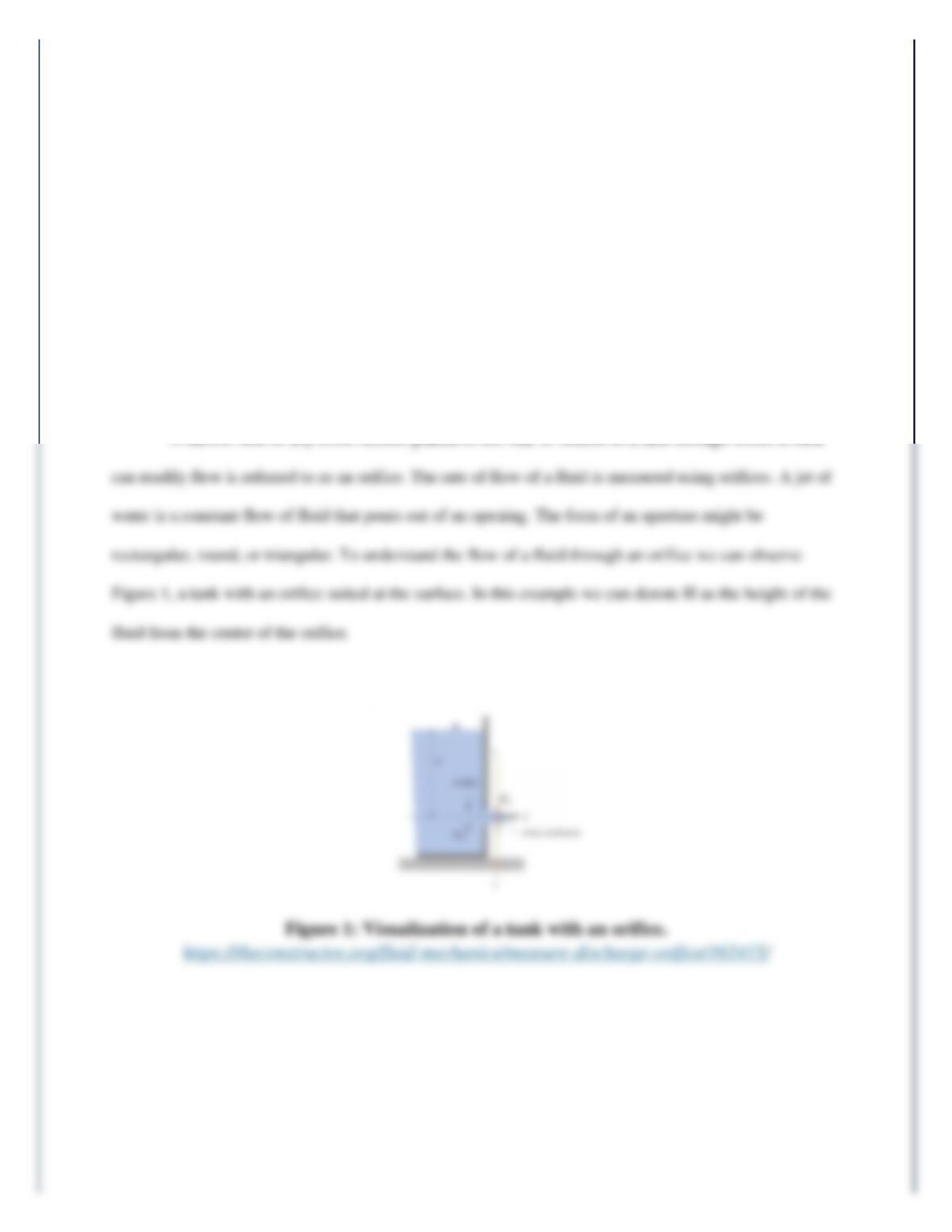
concepts that govern this flow. An orifice is a closed hole in the wall of a tank or plate that is
perpendicular to the flow of the fluid. This laboratory study analyzed the variables that influence flow rate
across an aperture. These are the velocity coefficient, the contraction coefficient, and the discharge
coefficient, as well as the speed of the water approaching the orifice, the depth of the water, the area of
the orifice, the kind of orifice edge, and the velocity coefficient.