Internal Assessment
IB Higher Level Mathematics
A Dilemma of Dimensional Darts
Word Count: 3805
Session: May 2020
Mustafa Khan HJZ378
Introduction
Familiar to most individuals, the game of darts is played by throwing small metal
projectiles known as darts at a circular target called a dartboard. I have enjoyed
playing darts with my family and friends ever since I received a dartboard as a
present when I was in middle school. I am conducting this exploration as I am
interested in the unique relationship between the game of darts and the
mathematical concepts that will be explored throughout this paper. This exploration
will begin by explaining the creation of a game of Dimensional Darts (Egan). The aim
of this investigation will be to answer the question: What is the expected score of a
player that throws an infinite number of darts in this dimensional darts game? Finally,
my exploration will also include a verification of this expected score through a
computer program I wrote that calculates the average score of a player playing
10,000,000 trials of this darts game.
How To Play The Game of Dimensional Darts?
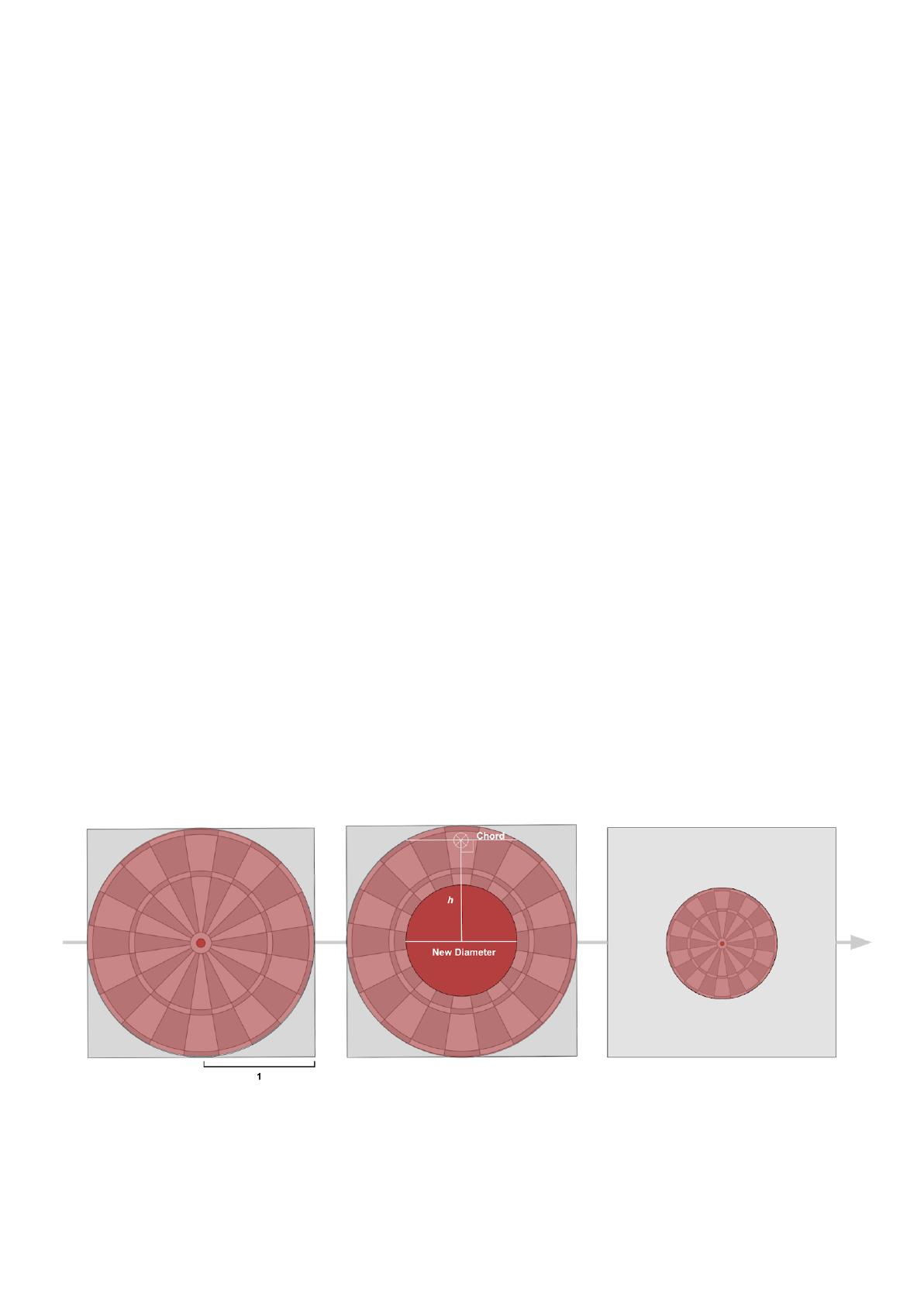
In the game of dimensional darts, the dartboard is defined as a circle with a radius of
1 unit inscribed within a square of 2 units in length. At the beginning of each game,
the bullseye is as big as the entirety of the inscribed circle of 1 unit radius. Next, a
player throws a dart at the dartboard. Assuming the dart lands somewhere on the
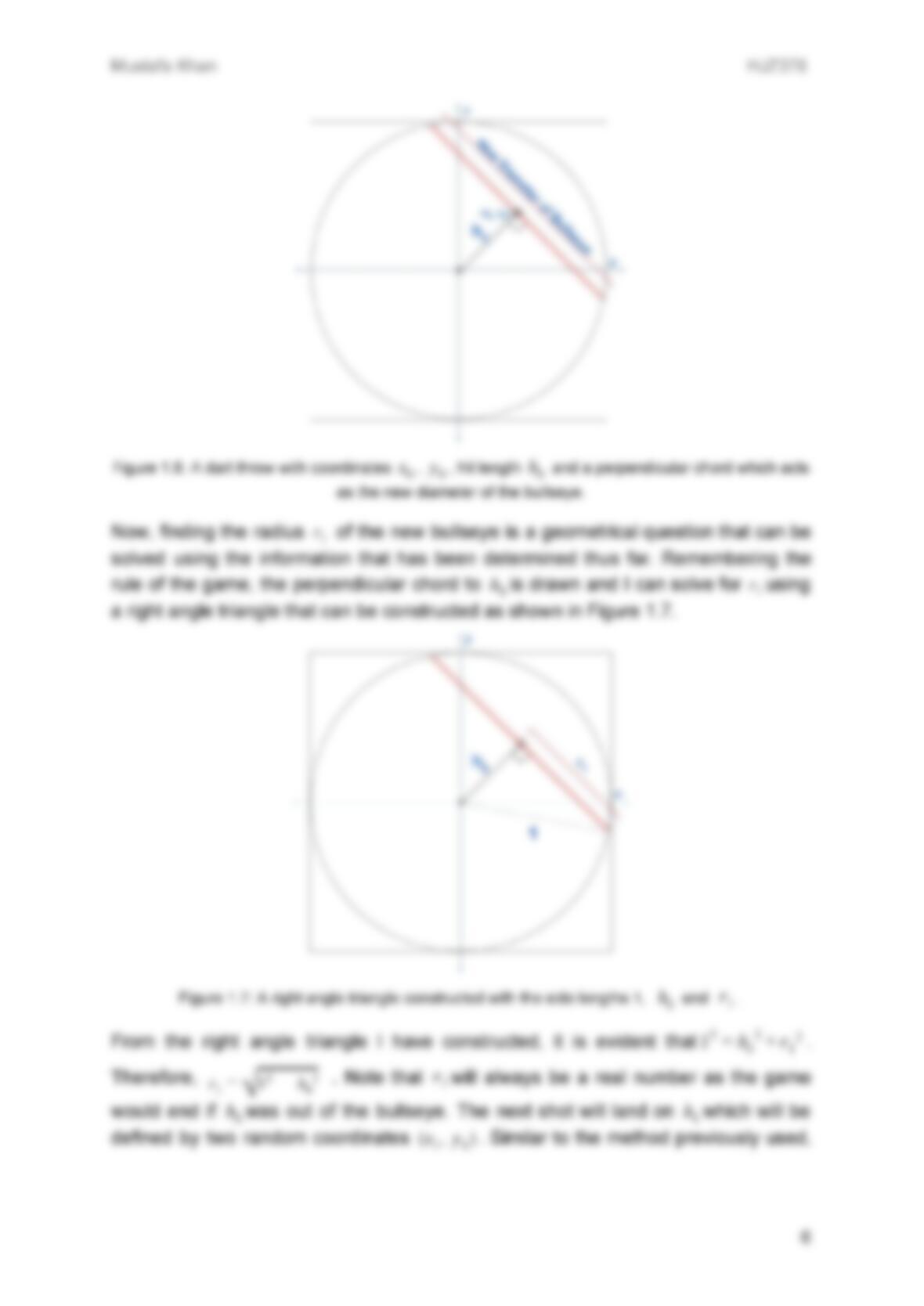
bullseye, it will be a distance units from the centre of the dartboard. The length of h
the perpendicular chord to will be the new diameter of the bullseye. With this new h
sized bullseye, the player repeats this process until their shot misses the bullseye.
The previous steps are illustrated in Figure 1.0. Once a player misses the bullseye
the game is over. The number of darts thrown is counted and this becomes the
player’s final score.
Figure 1.0: The three images above detail the steps of the game of dimensional darts.
2
Mustafa Khan HJZ378
Example Game
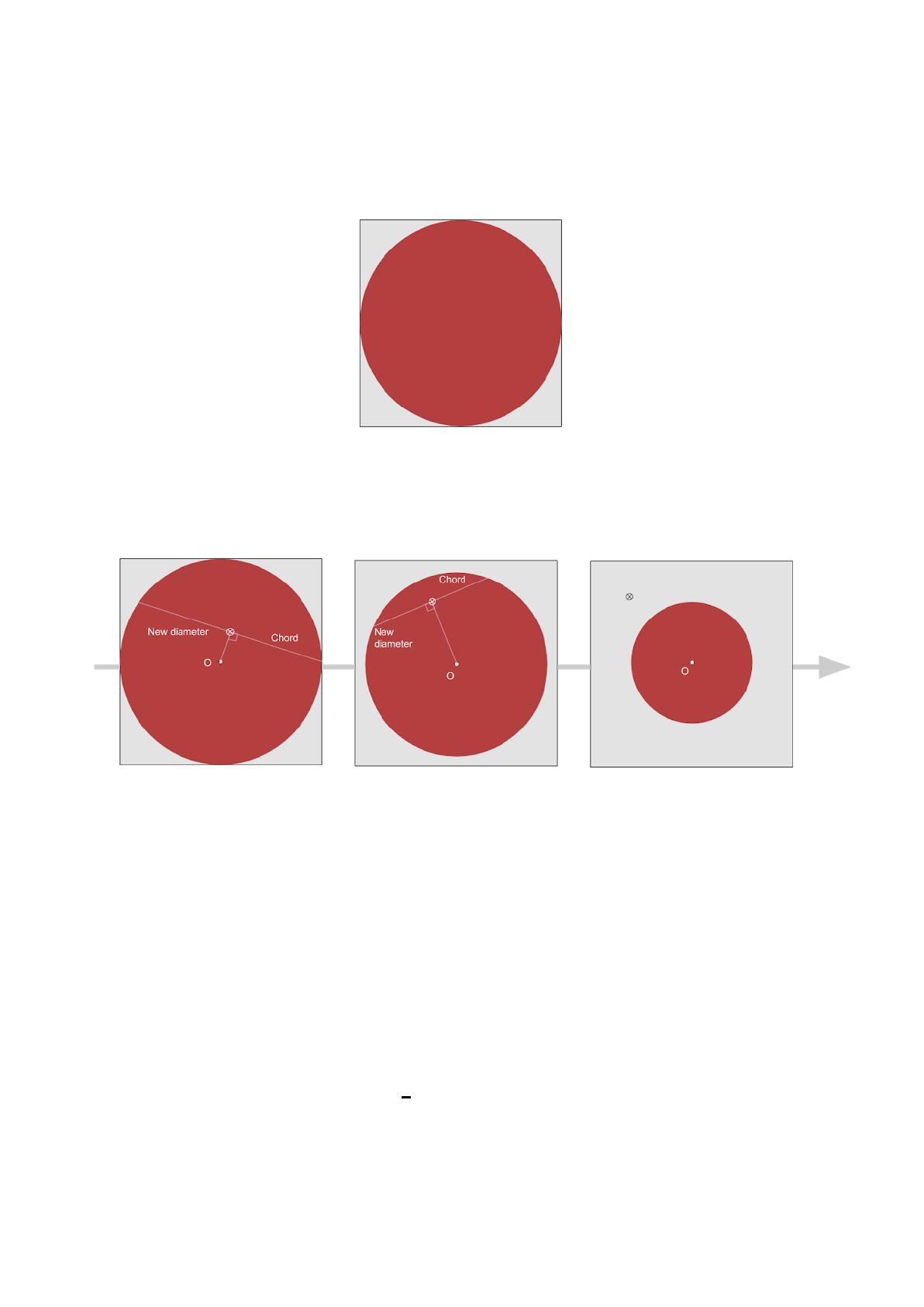
The following are the results of an example dimensional darts game I played. The
game began with the bullseye being as large as the circle.
Figure 1.1: The bullseye at the beginning of each game of dimensional darts.
Next, I successfully hit two shots as shown below in Figure 1.2. On the third throw, I
missed and with that the game was over.
Figure 1.2: The three shots I made in the example game of dimensional darts..
Notice how throws that are closer to the center of the bullseye are rewarded with a
bullseye with a larger diameter in the next turn, whereas throws farther away from
the centre result in a bullseye of smaller diameter in the next turn (making it harder to
continue playing). At the end of this game, I had thrown three shots in total and
therefore my final score was 3 points.
It is also interesting to note that while it is possible to hit the exact centre of the
dartboard or the exact border between the bullseye and the region of space that is
not the bullseye, these cases have a probability of 0. Much like how when randomly
selecting one number from the number line it is possible to select the number 2020,
however, this has a probability of which is equal to 0 as the sample space that is 1
∞
being dealt with is infinitely large. Similarly, the probability of a dart hitting any
specific point is zero as there are infinitely many points on the dartboard as well. This
reveals an intriguing distinction between possible events and probable events.
3
Mustafa Khan HJZ378
Expected Score of a Player
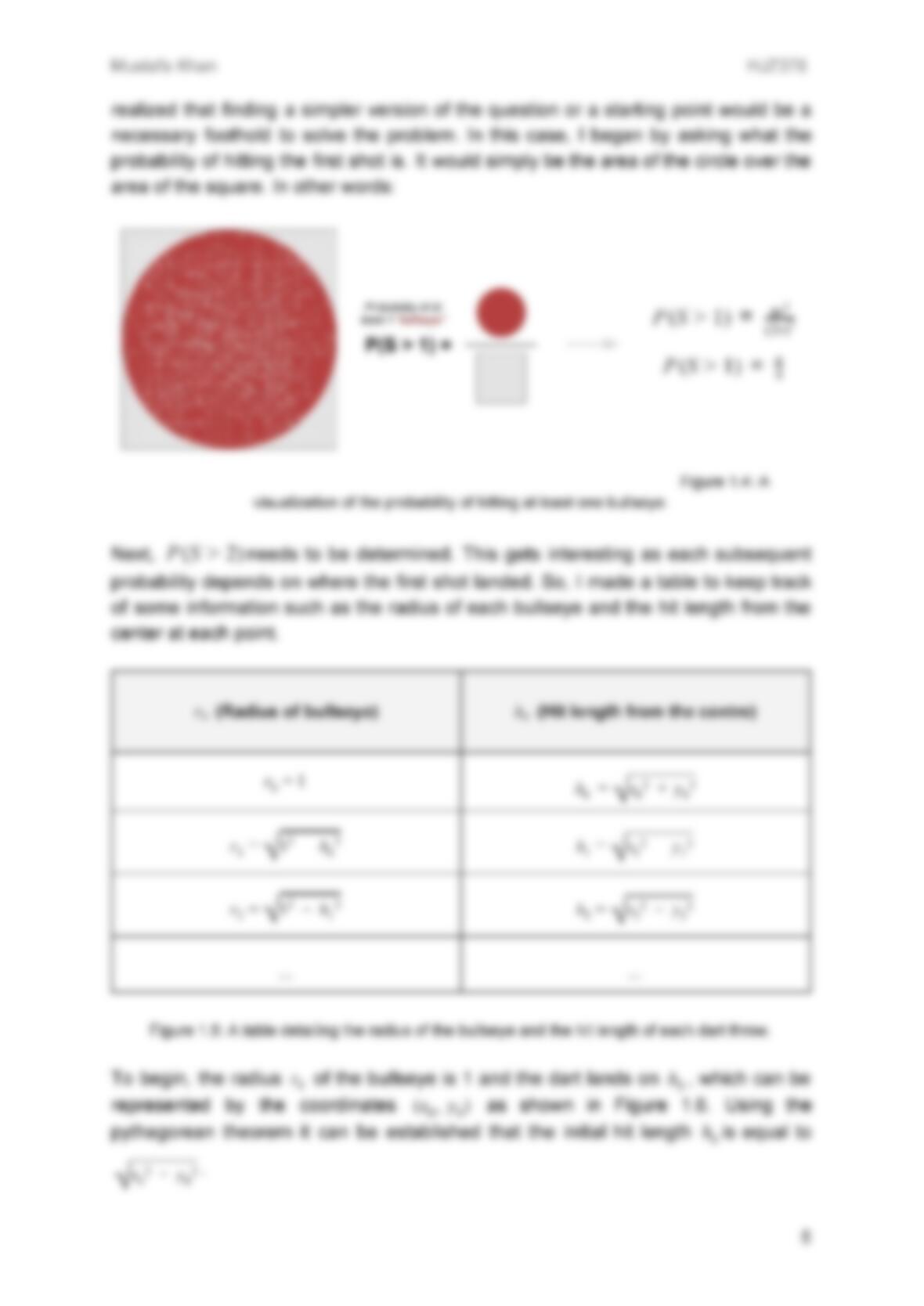
To calculate the expected score of a player that plays this game of dimensional darts
an infinite number of times it is important to make some assumptions. Firstly, I will
assume the player is unskilled and hits the dartboard with a random distribution.
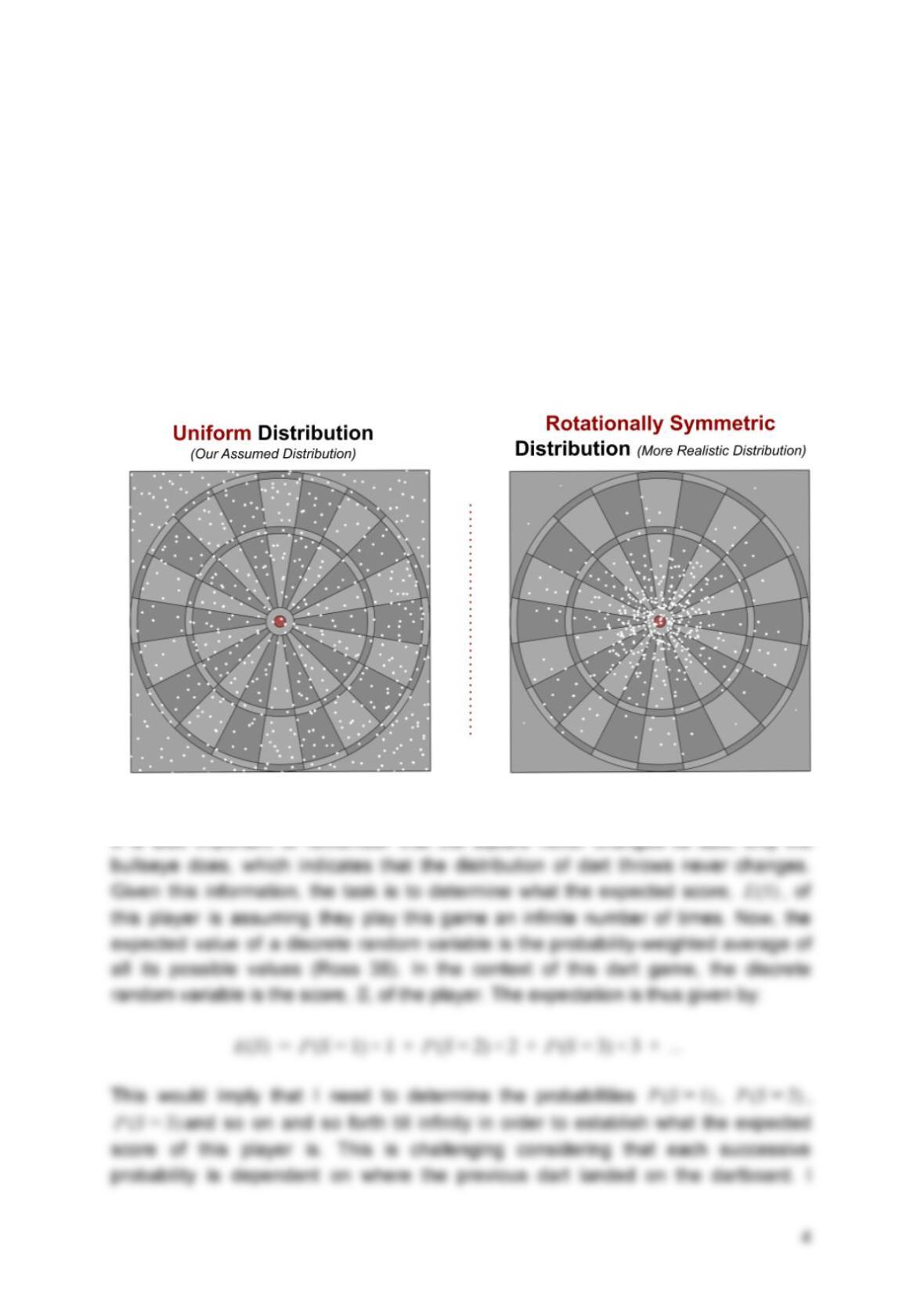
Note that a more realistic distribution would be rotationally symmetric, however, for
the purposes of this puzzle I will assume that this player hits at a random point
anywhere on the dartboard (the distinction between the aforementioned distributions
is shown in Figure 1.3). In this regard, the and – coordinates are always going to x y
be between -1 and 1, that is and where all | x∈R− 1 ≤ x≤ 1 | y∈R− 1 ≤ y≤ 1
points are equally probable.
Figure 1.3: A uniform distribution and a rotationally symmetric distribution of dart throws.