DATA VISUALIZATION
GSLC WEEK 3
1. Give an example of star schema (state the source), define the objective, dimensions, and
measure(s).
Star schema is the most business intelligence data warehouses use what is called a dimensional
model, where a basic fact table of data e.g. sales or support calls is surrounded and linked with other
tables holding the dimensions of the fact table.
The star schema architecture is the simplest data warehouse schema. It is called a star schema
because the diagram resembles a star, with points radiating from a center. The center of the star
consists of fact table and the points of the star are the dimension tables. Usually the fact tables in a
star schema are in third normal form(3NF) whereas dimensional tables are de-normalized. Despite
the fact that the star schema is the simplest architecture, it is most commonly used nowadays and is
recommended by Oracle.
The main characteristics of star schema:
– Simple structure -> easy to understand schema
– Great query effectives -> small number of tables to join
– Relatively long time of loading data into dimension tables -> de-normalization, redundancy
data caused that size of the table could be large.
– The most commonly used in the data warehouse implementations -> widely supported by a
large number of business intelligence tools
Example of star schema: SALES
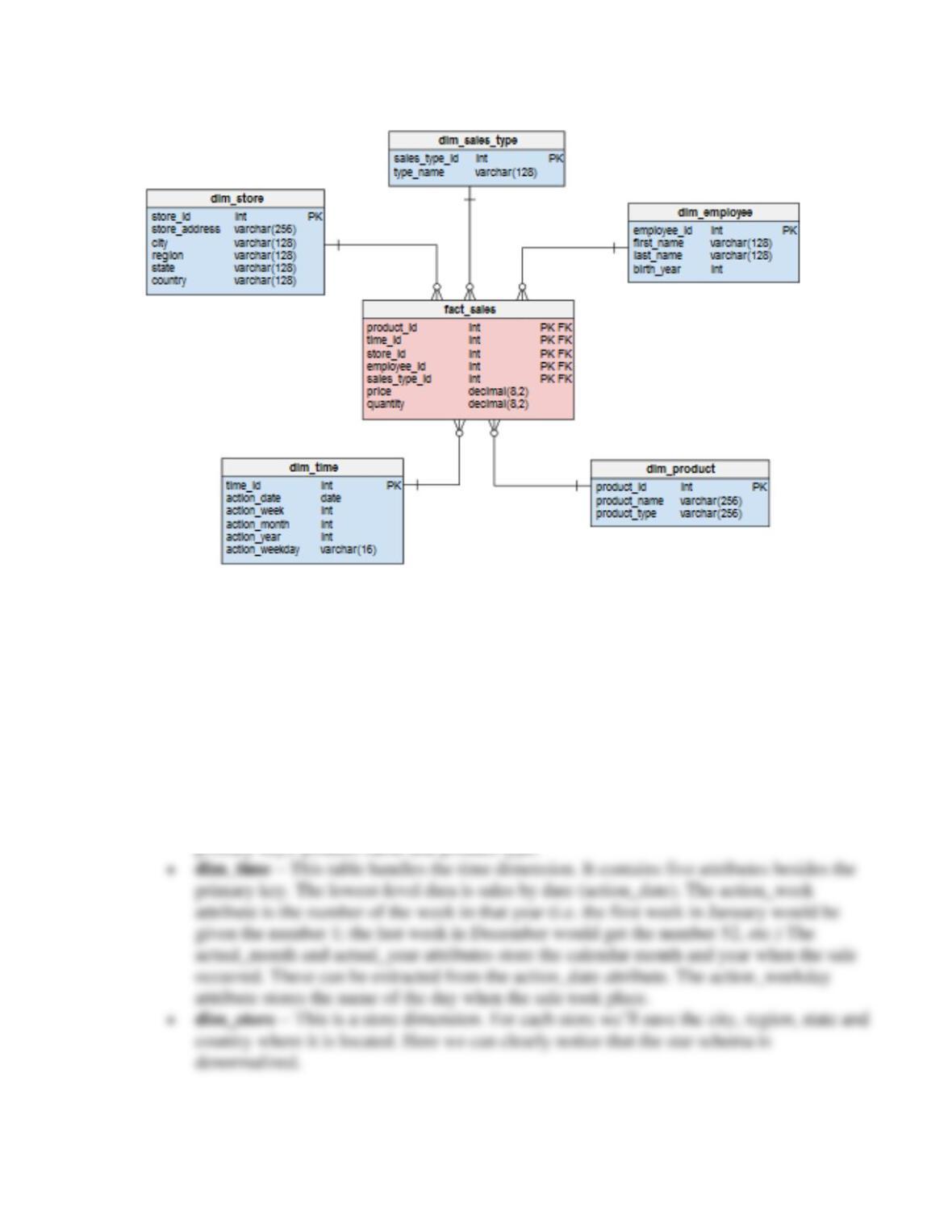
The model presented above contains of one fact table (colored light red) and five dimension
tables (colored light blue). The tables in the model are:
• fact_sales – This table contains references to the dimension tables plus two facts (price
and quantity sold). Note that all five foreign keys together form the primary key of the
table.
• dim_sales_type – This is a sales-type dimension table with only one attribute,
“type_name”.
• dim_employee – This is an employee dimension table that stores basic employee
attributes: full name and birth year.
• dim_product – This is a product dimension table with only two attributes (other than the