Capitalizing
on robotics
Driving savings
with digital labor
kpmg.com

© 2017 KPMG LLP, a Delaware limited liability partnership and the U.S. member firm of the KPMG network of independent
member firms affiliated with KPMG International Cooperative (“KPMG International”), a Swiss entity. All rights reserved.
1Capitalizing on robotics
Digital labor, a term that encompasses
robotic process automation, is the
application of software technology to
automate business processes ranging from
transactional swivel-chair activities to more
complex strategic undertakings.
For most organizations, it is no longer a question of if, but more
about when, where, and how fast they can apply digital labor
as a differentiator. Answers to those questions often rely on
understanding the financial investments required and setting
expectations on the timing and magnitude of the associated returns.
Understanding the investments and expected returns for digital labor
is complicated by the fact that no two automation opportunities are
the same—i.e., your mileage WILL vary. Furthermore, digital labor
can be categorized into three different classes—each requiring
different investments and providing returns—varying not only in
magnitude, but also in the drivers that impact those savings.
This paper suggests some answers to this financial puzzle by
identifying and exploring those financial considerations that are
common to all digital labor projects, as well as those that are more
specific to each of the three classes of digital labor.

If you have not yet started
implementing digital labor, it
is time to catch up with your
competitors. These days, it
is pretty much a given that
organizations will save money
when automating business
processes with digital labor. But
even for those organizations
that have begun the digital labor
journey, the answer to one
elusive question often remains—
am I saving all that I can? How
can organizations best position
themselves to capitalize on the
savings achievable through digital
labor implementations? This
paper identifies common savings
drivers for digital labor initiatives
in general, as well as identifying
those savings drivers that are
uniquely applicable to each of the
various classes of digital labor.
Before setting out on this digital labor
journey, it is beneficial to identify and address
concepts than can impact overall savings—the
foundational savings drivers:
1 Do we have clear executive sponsorship for the initiative?
2 Are we prepared for what could be a substantial impact
to our organizational structure—organizational change
management, training, etc.?
3 Are we thinking beyond the immediate? Do we have a
well-defined plan and strategy for labor automation—both
near term as well as long term?
4 Is there a defined approach to who and how we will
govern:
— The resulting automation capabilities?
— The automation initiatives moving forward?
— The changes in our business and/or technology?
5 Have we gained a basic consensus on mitigating security
and risk concerns?
As the journey begins, the considerations get
more tactical and detailed:
1 Have we limited our automations to a specific class of
digital labor that aligns both with the opportunities for
automation and the appetite for technology?
2 For each class of digital labor being leveraged, do we
understand the key characteristics and savings drivers?
3 Given the specific savings drivers, do we have a
strategic approach to identifying and prioritizing candidate
processes for automation?
4 What steps might we take to increase these savings
and/or accelerate the path to the savings?
5 When do we declare success and move on to the next
automation initiative?
While there may be a lot to consider when first venturing
into digital labor, it is these considerations that help provide
a more strategic approach to ensuring an organization is
appropriately benefiting from its digital labor initiatives. The
temptation is great to simply “jump in” and get started, and
indeed, taking action is far better than paralysis by analysis.
At the same time, the proper amount of up-front planning
will pay off in the long run, and digital labor, like any strategic
initiative, is better viewed as a journey rather than a race.
© 2017 KPMG LLP, a Delaware limited liability partnership and the U.S. member firm of the KPMG network of independent
member firms affiliated with KPMG International Cooperative (“KPMG International”), a Swiss entity. All rights reserved.
2Capitalizing on robotics
© 2017 KPMG LLP, a Delaware limited liability partnership and the U.S. member firm of the KPMG network of independent
member firms affiliated with KPMG International Cooperative (“KPMG International”), a Swiss entity. All rights reserved.
3Capitalizing on robotics
The spectrum of digital labor automation
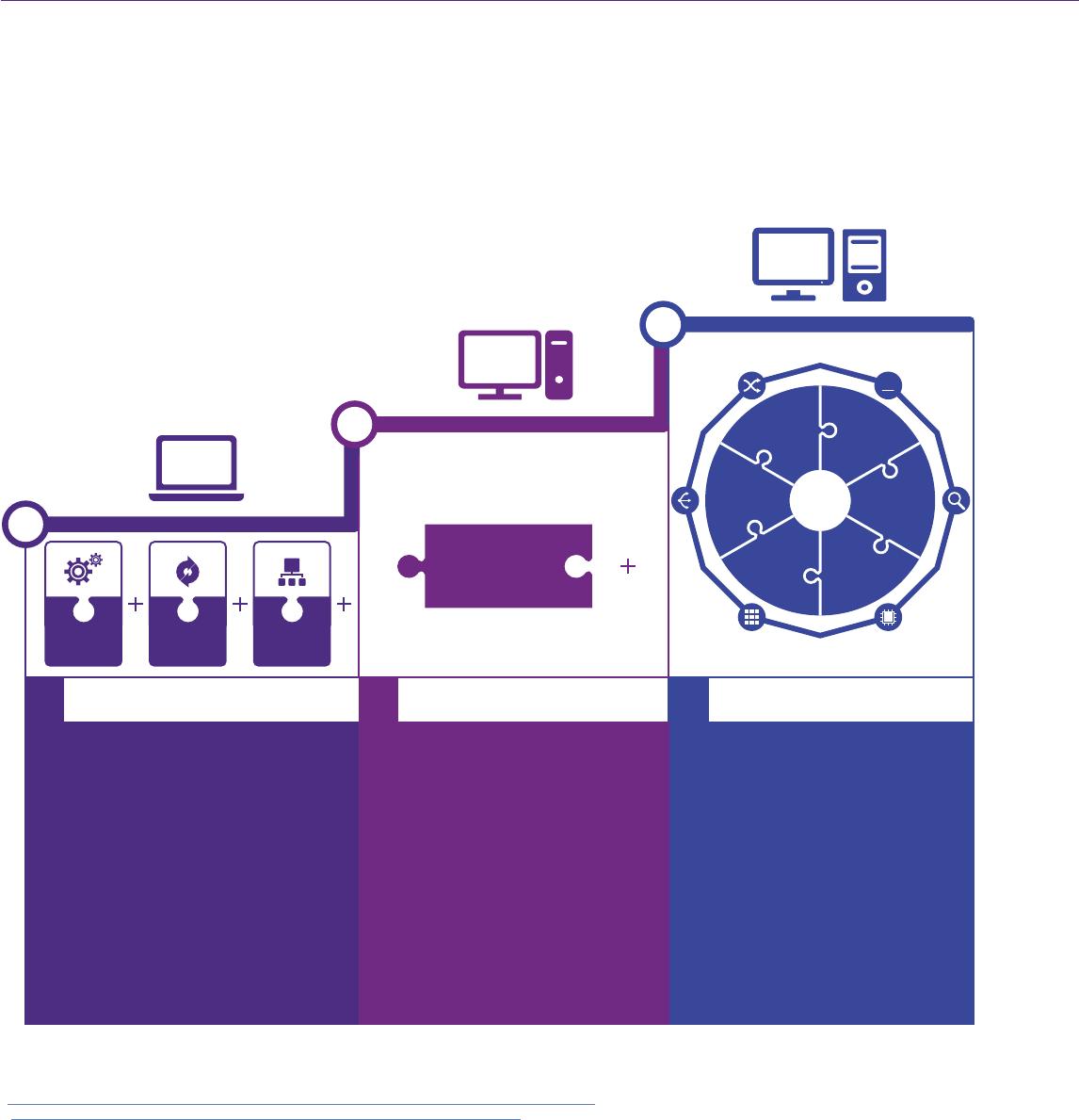
When discussing the sources of savings from digital labor
automation, it is helpful to have a basic understanding of
the three primary types of automation. Each addresses
a different target opportunity and leverages tools with
differing capabilities.1
Processing of
Unstructured
Data and Base
Knowledge
01
02
03
Screen
Scraping
Work
Flow
Rules
Engines
Adaptive
Alteration
Machine
Learning
Natural
Language
Processing
Artificial
Intelligence
Large-scale
Processing
“Big Data”
Analytics
A
1 2 3
Basic Robotic Process
Automation (RPA)
Enhanced Process
Automation Cognitive Automation
– Macro-based applets
– Screen scrapping data collection
– Work flow
– Vision-type building blocks
– Process mapping
– Business Process Management
(BPM)
– Artificial Intelligence (AI)
– Teaching versus programming
– Natural language recognition and
processing
– Self-optimization/self-learning
– Digestion of super data sets
– Predictive analytics
– Hypothesis generation
– Evidence-based learning
– Built-in knowledge repository
– Learning capabilities (e.g.,
‘learning assist’ by watching and
recording)
– Ability to work with unstructured
data
– Pattern recognition
– Reading source data manuals
(e.g., Natural Language
Processing (NLP)
Classes of digital labor
1 “Demystifying Digital Labor – the Layman’s guide to the spectrum of robotics and automation,” David B. Kirk, June 2016,
http://www.kpmg-institutes.com/institutes/advisory-institute/articles/2016/06/demistifying-digital-labor.html
The spectrum of digital labor automation
Basic robotic process
automation
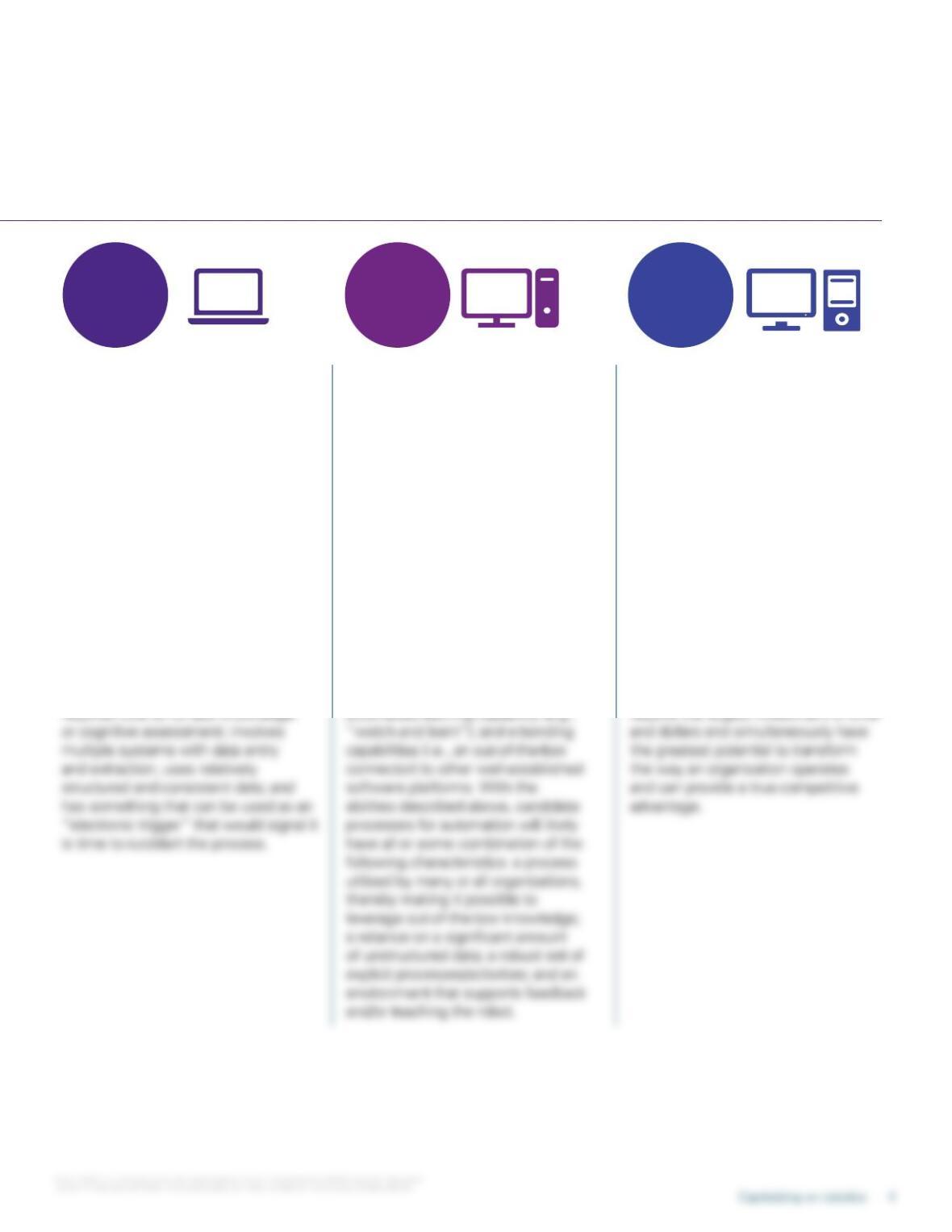
Class 1, which we refer to as “Basic
Robotic Process Automation,”
leverages several “tried and true”
technologies to automate rudimentary
swivel-chair processes found in
almost all organizations today. The
tools leverage capabilities such as
work flow, rules engines, and screen
scraping/data capture to automate
existing manual processes. An
ideal process candidate for basic
automation will have these types of
characteristics: repetitive in nature;
well-defined explicit activities that
are easily organized and sequenced;
Enhanced process
automation
Class 2, which we refer to as
“Enhanced Process Automation,”
leverages additional capabilities
to those discussed in Class 1 to
address automation of processes
that are less structured and often
more specialized. Tools and platforms
supporting Enhanced Process
Automation offer some combination
of capabilities such as “out-of-
the-box” (built-in) knowledge; an
understanding of natural language and
thereby the ability to consume and
leverage unstructured data (such as
e-mail, professional articles, etc.); an
Cognitive
automation
Class 3 is “Autonomic/Cognitive
Automation.” Cognitive systems
are systems that combine advanced
technologies such as natural language
processing, artificial intelligence,
machine learning, and data analytics
to mimic human activities such
as perceiving, inferring, gathering
evidence, hypothesizing, reasoning,
and interacting with human
counterparts. Cognitive systems are
“taught” rather than programmed
—a process that can take months to
years depending on the complexity of
the problem domain. These solutions
Class
1
Class
2
Class
3