Contingency theory of leadership focuses on the fact that leadership effectiveness is dependent on
whether or not their leadership style suits a particular situation or not. According to this theory a
leader an individual can become an effective leader in one situation and ineffective in another
situation. There is no universal guarantee that an effective leader in one situation will be effective
in all the situation. In leadership style fits in that particular situation or not. In most cases the leader
needs to be self-aware, objective and adaptable (“Understanding the Contingency Theory of
Leadership”, 2020).
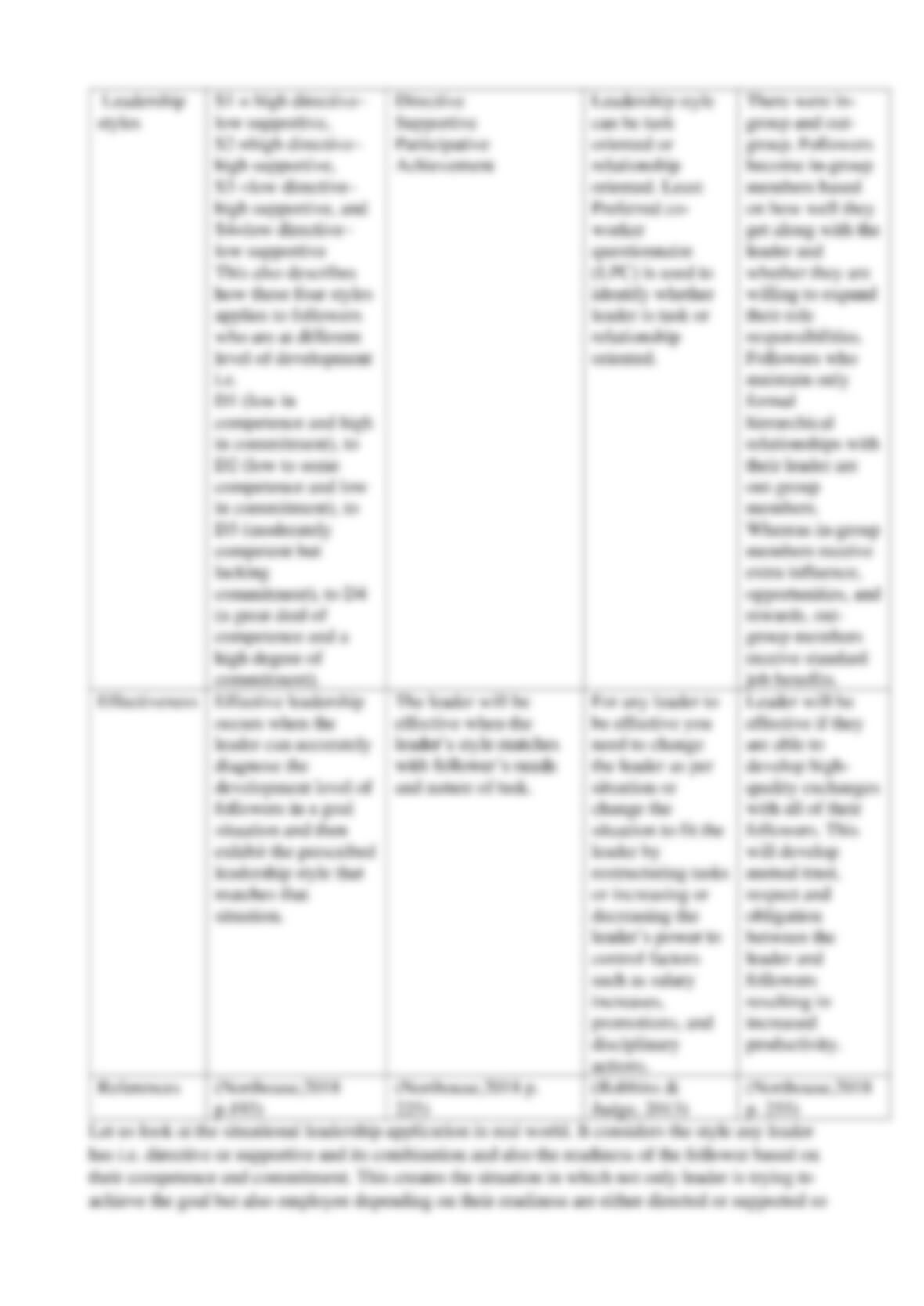
Let us have a look at some of the differences of different contingencies theories.
Base of
Difference
Situational
Approach(Hersey
and Blanchard)
Path Goal Theory
Fielder’s Model
Leader Member
Exchange
Definition
This theory stresses
that leadership is
composed of
directive and
supportive dimension
and each should be
applied as per
This theory was
developed to explain
how leaders motivate
followers to be
productive and satisfied
with their work. It is a
contingency approach
This theory
explains that any
leader will be
effective if there
is proper match
between the
leader’s style and
This theory
focuses on
interaction
between leader
and the follower
whereas previous
theories focused
the characteristics of
followers and the task.