EU I
DIFFERENCE BETWEEN HHRR AND FFRRR
➢ FFRR: linked to a political entity to which they belong (State or the EU). It limits the laws but serves
as a foundation for them. In the EU, Article 6 of the Treaty states that the FFRR will serve as a legal
basis for the extension of EU competence. They are only guarantees against the exercise of EU
competences.
➢ HHRR: are inherent and inalienable rights that we have since we are born. They were born with the
French Revolution. First human rights right to religion, “freedom of conscience”.
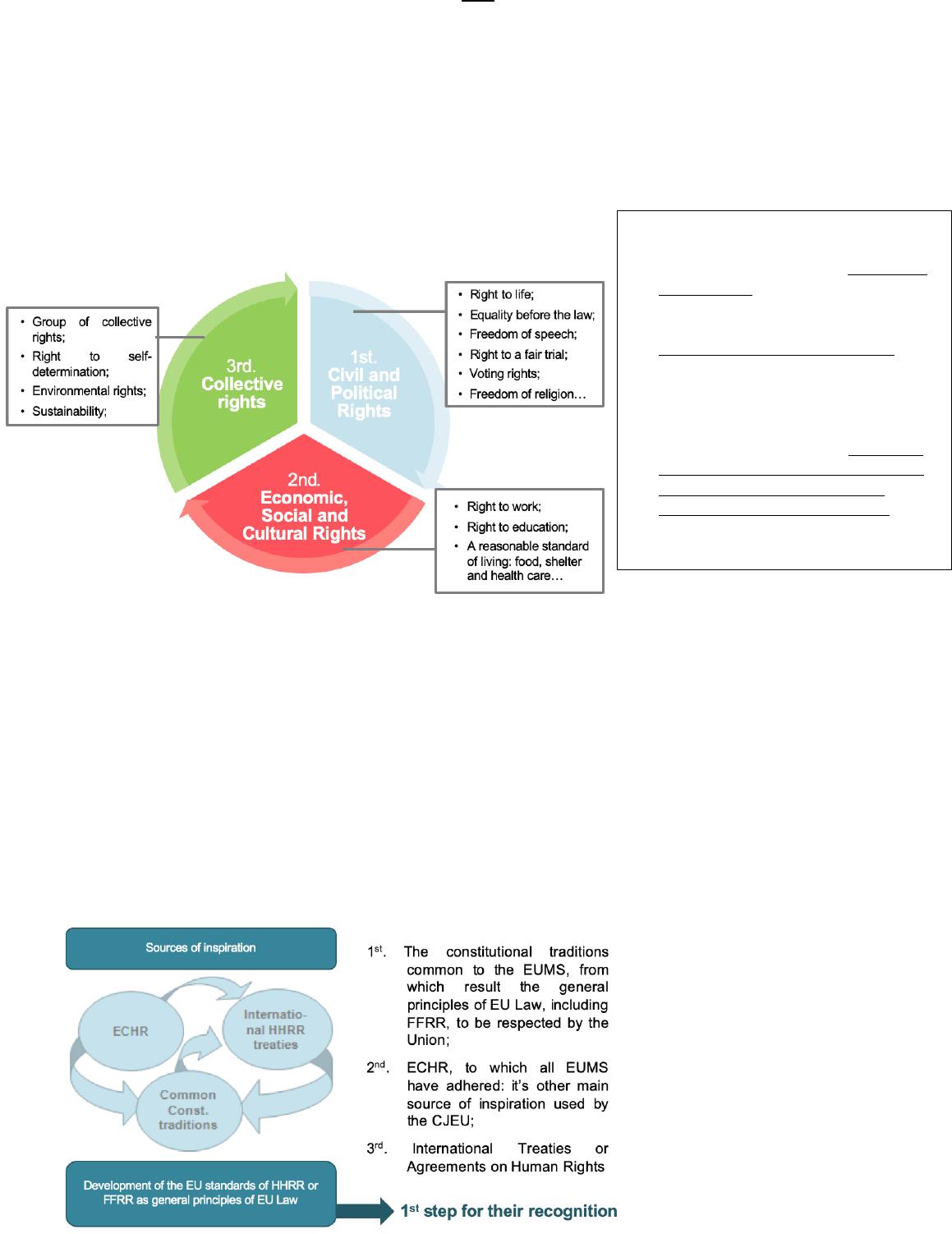
THREE GENERATIONS OF HUMAN RIGHTS
Sources: law, constitution and general principles
EU Law Sources: primary law, secondary law, treaties, CFREU, ECHR
EUROPEAN AGENCY FOR FUNDAMENTAL RIGHTS (FRA)
→ Respect and enforcement of FFRR and how to improve the respect of FFRR in the EU.
– EU agency with the objective to safeguard the rights, values and freedoms enshrined in the CFREU
– Powers: analysis of data, provide evidence-based advise on FFRR, aid in law-making and policy
implementation, strengthen cooperation between FFRR actors…
– The role of the FRA is supportive, with mainly monitoring powers
– However, it still serves as a protection mechanism for FFRR
EARLY SOURCES OF FUNDAMENTAL RIGHTS
The first generations of rights are born.
1. Rights essentially from your relationship
with the State.
2. Life is becoming more complex and
social, economic and cultural rights are
born in the 20th century.
3. At the end of the 20th century and the
beginning of the 21st, the third
generation of rights is born: the right to
the environment, sustainable economy,
data protection, protection of the
collective and not of the individual. They
are collective rights as a society, not
individual.

ECJ CASE LAW ON FUNDAMENTAL RIGHTS
By the early 70s, although not mandated by the Treaties, CJEU established a competence for HHRR issues
within its case law by declaring HHRR to be a general principle of Community law on the basis of the
constitutional traditions common to all MS, as well as international HHRR instruments ratified by them
(especially the ECHR):
– Case C-26/69, Stauder→ 1st recognition that FFRR was “enshrined in the general principles of Community
law”
– Case C-11/70, Internationale Handelgesellschaft→ ECJ accepted that protection of FFRR while “inspired
by the constitutional traditions common to the [MS] must be ensured within the framework and
structure of the objectives of the EC”
– Case C-4/73, Nold→ The ECJ referred for the 1st time to international HHRR treaties on which MS have
“collaborated” or of which they were signatories.
From these first decisions, it was clear that the EC institutions were bound to have regard to fundamental
HHRR and that the power of the institutions powers were limited by them.
– Case C-159/90, Grogan→ the protection of FFRR which conflict with TEU objectives would be treated as
derogations. However, this restriction “must respect FFRR which are part of the Community legal order
and in particular the provision of the ECHR”
– Case C- 46/87, Hoechts → the ECJ opted for protection at the “lowest common denominator”
TREATY OF THE EU
– Article 2 TEU: “The Union is founded on the values of respect for human dignity, freedom, democracy,
equality, the rule of law and respect for human rights, including the rights of persons belonging to
minorities”
• The reference to “values” is not an originality of the Lisbon Treaty; they were present in Maastricht
(Art. 6)
– Article 3 provides for EU’s fundamental objectives:
i. An area of freedom, security and justice in which the free movement of persons is matched with
appropriate border controls;
ii. An internal market based on balanced economic growth, a competitive social market economy and
a high level of protection and improvement of the equality of the environment;
iii. To promote scientific and technological advance.
POST LISBON
– Binding force of law
– EU’s institutions have gained greater powers to prevent encroachment of individual rights;
– The Treaty doesn’t legally oblige MS to have the same foreign policy. But it will change the way they
executes whatever common foreign policies governments are able to agree, through a newly powerful
High Representative for Foreign Policy and new external action service (EAS);
– CJEU gained stronger powers than ECtHR to protect HHRR and FFRR.
SOURCES OF FUNDAMENTA RIGHTS
Article 6(2) TFEU: “The Union shall respect fundamental rights, as guaranteed by the European Convention
for the Protection of Human Rights and Fundamental Freedoms signed in Rome on 4 November 1950 and
as they result from the constitutional traditions common to the Member States, as general principles of
Community law”
Sources of FFRR:
– All the rights found in the case law of the CJEU
– All the European Convention on HHRR’s rights & freedoms
– Other rights and principles resulting from the common constitutional tradition of EU countries.
This provision doesn’t prevent from relying in other HHRR treaties as sources of the General Principles of EU
law applied by CJEU (e.g. the International Covenant on Civil and Political Rights: Case 37/87, Orkem v.
Commission; Joined Cases C-297/88, Dzodzi).
Article 6(3) TFEU: “The Union shall respect the national identities of its Member States”
– Consistent with the constitutional order of EU and MS: it’s the doorway through which national
constitutional rights which MS authorities are bound to observe, enter into EU law;
– Remain in contact with the development of the common constitutional tradition of EUMS. FFRR aren’t
static and their meaning develop over time.
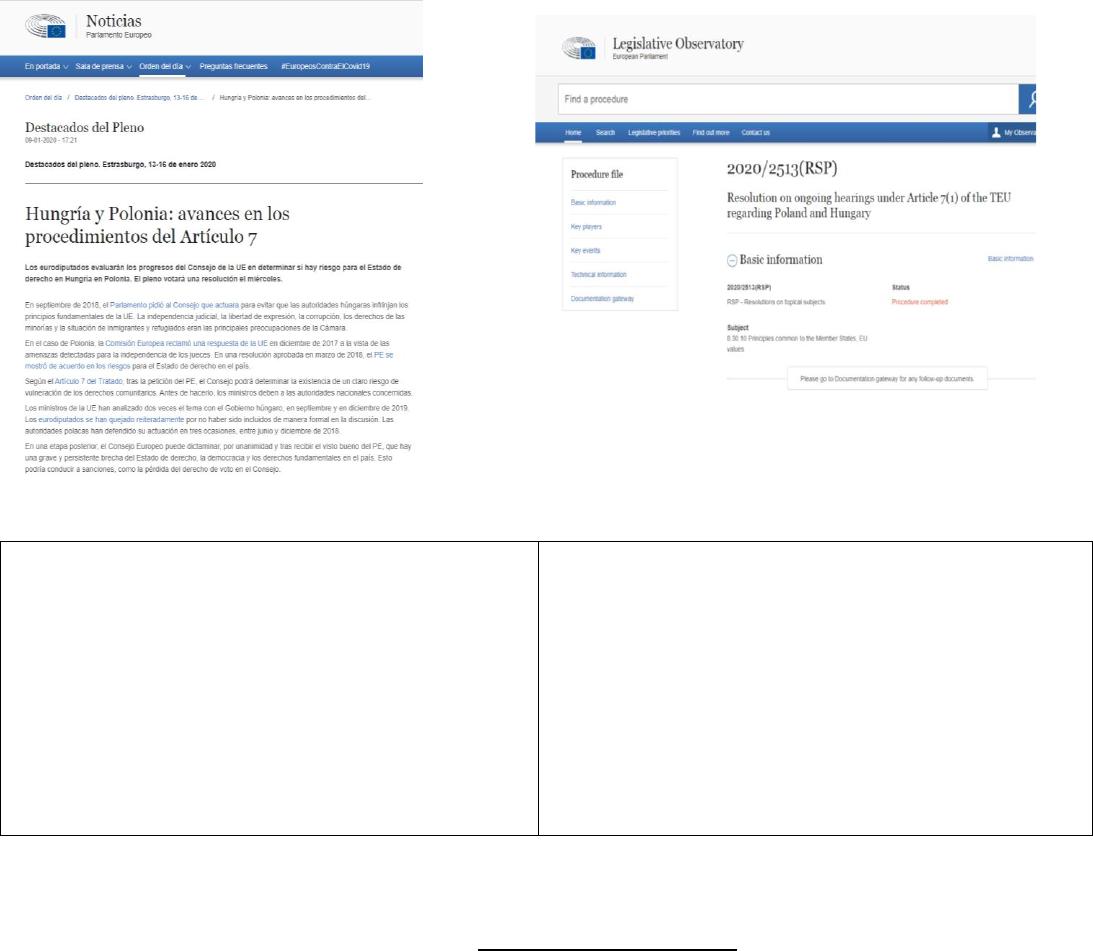
PROCEDURE UNDER ARTICLE 7 TEU
THE RESULT – The procedure may conclude with the suspension of the rights deriving from the application
of the Treaties to the Member State in question, including the voting rights.
PREVENTIVE PROCEDURE
– Determination of a clear risk of a serious breach
of the values in Art. 2 by an EUMS
– Proposal by one third of the EUMS, by the
European Parliament or by the European
Commission
– The Council takes the decision acting by a
majority of four fifths of its members.
SANCTIONING PROCEDURE
– Determination of the existence of a serious and
persistent breach of the values in Art. 2 by an
EUMS.
– Proposal by one third of the EUMS or by the
European Commission.
– The European Council takes the decision acting by
unanimity.

CHARTER OF FUNDAMENTAL RIGHTS OF THE EU (STRUCTURE)
– CJEU’s Opinion 2/94: The EC Treaty as it then stood didn’t grant competence to the EC to accede to the
ECHR. Following this Opinion, the MS governments might have amended the Treaties to provide a legal
basis for accession to the ECHR.
– CFREU was proclaimed at the IGC in Nice on 7 December 2000, but it didn’t have any binding legal effect
until the entry into force of the Treaty of Lisbon (by virtue of Art. 6(1), as amended by it);
o CJEU had previously accepted FFRR as part of the general principles of EU Law (e.g. Stauder, 1969;
C-4/73, Nold, Kohlen; C-222/84, Marguerite Johnston);
– Now, after the Lisbon Treaty, CFREU is part of the primary EU law.
– The Charter isn’t in itself reproduced in the TEU
– CFREU has de “the same legal value” as the Treaties (art. 6(1) TEU)
o Interpretative tool for EU/national law within scope of EU law
▪ Including to justify MS actions that might otherwise contravene EU law
o Ground of invalidity of all EU actions and all MS actions within scope of EU law
▪ Whether MS is interpreting/applying EU law
▪ Or even restricting EU rights
– A minimum level of protection (art. 52(3) CFREU)
o Case Connolly was the game changer for the application of more stringent judicial standards to
which European acts should live up, in line with the practice of the ECtHR and some of the national
constitutional courts.
SCOPE OF THE CFREU
– Scope: CFREU applies:
o primarily to the EU institutions, bodies, offices and agencies (art. 51(1))
o to the MS “only when they are implementing Union law”
– Application:
o ratione materiae: in application to the EU Law
o ratione loci: (lugar) in the EU (people entitled to invoke the Charter are any human being living or
staying in the EU.
o ratione personae: institutions, bodies, member states of the EU
o ratione temporis: a specific date, 2010
ARTICLE 52 SCOPE OF GUARANTEED RIGHTS
1. “Any limitation on the exercise of the rights and freedoms
recognised by this Charter must be provided for by law
and respect the essence of those rights and freedoms.
Subject to the principle of proportionality, limitations
may be made only if they are necessary and genuinely
meet objectives of general interest recognised by the
Union or the need to protect the rights and freedoms of
others.
2. Rights recognised by this Charter which are based on the
Community Treaties or the Treaty on European Union
shall be exercised under the conditions and within the
limits defined by those Treaties.
3. In so far as this Charter contains rights which correspond
to rights guaranteed by the Convention for the Protection
of Human Rights and Fundamental Freedoms, the
meaning and scope of those rights shall be the same as
those laid down by the said Convention. This provision
shall not prevent Union law providing more extensive
protection.”
1. Provided by law
2. Proportionality
3. Necessity
4. A legitimate aim(objectives of general interest)
CFREU includes civil and political rights and economic and social rights thus affirming the indivisibility of
HHRR, which rights are divided into six sections:
1. Dignity
2. Freedoms
3. Equality
4. Solidarity
5. Citizenship’s rights
6. Justice
(*) Poland and the UK have been granted exception from parts of the CFREU and a specific annexed to the
Lisbon Treaty provides that Title IV (Solidarity) doesn’t apply to them.
RIGHTS, FREEDOMS AND PRINCIPLES
The CFREU’s term “Fundamental Rights” encompassed not only the classic universal guarantees of freedom
from interference by the State, but also the right to participation in certain aspects of political, social &
economical life, as well as certain rights restricted only to EU’s citizens.
“Rights” & “freedoms” are distinguished in the CFREU’s Preamble and in a
number of Art. Titles;
Distinction between rights/freedoms & principles: